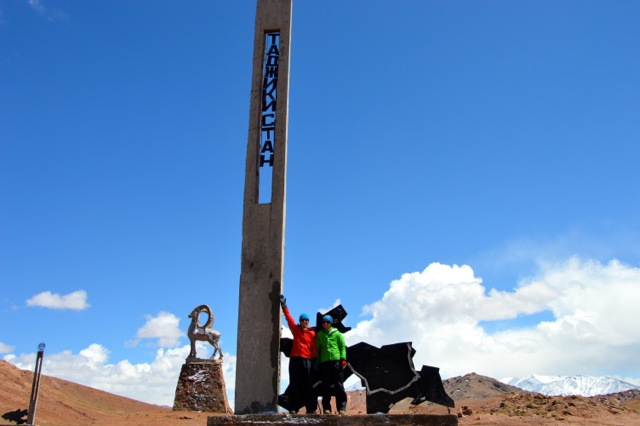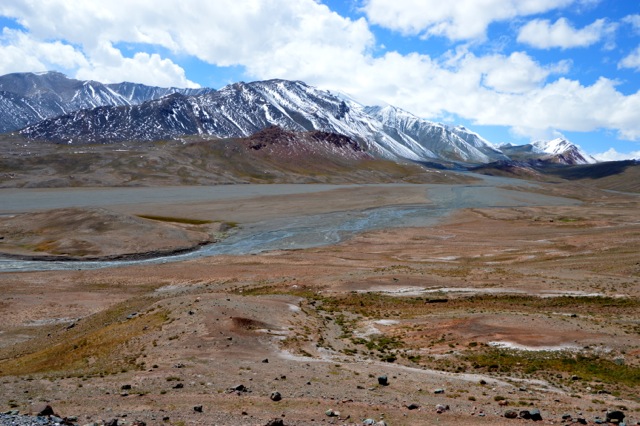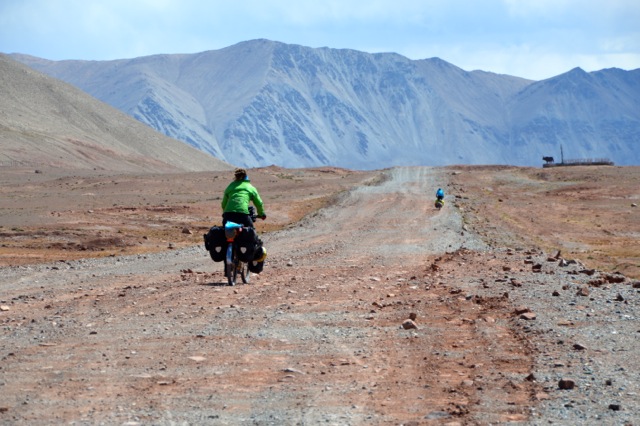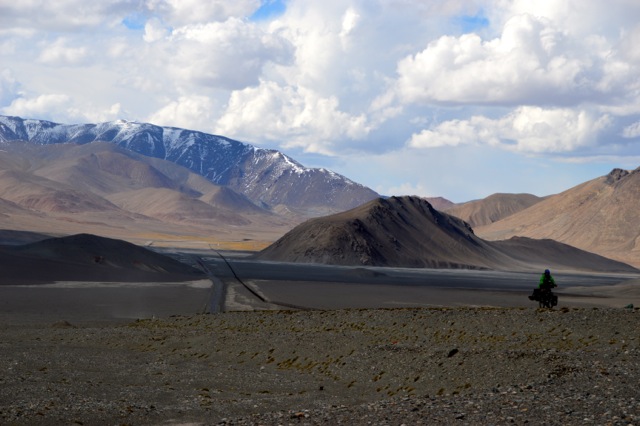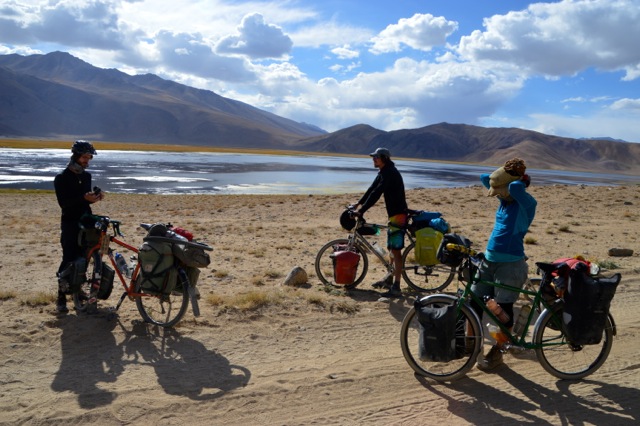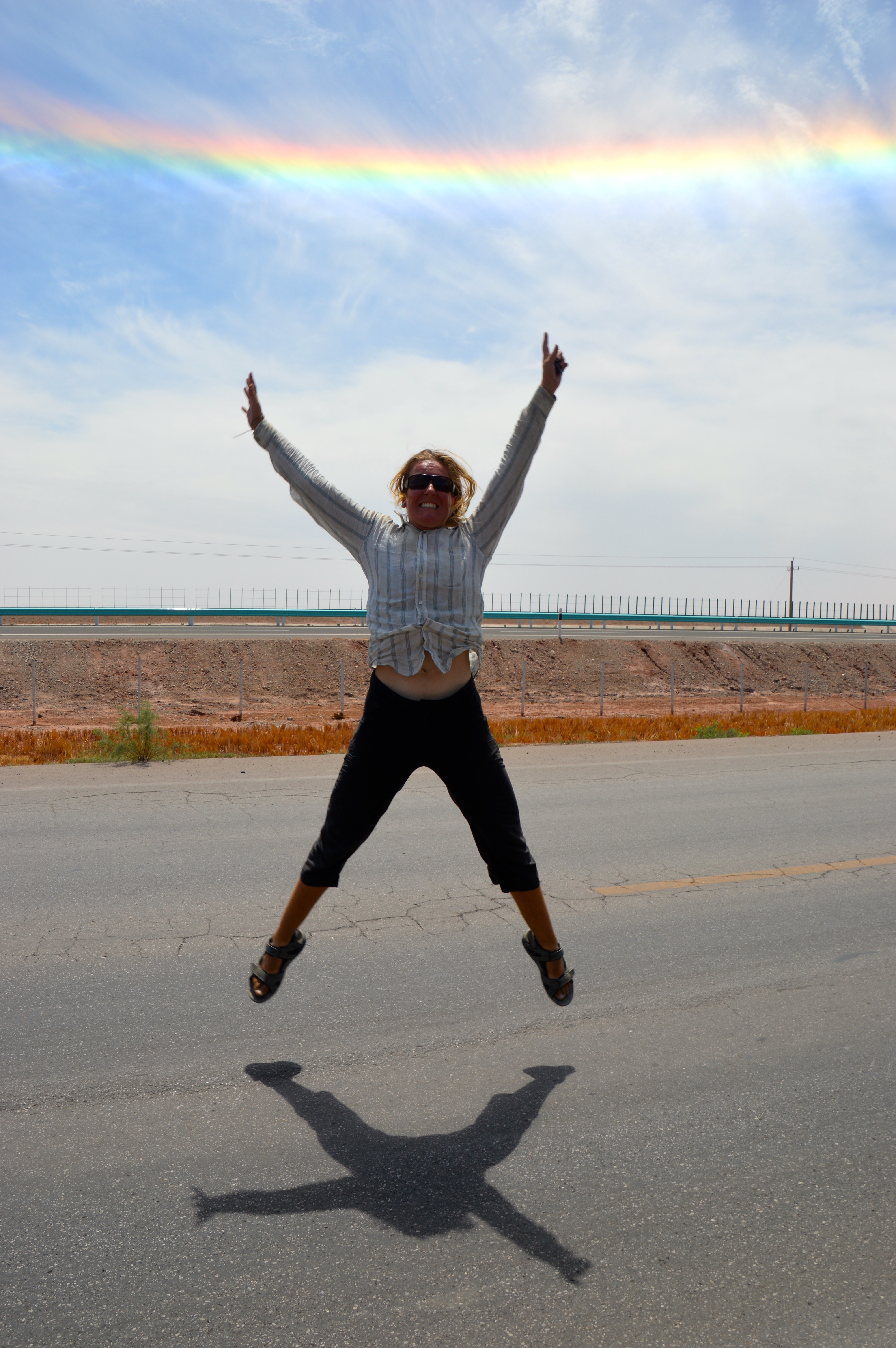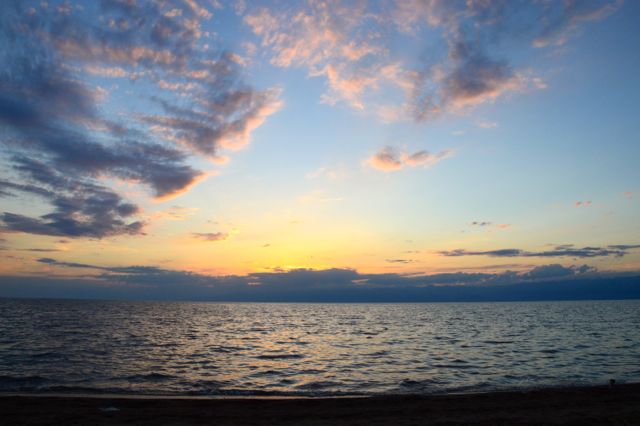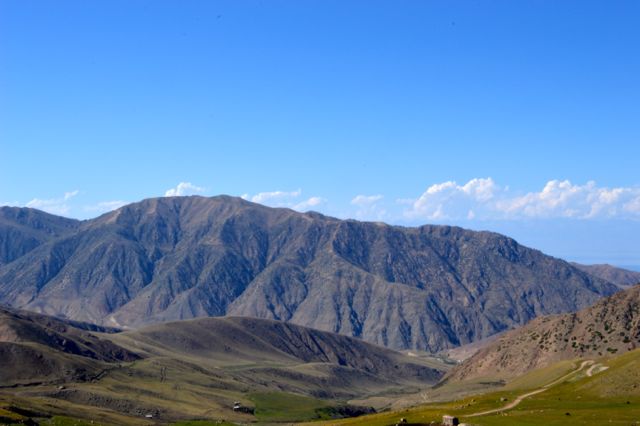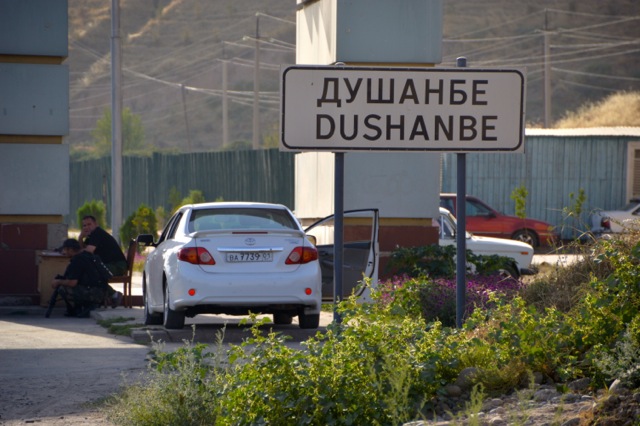
DUSHANBE

I don't think this needs an explanation.

I don’t think this needs an explanation.

Post Pamir Highway relaxation/ Visa application party

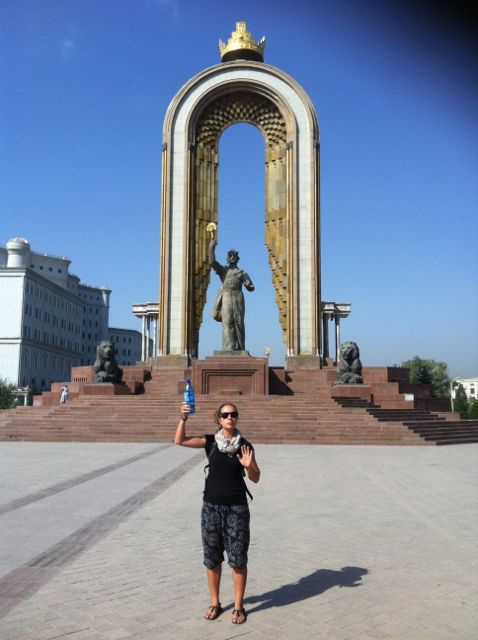
 What do I know of Dushanbe, the capital of Tajikistan? The sites, the museum, the history?

Nothing really.

I know where the Uzbek, Iranian and Turkmen embassies are. I know where the cheap and expensive supermarkets are, and the ATM that disperses the most US dollars at a time. I know where the expat pub is and the café with free wifi.

IMG_5047

The bikes go to the pub for a pint or 3

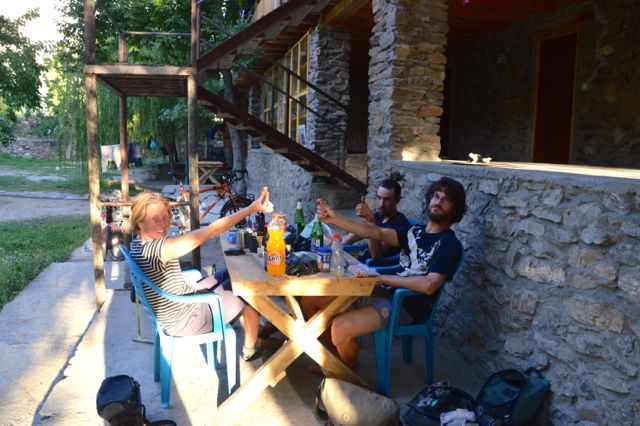
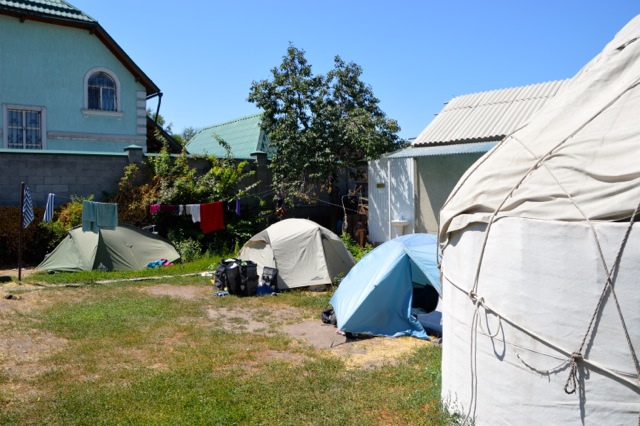
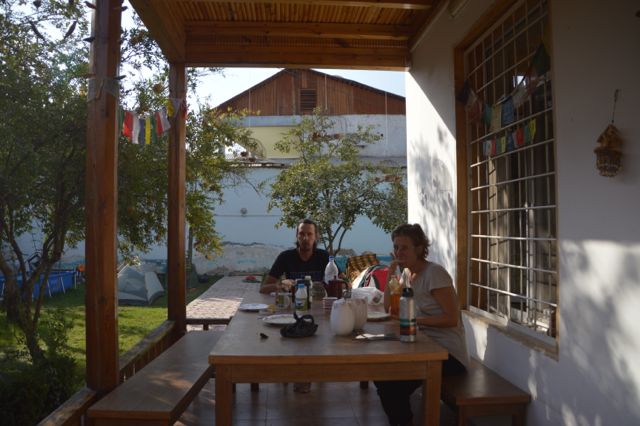
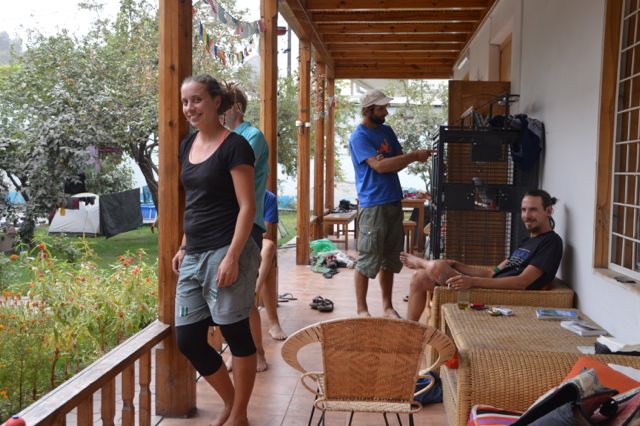
Mostly though, I know Vero’s backyard. The high walls, garden scattered with cyclist’s tents, the porch, where at any point in the day some cyclists will be sitting, chatting, drinking coffee or beers, reading and resting.

DSC_0027

Best Backyard ever

DSC_0029

Love this porch

When we pushed our heavy bikes through Vero’s door (opened by the kindly guards whose job it is to do this and seem rather amused by the constant arrival of foreign cyclists) we stepped into another world. In fact we stepped into a home. After more than a year on the road, for the first time, we really felt at home.
DSC_0026

Breakfast time

Let me take a minute to explain. Vero is a legend in the cycle touring community. Not only has she cycled on a tandem with her young son, both in South America and here in Tajikistan (she cycled the Pamir Highway this summer) she is also the most wonderful WarmShowers host. Central Asia is a real bottleneck for long distance cyclists, not only is the area is plagued by complicated visa procedures but most people cycle the Pamir Highway and will find themselves in Dushanbe either before or after this epic feat. The people who come before general stay a day or two as they get their GBAO permit (unless of course they stop giving out permits, then people stay for weeks) and the people coming from the Pamir highway (like us) generally seem to stay a bit longer, recovering and applying for onward visas. As it was still warm when we arrived, some days there were up to 16 cyclists camped in Vero’s backyard!

DSC_0036

Dinner is served!

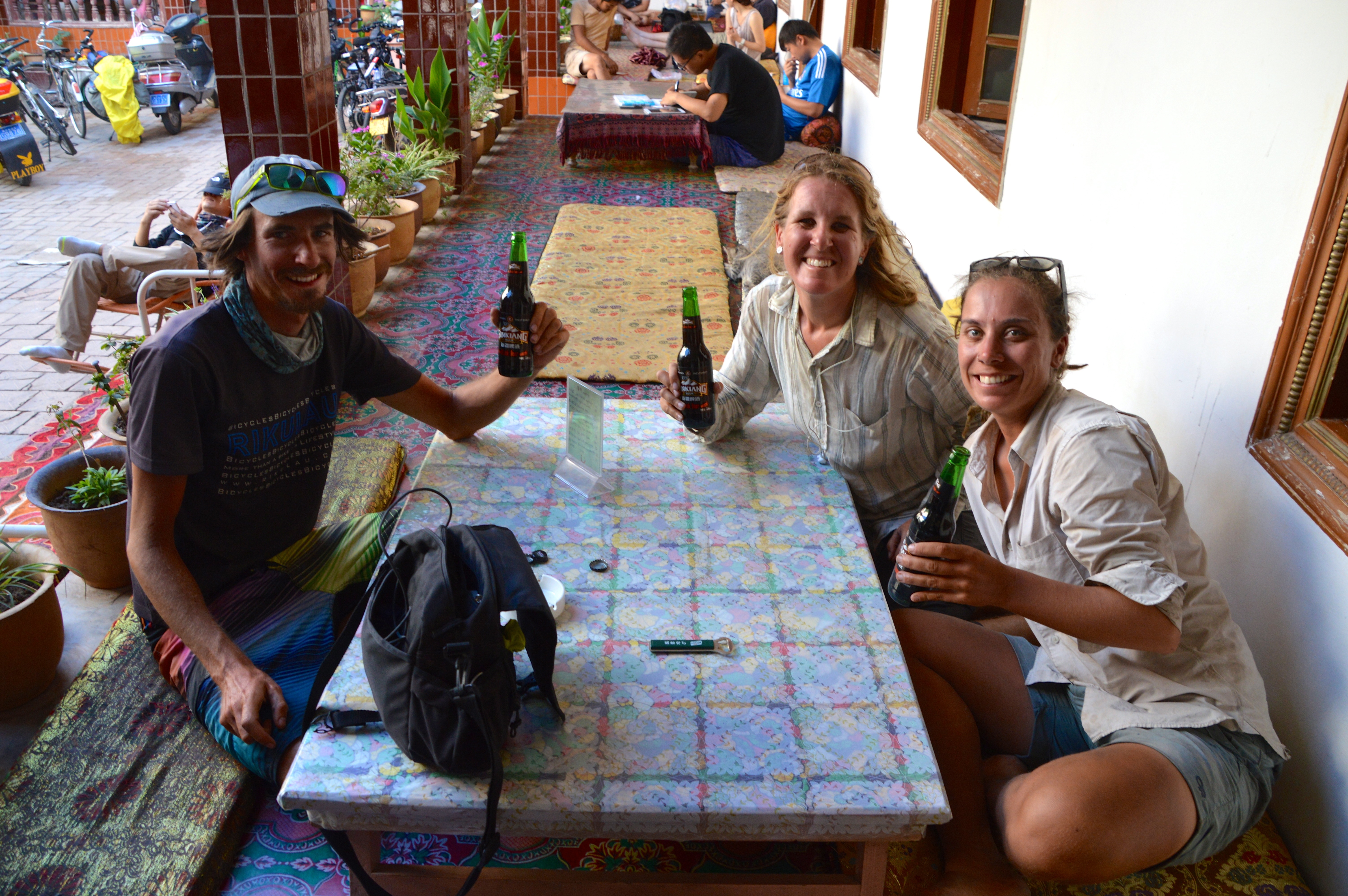
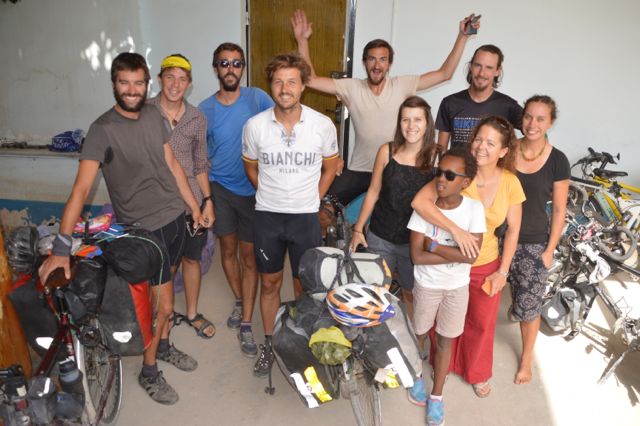
We had heard about the legend of Vero well before we ever arrived in Tajikistan from other cyclists, and had been looking forward to our stay. All three of us had visas to apply for and bike maintenance to attend to. Not to mention an epic amount of washing. And resting. The night we arrived there were already a handful of cyclists there and it was not long before we were sipping beers and sharing stories.
DSC_0041

Cyclists come and gp


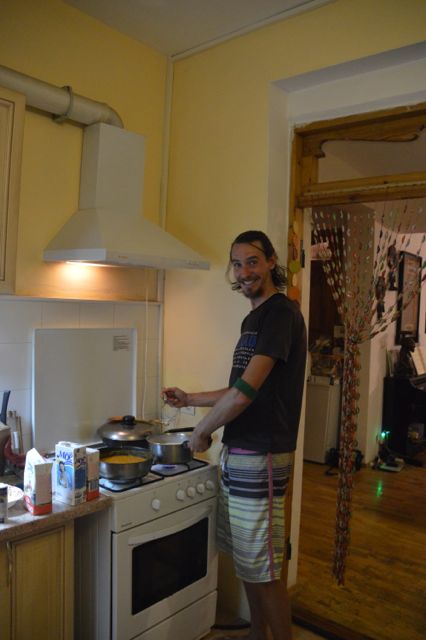
After weeks on the road, Vero’s place was paradise. A flushing toilet (with toilet paper!) a hot shower and the most amazing thing – an oven! I don’t think I have seen an oven in over a year. We abused that oven every night.
DSC_0033

In the kitchen where he belongs, cooking up a storm! (-:

Our days at Vero’s began with yoga in the backyard, followed by coffee on the porch with Vero and whoever was up. After breakfast the morning was a slow meander, marked by cups of tea and coffee. We tinkered with bikes, read books, researched, emailed, skyped and chatted to whoever was around. Sometimes there were visa errands (we successfully applied for our Turkmen, Iranian and Uzbek visas) or runs to the supermarket. The vibe was really communal and in the afternoon we usually planned what to make for dinner (it usually involved the oven) and we would cycle off to purchase ingredients and cook together.

DSC_0024

More delicious food

The cyclists came and went. Sometimes the house was bursting, and you could hardly get to the kitchen and other times it was just 4 or 5 of us. Everyone we met was super cool. Most people were on long trips, and most were heading east. We eagerly shared our stories and swapped information. There was a lot of laughter, especially because Vero’s eccentric African Parrot had impeccable timing and would always choose the perfect moment to burst into an eerie laugh.

DSC_0072

This parrot has amazing comic timing! I like him so much

DSC_0046

There was a downside to our stay in Dushanbe, a lot of us at Vero’s got sick at some stage with ‘Tajik belly’. Neil succumbed once (after having just recovered from it on the road) and poor Astrid twice. I was one of the few lucky ones to remain immune. Astrid spent a lot of time on the couch reading Jane Austen and not writing the blog.
DSC_0117

Porch time


One night at Vero’s we went clubbing. I’m not the biggest clubber around, but I do like a dance and I must say clubbing in Dushanbe was a lot of fun, especially with a bunch of cyclists in their ‘fine attire’. I can’t remember the last time I had a good dance like that. Another night we crazy danced in the kitchen while making pizza. One Monday Vero generously poured us all champagne ‘just because it was Monday’. The longer we stayed, the more we got to know Vero and her son Gab, the harder it was to leave. Gab too is quite a legend. I don’t know many 8 year olds that have cycled the Pamir Highway, or switch so effortlessly between French and English. He was a lot of fun to hang out with.

IMG_5065

‘Champagne Monday’ 

DSC_0018

Early morning farewell

The nature of travel is that eventually one must leave and pedal off to the next destination. However, not without a party. The main reason for the party was that Stephanie, an intern at the EU (where Vero works) was to finish her Masters Degree. We had all gotten to know Stephanie as she lived at Vero’s and it seemed an excellent reason to celebrate. Plus a lot of the ‘long term’ cyclists (us included) were leaving that Sunday. Poor Neil, he had finally really been bitten by his Green Mumba passport. Despite having not lived in South Africa for years he was denied a Turkmenistan Transit Visa, possibly on the grounds of Ebola paranoia. So Neil and Courtney (an awesome Australian cycling alone) were flying to Tehran that Sunday and we were heading towards the Uzbek border.

DSC_0091

Barbara fitting Courtney for her ‘Iran appropriate’ wear
DSC_0086

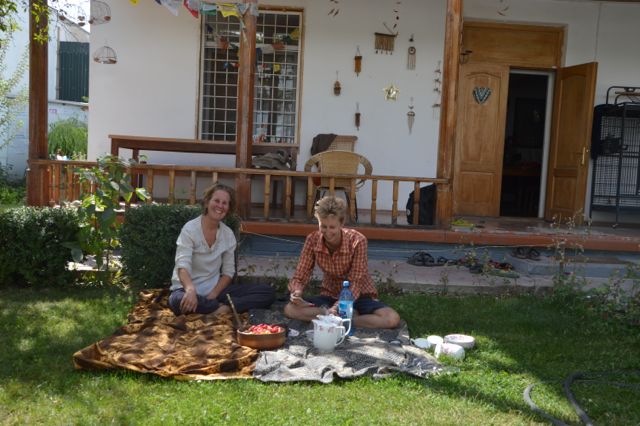
One day we had a picnic in the garden
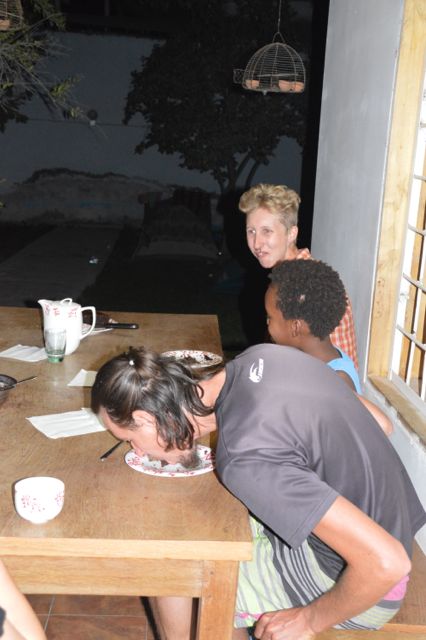
DSC_0084

“Eating Chocolate cake without hand’ night

DSC_0082

Awesome chocolate cake face from Gab


IMG_5048

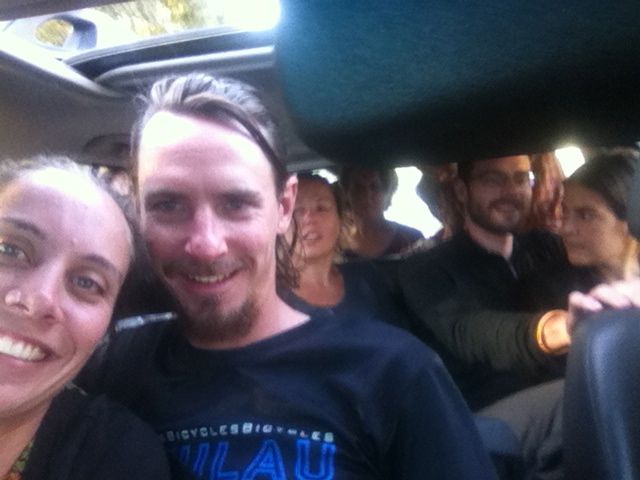
How many people can fit into one 4WD…

DSC_0061

Afternoon beers overlooking Dushanbe

So that Friday we geared up to celebrate. Neil was on cocktail duty, Astrid, Courtney and I were the pizza makers, Anna and Nico (a cool French couple) baked amazing cakes and Barbara made an awesome salad. A quick side note on Barbara, an awesome Austrian cyclo woman who has been traveling by bike and sailboat around the world. Barbara and I have been emailing since we were in Indonesia as after 2 years cycling alone she was looking to form a woman cycling gang. However, we were too far in front initially, then behind in China and in front again through Kyrgyzstan and Tajikistan. Finally we met at Vero’s. Barbara is a really inspiring rad woman and after comparing Turkmen transit visa dates we realised we would be in Iran at the same time. Our plan is to cycle together from Mashad in Iran.
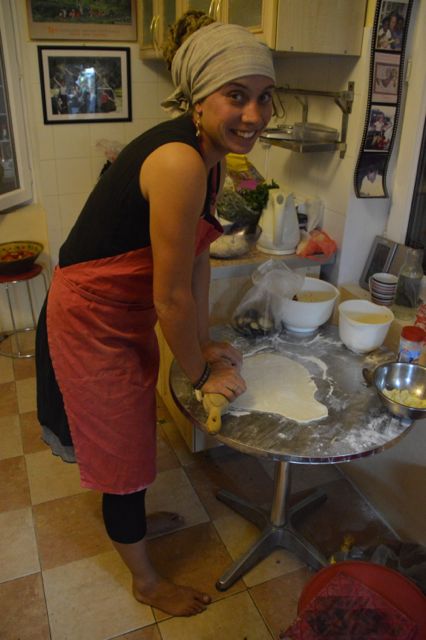
DSC_0098

Preparing pizza

DSC_0101

I think we are dancing, Astrid looks a little dangerous with that knife!
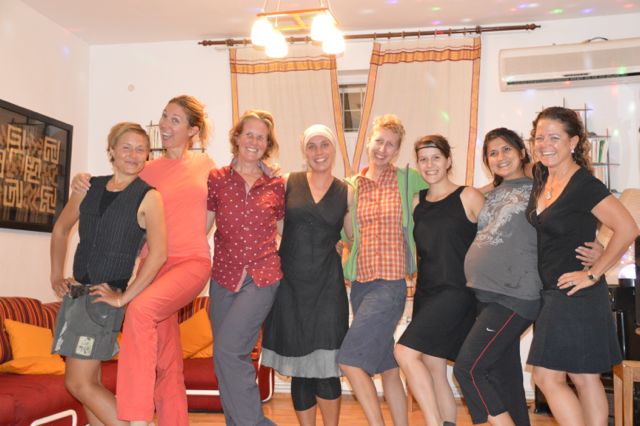
DSC_0103

The ladies of ‘sept 2014

DSC_0094

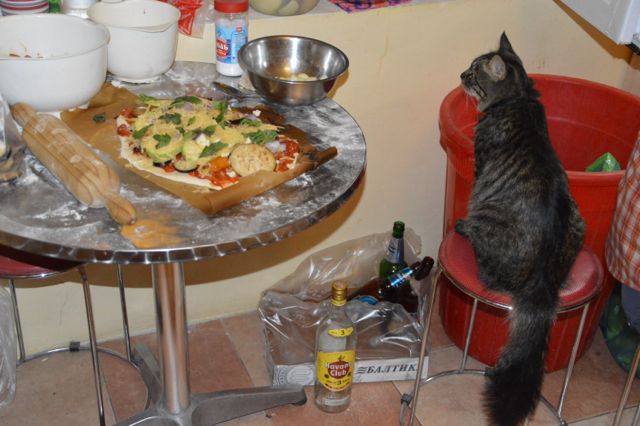
Jack eyeing off the pizza

DSC_0096

Cheers


Anyway, I don’t know if it’s the expat community, or the French expat community but the ability for mobilisation when there is a party was amazing. I don’t think many people would turn up if I set an email out on a Friday afternoon for a party that night. But by 9pm the house was packed, the music was pumping (Vero is also a DJ) and we were dancing like crazy. A great way to finish our time in Dushanbe.
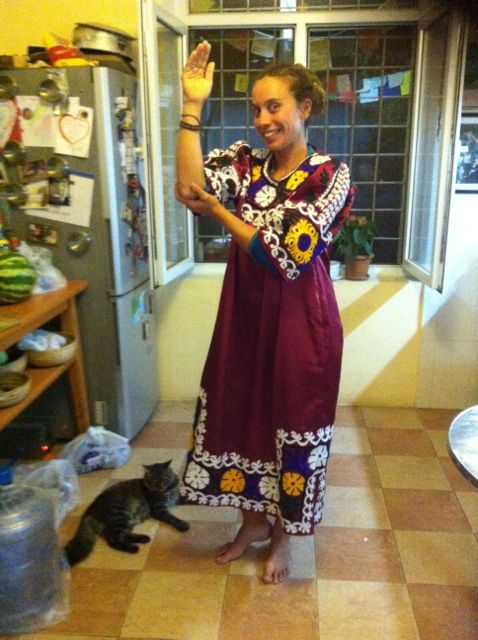
IMG_5059

Tajik fashion and dancing


Needless to say, Saturday was a mellow day full of packing, coffee and ‘hair of the dog’ beers. It was sad to say goodbye to everyone. Our time in Dushanbe has been very special. Meeting so many other cyclists was inspiring and getting to know Vero, Gabriel and Stephanie was wonderful. Thank you.We miss you and hope our paths will cross again one day
IMG_5062


DSC_0115

The ‘end of september’ group. Thanks Vero, we had the best time!

DSC_0121

Off to the Uzbek border


The other side of the Pamirs.

Khorog -> Kalai Khumb -> Dushanbe (via the new road).

DSC_0985

Khorog is a lovely place to relax.

We do apologise for the long delay between blogs and thank everyone who wrote to us to check if we are okay. Yes we are! We have been in the Central Asian internet blackhole and as daylight hours are getting shorter cycling and everyday living is taking up our time. So after a long hiatus, the stories of cycling and food are back. Our rest days in Khorog were truly relaxing. Time was spent tinkering with our bikes, people watching in the park, exploring the bazaar and stuffing ourselves with food. After weeks of bland, meat heavy central Asian cuisine, the local Indian restaurant was a vegetarian cycle tourist’s wet dream. Plates of curries were ordered and devoured with relish. We ate to celebrate and we ate to commiserate. After setting off from Japan a year earlier, MacG’s current cycle tour was coming to an end and our little pedal through the Wakhan together was his last cycling leg. MacG, you rock! Thanks for the awesome times and we hope our wheels cross paths again.

Thanks for the great times MacG!!

Thanks for the great times MacG!!

Back to being our family of three for the last time, the road would now take us 900 kilometres to the capital Dushanbe. It was a relaxing first day back on the bikes, the road meandering alongside the Panj River. The warm afternoon sun persuaded us to stop early and we found a lovely campsite under some trees at the junction of two rivers. As I lifted my leg over the bike an all too familiar feeling filled me with dread. I had been experiencing niggles in my back since pushing the Dirty Salmon up the hill of doom to Bibi Fatima, and now she let me know she’d had enough. I have learnt that movement rather than rest is what my back injury requires, so a yoga session was followed up by some pre-dinner Frisbee. I’m not the best player in the world and this coupled with me running about like I was sitting on a horse was a hilarious sight I’m sure.

Back to camping.

Back to camping.

The road hugs the Panj River.

The road hugs the Panj River.

The following morning we met up with Christine, a French woman who has been working with an NGO in Tajikistan for the last 4 years. She was a fountain of information and we spent the morning cycling together chatting about Pamiri and Tajik life, history and culture. What Christine shared was fascinating and at times frustrating and sad, especially with regards to health, education and equality. At my request she also pointed out the road leading to the Bartang Valley which is on my list of must do cycle routes for the future (Kev, Pabski and Rich – booking you in for this now). At 10am we arrived in a bigger village and the smell of shashlik lured Neil and Jude into a kebab-based morning tea. Neil amused the owner by doing a chicken dance and he confirmed that it was indeed chicken on the skewers. My back continued to give me grief so I decided to stop often to stretch and by the late afternoon I needed to get off the bike altogether. Our campsite was set up, perched on the edge of a cliff with a steep rocky scramble down to the water below. I interchanged yoga and walking exercises, while Jude and Neil cooked up a storm and brewed our mandatory cups of tea.

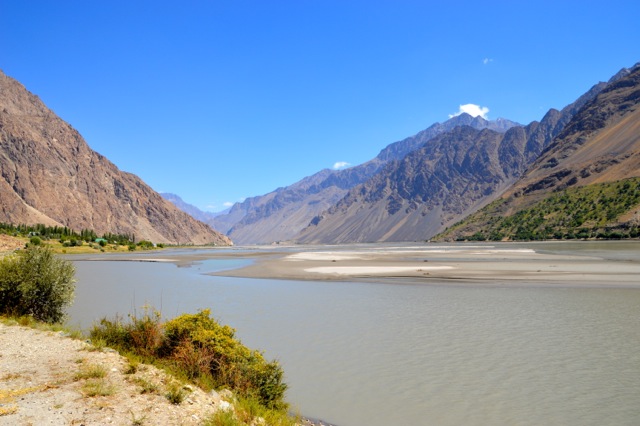
Calm waters of the Panj.

Calm waters of the Panj.

Looking up the Bartang Valley, a future cycle tour for sure.

Looking up the Bartang Valley, a future cycle tour for sure.

Camping on the edge.

Camping on the edge.

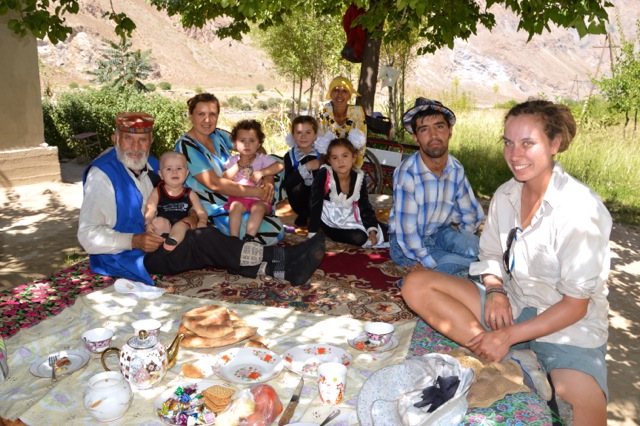
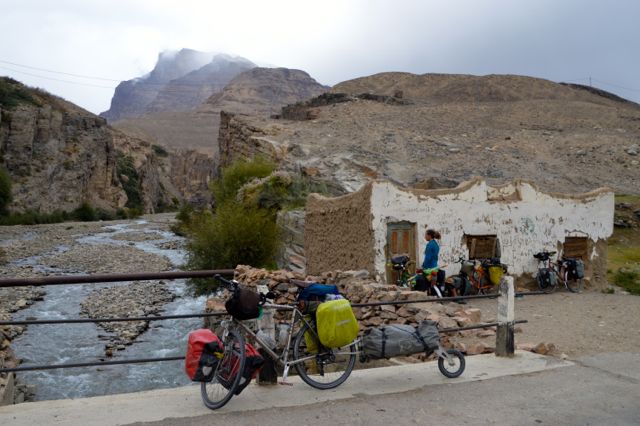
The road continued to follow the Panj River, but the wide valleys soon gave way to rocky canyons and little villages were located on the only flat land amongst these. The undulations along the canyon walls and the poor road surface provided a challenge for my back and I commenced a regime of cycling for 40 minutes followed by 20 minutes of yoga. In addition to these extra breaks we continued to be stopped regularly by locals offering us chai (tea). We learnt only to accept an offer when we were hungry, as chai is never just chai and today was no exception. We were provided with tea, fried eggs, bread, fresh tomato and cucumber, biscuits, confectionary and peaches picked from the tree we sat under. Such kindness and hospitality is the norm in the Pamirs

The valleys narrow into canyons.

The valleys narrow into canyons.

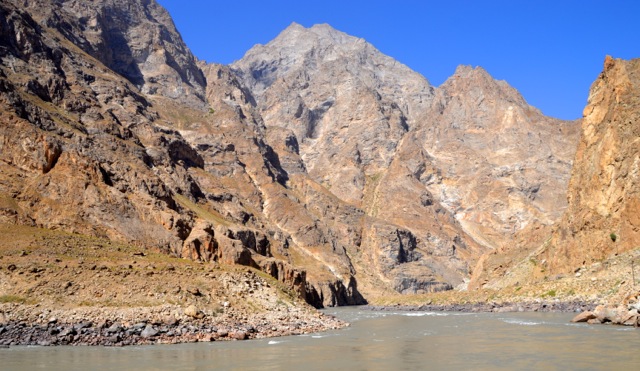
The valleys become canyons and the waters become choppy.

And the waters become choppy.

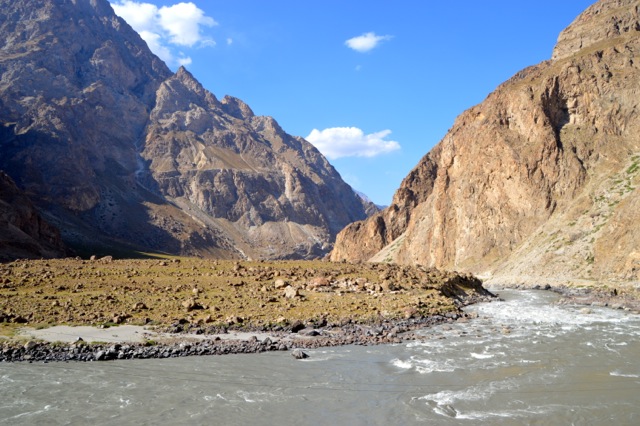
Afghanistan's mountains continue to impress.

Afghanistan’s mountains continue to impress.

Chai never means just chai.  Invites all round on the side of the road.

Chai never means just chai. Invites all round on the side of the road.

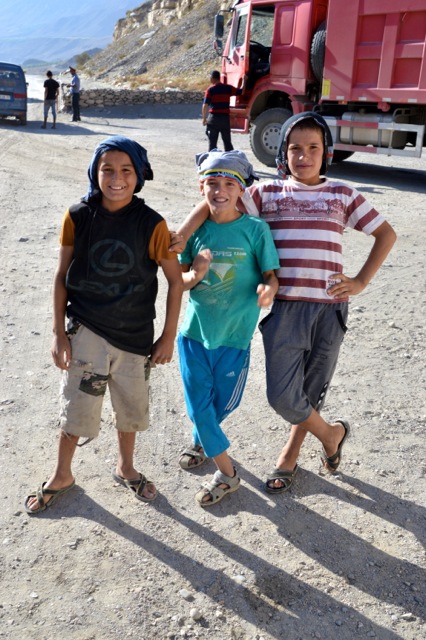
Late in the afternoon we crossed the dodgiest looking bridge thus far and proceeded to our final check point. While waiting, three boys came by and asked to have their photo taken. Little tough guy poses ceased when their (?extra) undies came out to be worn like hats. Once the photo shoot was over they asked to try riding our bikes. We told them it was not a good idea as they were heavy but they chose to give it a go anyway. Needless to say there was some falling and bruises, but they were super happy and they pushed us on our bikes through the sand track which the road became. Camp was set up in a sandy basin and we fell asleep to the roaring of the river (and the occasional truck).

The stunning scenery continues.

The stunning scenery continues.

Tough guy poses become funny with underwear.

Tough guy poses become funny with underwear.

Sand bank next to the Panj makes a lovely camp spot.

Sand bank next to the Panj makes a lovely camp spot.

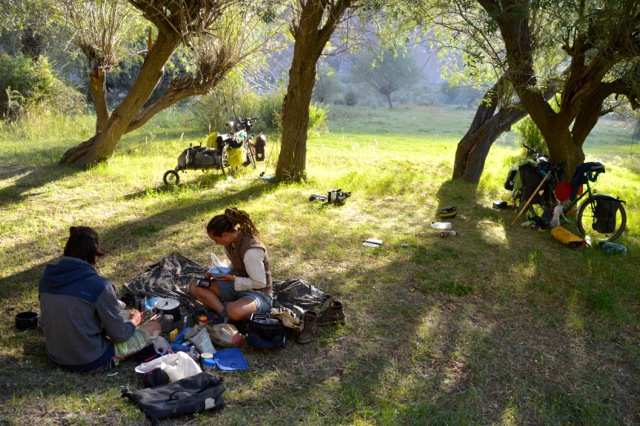
Relaxing after a day of cycling.

Relaxing after a day of cycling.

Pedaling off in the morning I knew it was going to be a slow day. I chose to continue my cycle/yoga regime, and the road continued to undulate through the canyon. I was so slow that Neil was able to finish an entire book while waiting for me to catch up. At lunchtime a roadside restaurant appeared and the advertising signs were promising. As usual, reality did not match the picture. The only food available was fried eggs and frankfurters. And Cornetto ice cream – yes two of them did accidently fall into our mouths. Somehow during a yoga session Neil failed to see us as he cycled by and he spent the next hour and a half trying to catch up to the two of us who were now behind him. Not being sure where we were comparatively, we decided to spend the night separately. Jude and I pitched our tent on a beach with an Afghani village overlooking our campsite. The lights of the houses on the mountainside joined the stars in the sky and a deep feeling of peace settled on the night.

Canyon riding, the road on the right side is ours.

Canyon riding, the road on the right side is ours.

Sometimes the Afghan side looked more agriculturally developed that the Tajik side.

Sometimes the Afghan side looked more agriculturally developed that the Tajik side.

Yoga after cycling heals a sore back.

Yoga after cycling heals a sore back.

Late the next morning we met Neil at the township of Kalai Khumb. The size of a town here can be judged by the presence or absence of aisles in the supermarket – this one had many. Staples and many treats were purchased and eaten. Kalai Khumb is located at the intersection of the new and old roads to Dushanbe. Most cyclists take the old dirt road – which is 100km shorter and supposedly more scenic. Despite being longer I had chosen to take the new road as I thought it would be better for my back if I pedaled a road that was mostly tarmac. Neil’s bike continued to have rack issues so he made the decision to join us on the new road. Our decision to stay together was celebrated with a large bowl of plov and an afternoon beer. Afternoon beers are not so conducive with cycling, so after about 20 kilometres we pulled over and set up our tent in a food forest. It was an incredibly magical place. An old man from the village discovered us and used every excuse under the sun to convince us that we needed to come and stay at his house. Wolves would eat us, an avalanche would bury us, or the Afghanis across the river would shoot us. Realising that all his protestations were in vain, he then took pleasure in showing me all the edible fruits that were to be enjoyed around us. I’m so planting a food forest when we buy a property on our return!!

The children continue to request to have their photos taken.

The children continue to request to have their photos taken.

Our food forest, everything grown here is edible.

Our food forest, everything grown here is edible.

None of the aforementioned incidents occurred during the night and we pedaled into the morning well rested and happy. The canyon narrowed even further and I felt as if I could reach over and touch the mountainsides of Afghanistan. Being so close provided a different kind of problem for us though. The police along this stretch of road were hyper paranoid about us getting shot by Afghani’s. I stopped to do my usual yoga, to have 3 police officers materialize out of nowhere to try and inform me that I couldn’t stop there as I was in danger. I did my best ‘dumb tourist’ look and continued on with my stretching much to the officer’s chagrin. The same officers received the one finger salute from Jude when the last one blew her a kiss as she cycled passed. Our tolerance for sexist and overt attention from men continues to decline. Lunch was then interrupted by another group of police who again warned us of our imminent danger. Luckily for our paranoid police friends, we spent that night camped among giant trees next to a natural spring at a local families property. They found my yoga extremely amusing, especially the sun salutations. I wondered if they knew it was for stretching or if they thought it was some kind of weird religious ritual.

Lush greenery surrounds us.

Lush greenery surrounds us.

Looking back down to the canyons we had just cycled out of.

Looking back down to the canyons we had just cycled out of.

Knowing that we would have a climb, we woke earlier than usual and set off in the cool morning air. The road became super smooth tarmac after a few minutes and we flew along enjoying the lack of bone shaking corrugations and potentially bike breaking potholes. The canyon soon opened into a valley and rolling hills, the first difference in landscape for a couple of weeks. The tarmac soon disappeared as quickly as it appeared. Being more exposed to the elements the heat soon became oppressive and we stopped at the first Magazin for a cold drink, an ice cream and some treats. After sampling a selection of chocolate bars imported from Turkey, we are aware that we will be chocolate free for our time there. As the temperature climbed, so did we. The road now turned away from the border and up the pass that we were expecting. Finding some shade at lunchtime proved difficult, but not impossible. It was hard to get back on the bikes and start climbing again, but we were soon able to rest again. Road works were being carried out and as we waited, giant boulders were being dropped over the edge of the switchback above us. Ah the switchbacks and the false summits, not a good combination as the day comes to an end. The top of the pass remained elusive and we set up camp in a quarry as twilight set in.

The land opened up from the canyons we had been in.

The land opened up from the canyons we had been in.

Turkey fails to produce good chocolate.

Turkey fails to produce good chocolate.

Parking for lunch.

Parking for lunch.

The top of the pass was reached the next morning and soon the wind was rushing through our hair as we descended into the next valley. On the way down I noticed an apiary and stopped to see if I could buy some honey. Next thing I knew we were seated in their tent drinking tea, eating melons and enjoying freshly gathered honey on homemade bread. In true Tajik style we were gifted more honey on our departure and made to promise to visit again when we were next in the area. You would think that after stuffing ourselves with such good food and not expending much energy due to cycling downhill, lunch would have been the last thing we wanted. Sure enough it wasn’t and soon we were sitting in a shaded restaurant garden eating more. This was followed by a couple of ice creams, as we bought our own and then were gifted others. The valley we were in was fertile and the townships well developed. It came as no surprise to find out that the president was from the area and that most governmental funding is spent here. Our good luck did not last into the evening – we had been offered a place to stay but the guy didn’t return, therefore we made camp in an orchard next to the freeway and the roar of trucks and cars didn’t abate all night.

Chai again does not mean just tea. Our feast with the honey man and his family.

Chai again does not mean just tea. Our feast with the honey man and his family.

A farewell salute from our lovely honey host.

A farewell salute from our lovely honey host.

Descending into the next valley after the never ending climb.

Descending into the next valley after the never ending climb.

Our waitress tries on Neil's glasses.  I wanted to capture her gold teeth but she wouldn't smile.

Our waitress tries on Neil’s glasses. I wanted to capture her gold teeth but she wouldn’t smile.

French toast and coffee cured our fatigue and feeling rejuvenated we continued to cycle through fertile fields. The greenery gave way to golden grass as we climbed and then undulated our way through hills as far as the eye could see. Being gifted melons and grapes was a welcome treat as the heat of the day came on rapidly and shade was scarce. A post lunchtime break was enjoyed in the shade of the petrol station where we spent two hours reading books and drinking cold drinks. The road again improved but the attitude of the drivers didn’t. A plastic bottle was launched at me and luckily missed its target. Needing a good nights sleep we pulled off the main road and asked an old man if we could camp on the land there. He was obliging and very much wanting to converse with us. Despite his knowledge of seven languages and the combined five that the three of us knew, we unfortunately had none in common. After a quick chat in Russian he left us to set up camp and enjoy our evening of peace and quiet.

Camping in the orchard.

Camping in the orchard.

French toast of awesome.

French toast of awesome.

Golden hills rolling as far as the eye can see.

Golden hills rolling as far as the eye can see.

More donkey love.

Donkey love.

With cups of tea in hand we watched as the sun rose over the valley. It was another hot day and we had two big climbs to really make us feel the heat. After the first ascent lunch was eaten at a roadside rest stop where every stall sold the same two dishes. The next climb, some tunnels and a lovely downhill placed us further along the road than we expected. Finding ourselves only 30 kilometres out of Dushanbe with at least three more hours of daylight we decided to make a push for the hospitality and warm shower at Veronique’s home in Dushanbe. Fortune was with us as the road was flat and we sped along with happy hearts. The last gift of hospitality on our Tajik crossing came from an old man who presented me with a pear and some sweets. He had cycled his grandson into Dushanbe and back that day for medical treatment, but still had the time and inclination to welcome a guest to his country. Such acts of kindness continue to remind me of the inherent good that is found in the world.

Donkeys feeling as hot as we were.

Donkeys feeling as hot as we were.

The iridescent blue of the dam near Dushanbe.

The iridescent blue of the dam near Dushanbe.

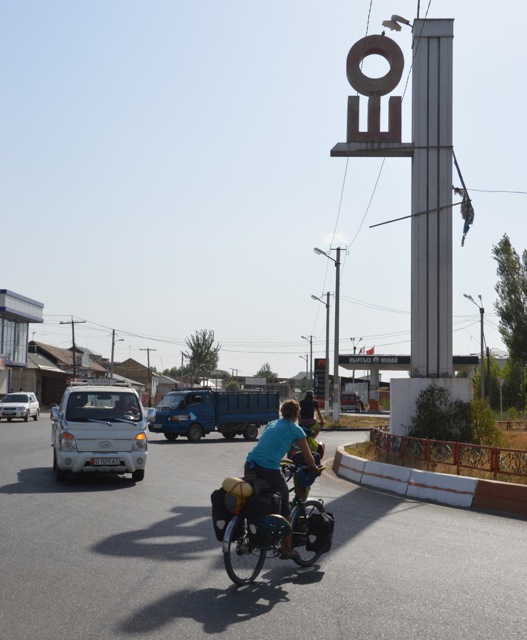
Entry gate to Dushanbe, a welcome site.

Entry gate to Dushanbe, a welcome site.

Our family of three cycled into Dushanbe, the last leg of the road together since we joined forces in Turpan.  The feeling was bitter sweet, but this didn’t last too long.  The haven of Veronique’s awaited us, as did a cold beer to celebrate achieving our dream of cycling the Pamirs.

Love, Astrid.

I don't think this needs an explanation.

I don’t think this needs an explanation.

Note: I’m sorry for the less than usual amount and diversity of photos, I don’t take as many if I’m unwell.  Oh yes, and my back did fully heal with my cycling and yoga regime. Yay for freedom of movement!

I can see Afghanistan from my tent

Bulunkul to Khorog via the Wakhan Valley

DSC_0795

Heading towards the pass that would take us into the Wakhan valley

We turned southwards now, away from the Pamir Highway itself and into the Wakhan corridor. The river that cuts through this narrow, dramatic valley forms the border between Tajikistan and Afghanistan and is home to the Pamiri people, who are both different from the Kyrgyz nomads of the Eastern Pamir’s and the lowland Tajik’s. To many cyclists, this detour is considered a must. We were no exception.

DSC_0794

Lake, part way up the pass

DSC_0793

Stunning but it kept going up and up!

But first we had to get there. Other cyclists had told us the ride in was tough. I am never one to fully believe what I am told until I experience it. However, I can certainly say it was challenging! Not only were we ascending a 4000m plus pass, the road also alternated between horrible loose rocks and thick sand. I was often pushing (and swearing), and it took us most of the day to do 30km.

DSC_0797

Beautiful cycling, near the top

DSC_0799

The moody weather starts in the afternoon

DSC_0801

Dwarfed by the landscape

DSC_0804

The following morning we woke to our first really cloudy day since entering Tajikistan. This moody, unseasonal weather would follow us almost all the way to Khorog, unfortunately often obscuring the mighty Hindu Kush mountain range that borders Afghanistan and Pakistan. A short cycle from our camp found us at a checkpoint and at the opening of a large river valley. Across the river lay Afghanistan, seemingly peaceful and unassuming. In fact, this part of Afghanistan is peaceful. In Khorog the Afghan embassy issues tourist visas (for $100 USD) and you can organise a tour to the Afghan Wakhan. While we did not go into Afghanistan itself, we were often camped closer to the Afghan settlements across the river, than to Tajik ones. We waved and called out ‘hellos’, watched the donkey traffic and observed how life on the Afghan side looked very similar to the Tajik side. The only real difference was that thanks to the Aga Khan foundation (the Aga Khan is the leader of Ismaili Islam), the Tajik Wakhan had electricity and a road. Well, a kind of road. Oh and also, the Afghan donkeys are a lot louder.

DSC_0808

Sheep and goats on the other side of the pass

DSC_0816

Our tents form a line for wind protection

DSC_0817

Double checking our route. That’s Afghanistan in front of us

DSC_0819

The stark beautiful valley as we head down into the Wakhan

That first day we bumped and looped our way down into the Wakhan (sadly it wasn’t always actually down). The road was rough, and poor Neil had a few issues with his front rack. Towards the evening the weather really began to come in, a fierce wind blew and the occasional bouts of rain accompanied. We had wanted to camp, but up here on the exposed road there was very little shelter. Even when the first small settlement was reached, no choice camp spots revealed themselves. After a quick group discussion and a look at the blackening sky it was decided we would push on the Langar, the first larger village of the Wakhan. Luckily, from where we were it was downhill and we reached the first houses of Langar just as it was growing dark. While we were cycling through, looking for signs for homestays, a couple in an apricot orchard called Astrid over. After handing her a huge bag of apricots, they also invited us all in for the night.

DSC_0824

Looking out towards Afghanistan

DSC_0825

Heading down

DSC_0826

It’s dry and exposed up here

DSC_0838

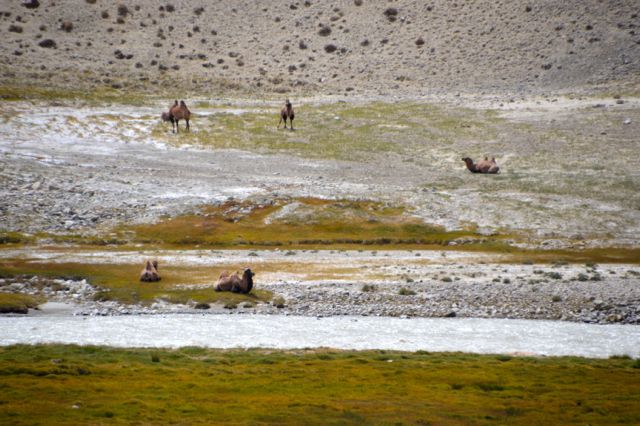
Afghan camels

DSC_0856

The weather starts to come in during the afternoon

DSC_0851

The peaks are obscured

DSC_0854

It gets colder

DSC_0853

Snack stop

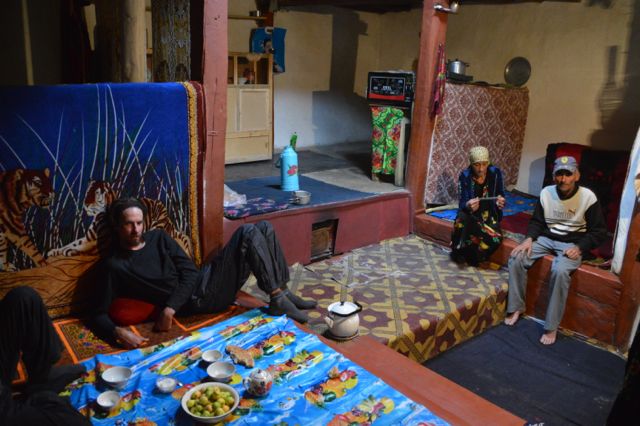
And what a beautiful home it was. The husband had built it himself and it was in the traditional Pamiri style. Epic thick walls, white washed exterior with blue door and window frames. The interior, while open plan, had little raised sections, carpets hung on the walls and a pointed skylight (Tajik dome as he called it) let natural light in. The whole place was incredibly warm and welcoming. Pamiri houses (like Kyrgyz ones) always seem to have piles of blankets, and it was these that the couple made into amazingly comfortable beds for us in the front two rooms. We were then treated to a huge dinner, eating till we thought we might explode and using a mixture of bad Russian and charades to communicate.

DSC_0867

Our wonderful Pamiri hosts

DSC_0865

The outside of their home

DSC_0863

Inside their home

DSC_0860

Sharing a meal

It rained during the night and we were incredibly thankful for the hospitality we received. Bidding farewell to our lovely hosts we pedaled out into the Wakhan. Now we were really in the valley. The Hindu Kush, although their peaks obscured, towered above us from the other side of the river. Poplars lined the road, as did carefully crafted low brick walls and the occasional Ismaili shrine with ram horns marking the entrance. We were no longer in high altitude desert, green had come back into the landscape and farm animals moseyed about, kids shouted as we passed and men tried to push start ancient Ladas. After the solitude of the eastern Pamirs, it was a very different experience.

DSC_0872

The Wakhan Valley

DSC_0873

An Ismaili Shrine

DSC_0874

A Mosque, opposite the shrine

DSC_0877

A Pamiri home

DSC_0978

Edge of a village

Our first task of the day was to find chocolate. We visited about 5 poorly stocked magazins and managed to scrape together a few snacks (it was about here that Astrid’s date obsession began, thanks to Jeff). All of us remarked on how much money the locals could be making off cyclists, if they stocked a few choice products like cheese and chocolate. Most of the tourists in the Wakhan are cyclists, and cyclists are HUNGRY almost all the time. Provide cheese and they will come.

DSC_0876

Searching for chocolate, a typical Wakhan shop

DSC_0869

Cute donkey 1

DSC_0870

Cute donkey 2

DSC_0879

A rare section of paved road

DSC_0881

View across the valley

DSC_0885

Moody clouds over Afghanistan

DSC_0888

Can you see the corrugations?

DSC_0891

Lunch by a natural spring

Anyway, aside from obsessing about food we bounced along the Wakhan, trying to remember at what point Remi and Rebecca had told us the road improved. Was it 30 or 40km after Langar? Of course, being Tajikistan, we ran into a few cyclists coming the opposite way and they assured us the road did eventually improve in about 30 or 40km.. Poor Neil, he was starting to have serious issues with his racks. While his bike is pretty much indestructible, his racks were not and after weeks of rough roads they had seemingly had enough. It was about this time that Jeff, being knowledgable about most things, especially bikes, began to be referred to by us as ‘McGyver’ as he was able to fix anything with a piece of wire. Soon McGyver became simply McG.

DSC_0893

Back into the elements

DSC_0894

You can almost see the Hindu Kush…

DSC_0895

A slight view of the snow caps..

DSC_0897

Beautiful cycling through the sheltered valley

DSC_0843

McG, protected from the wind and sun

So after more than a few McGyver stops we reached the turn off to Bibi Fatima. At the top of this 7km climb lay some castle ruins and hot springs, which Astrid and I had managed to convince the guys was worth seeing, not the mention the amazing view we would have if the weather cleared. We began the climb and it was epic. The gradient was insane, and being the Wakhan the surface was terrible. Poor Neil was already beginning to feel a little unwell, then his chain snapped only about 4km in. While he and McG were McGyvering it back into place in the fading light, Astrid and I hiked further up to see if we could find a homestay. We were in luck. The four of us gathered up our bikes and pedalled the 600m to warmth and shelter just as it began to rain.

DSC_0898

Wheat fields and wind

DSC_0901

Buddhist caves in the distance

DSC_0902

Another beautiful Pamiri home

DSC_0910

Pretty happy about cycling the Wakhan

DSC_0911

Moody clouds over the Hindu Kush

DSC_0912

The fairy has a fall climbing up to Bibi Fatima

DSC_0913

View from part way up

DSC_0914

looking cute

Again we were in a thick walled, warm Pamiri house, full of blankets and carpets. After an awesome feast we decided to embrace the sleepover vibe and watch a movie. Yep, being total dorks, we decided to watch a cycle touring film.

We woke to rain and delayed our departure till the weather had somewhat cleared. By now poor Neil had a full blown case of what would become the infamous and way too familiar ‘Tajik belly.’ It was decided we would cycle the remaining km’s to the top and then have a rest day. Once at the top we found ourselves a hotel to call home, met some other cycle tourists and all had lunch together. After lunch Astrid and I went and had a very relaxing bath in the hot springs and were taught by all the local women how to check how many children we would have (the springs are supposed to enhance fertility). Apparently Astrid and I are supposed to have 6 kids each (!). While we were relaxing, sadly, McG and Neil were not. Having decided to fix one thing on Neil’s bike, they inadvertently opened a can of worms and spent the better part of the day working on the racks.

DSC_0915

View off the Wakhan from near the top

DSC_0920

12th Century ruins, high above the valley floor

DSC_0918

A bit more fort action

DSC_0932

Looks like it may clear..

DSC_0934

No, more weather comes in from Afghanistan

We rolled down the hill the next morning with Neil’s racks firmly McGyver’ed into place. Unfortunately the same could not be said for Neil’s stomach. The weather kept teasing us, it looked like it was clearing but then another front of inclement weather would come rolling in. We were however, afforded some beautiful views of the Hindu Kush between the clouds that day and felt like we hadn’t all together missed out. After not many kilometres we called it a day and crawled into the undergrowth, having found a very sheltered camp thanks to McG.

DSC_0936

I decided it was a choice moment to drain and replace my Rohloff oil while the others enjoy the view

DSC_0937

Heading back down

DSC_0941

Our lunch spot, sheltered from the ever present wind

DSC_0948

Cultivated fields

By now we were running low on food, well not really food, just snacks. We reached Ishkashim, the main Wakhan town before Khorog with grand expectations. This seems to happen with Neil and I a lot. We start imagining all the food we might find (snickers perhaps, maybe cheese?) and are inevitably disappointed. Instead we had yet another bowl of soup with cabbage and meat and rolled out of town with a few wilting carrots, some weird Russian chocolate and a bottle of vodka. That night we found another prime camp spot, McG built a fire and we all enjoyed a bottle of vodka together. Ah, life on the road.

DSC_0944

The Hindu Kush reveal their beauty

DSC_0951

Epic snow caps of awesome


DSC_0976

Astro and the Samon out in front looking cool

DSC_0962

Tarmac!

Our last full day before Khorog and we could see that we would soon be in the regional capital. The road for one had improved a lot, and we soon began seeing well stocked Magazins as well as finding a restaurant that had actual salad on the menu. The four of us rejoiced at being able to eat something other than soup. We spent the rest of the afternoon out cycling a storm (finally, a tailwind) and made camp on a beach, right next to the river.

DSC_0954

The kids love to be photographed! We got so many requests.

DSC_0955

The river must be immense in the spring with the snow melt..

DSC_0957

Afghan settlement

DSC_0961

Gah! Clouds.

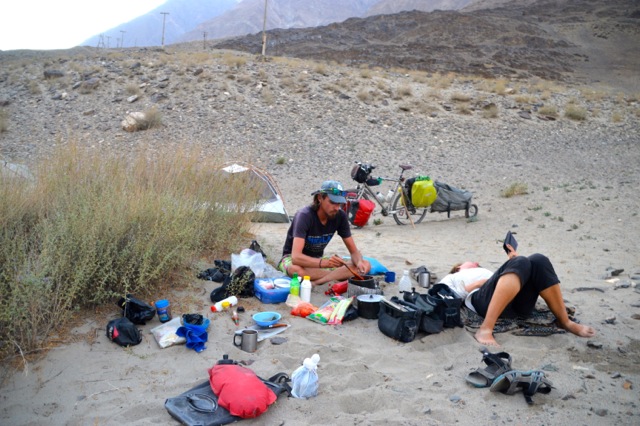
Let me now describe a typical evening. It goes something like this. The front cyclists (usually Astrid and McG) will stop and wait while Neil and then I catch up at a spot that could have some good camping. Two or three of us will then scout around, looking at things like shelter, access to water and how hidden we are. A discussion will ensue about the merits of each spot, or perhaps pushing on. Sometimes this can take a while. A spot will then be decided and we will haul our bikes over (usually our spots have difficult access). Teabitch (aka Neil) will then get ‘Betty’ (my front, ‘kitchen’ panier) and will start making tea for all of us. After initial hesitation, McG succumbed to tea as well. We will then set up our tents, put water up to filter and dig food out from various parts of our panniers. Once the tea is ready we generally sloth around chatting and drinking tea until someone has the initiative to start chopping vegetables. Dinner is prepared and eaten together and is generally followed by a second cup of tea.

DSC_0960

Breakfast in one of our great camp spots

DSC_0967

Afghan waterfall

DSC_0965

More cute village kids

Our camp on our last night was however neither hidden, nor sheltered, as the land was becoming more heavily cultivated and the valley narrow. Just as dinner was ready the storm front caught up with us. So the four of us somehow managed to squeeze into our tent until the front passed. Then we climbed out, built a fire and had a few beers (thank you well stocked magazins). This would be our last night all together in the Wakhan. It had been truly great sharing this experience with McG and Neil (who wouldn’t be leaving for a while yet).

DSC_0979

Our last camp before Khorog

DSC_0980

Camp fire on the ‘beach’

We woke to brilliant sunshine but the Hindu Kush were now too far to our east to see. After a slow pack up we hit the road and reached Khorog by lunchtime. Here we navigated our way to the Pamir Lodge where we immediately met more cycle tourists. For a couple of dollars we threw our tents up on the balcony and began the tasks of washing ourselves and our filthy clothes. Arriving somewhere after a hard stretch of cycling is always a little bittersweet. I will miss the tranquility and beauty of the high mountains and the Wakhan, as well as the friendship and camaraderie of our little group of four. At the same time, I am excited about having now cycled through such amazing scenery and for all the adventures that lie ahead.

DSC_0983

Perfect weather as we head into Khorog

DSC_0984

Khorog

DSC_0985

More Khorog and importantly Indian food!!

That evening we celebrated our epic Pamir highway/Wakhan Valley cycle with way too much beer and vodka.

DSC_0986

Made it! Beers of celebration

DSC_0987

Neil tries a new hair style..

DSC_0991

And riding the Samon on a beer run..

DSC_0995

Cheers

Till next time

Jude

Into the Pamirs.

Osh -> Sary-Tash -> Tajikistan border -> Murghab -> Alichur -> Lake Bulunkul.

Quintessential Pamirs.

The lady didn’t blink an eye when I asked for 6 kilograms of oats. She just piled them into two large shopping bags and we were left to wander the rest of the Osh bazaar to buy the last necessities for our time in the Pamirs. We had been warned that food was scarce in this high altitude dessert and being hungry cyclists we didn’t want to be caught out. Our bikes were significantly heavier but being well fed is worth the extra weight. Our plan was to hitch a ride back to Sary-Tash and from there our estimated 28 day journey along the second highest highway in the world would begin.

Our fantastic companions on the way to Sary Tash (plus the drunk local on the right).

Our fantastic companions on the way to Sary Tash (plus the drunk local on the right).

Relaxing in the warmth our homestay.

Camping was abandoned for the warmth of our homestay.

The sound of rain pounding on the tent woke us early and mud soon covered everything. Not dissuaded by this abnormal weather, we were ready by mid morning to hit the road and try the luck of the thumb. I spent the first ride sleeping in the back of a pick-up surrounded by milk pails, while Jude and Neil fretted in the front as the farmer continually fell asleep and hit himself to remain awake. The second ride was a little more favourable, despite Neil’s truck catching on fire and smoking out the cabin, Jude being proposed to again and again by our driver, and the weather getting colder and colder the higher we climbed.

A white wonderland.

A white wonderland.

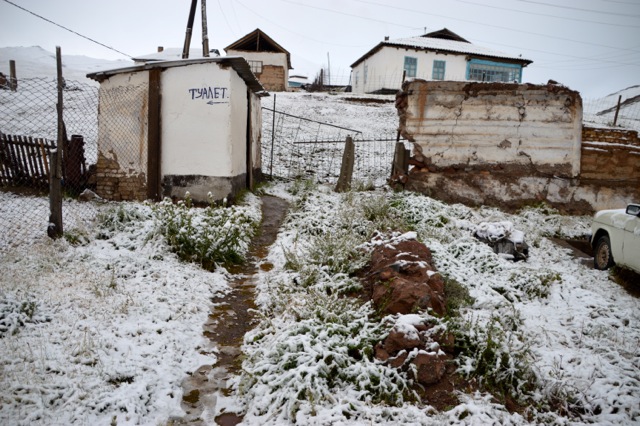
The way to the toilet.

The way to the toilet.

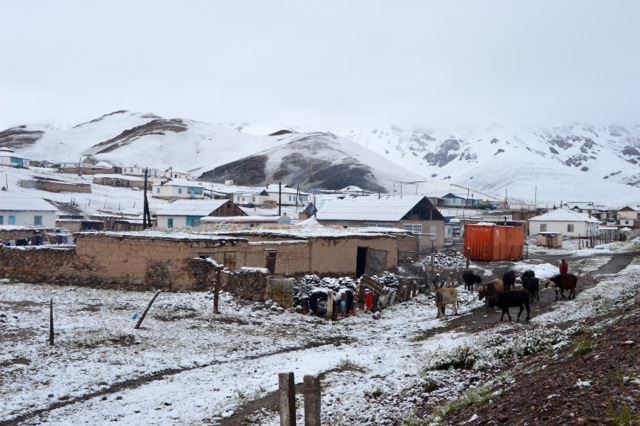
Cattle in snow.

Cattle in snow.

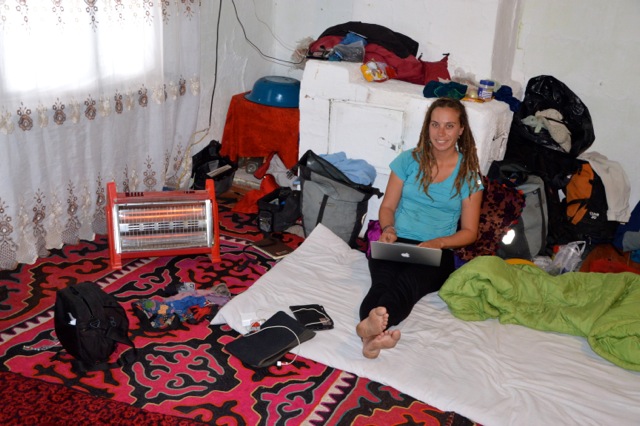
Sary-Tash was hidden by cloud and a cold sleet began to fall on our arrival. Our idea of camping was quickly abandoned when we were offered a room and full board for the equivalent of $4 each. A heater as old as the ancient house was supplied to us and we were glad of its warmth as the sleet turned to snow overnight. A white wonderland captivated us in the morning and I walked around in awe at the transformation that a bit of frozen water can bring to an already stunning landscape. Dark clouds closed in and with heavy hearts we chose to spend another day in Sary-Tash. Cycling the Pamirs has been a long-term dream, and being held back when we were so close was irksome. The disappointment and cold were driven away by our attendance at the local banyan (sauna and washing house) with the ladies of the house. Tomorrow we resolved, would be the day of our departure.

Sheltering from the snow during lunch.

Sheltering from the snow during lunch.

Leaving Kyrgyzstan behind.

Leaving Kyrgyzstan behind.

Excited selfie.

Excited selfie.

No mans land.

No mans land.

Finding shelter from the wind and snow.

Finding shelter from the wind and snow.

Yes it was freezing!!!!

Yes it was freezing!!!!

Snow had fallen again during the night, but the low hanging clouds remained only on the higher mountains. The sun peaked her rays through to us and we knew it was time to go. We had a last coffee at our favourite little restaurant and were slightly delayed by making the acquaintance of many other cycle tourists. They had just come from the Pamirs the night before and were eager to share their experiences and to ask if we knew a place to get some good food. This question would be asked of us time and again by cyclists coming from the opposite direction and we were glad that we had packed all the extra food. The Tajikistan border was a days cycle away and we set off across the valley that we had first entered Kyrgyzstan along.

Delicious tea, bread and homemade Jam is far superior to my Russian language skills.

Delicious tea, bread and homemade Jam is far superior to my Russian language skills.

Looking back at the warm cosy house.

Looking back at the warm cosy house.

Having a rest on the switchbacks.

Having a rest on the switchbacks.

Reaching the top of our first 4000 plus metre pass.

Reaching the top of our first 4000 plus metre pass.

The border!! Country number 10...

The border!! Country number 10…

It was a steady ride, marked by the occasional drunken shepherd on his horse and one lying in the middle of the road. As we approached the far side of the valley, the storm clouds were blown eastward and the view of the road and surrounding 6000m peaks opened before us. It was time to climb. The ascent was gradual and as we ate lunch snow began to sporadically fall again. We crossed the Kyrgyzstan border without incident and returned to climbing through no-mans land. The Tajikistan border was still quite far away, on the other side of our first pass of 4336m, not a distance or height we would be able to reach that day. We collected water from the river we had been following and sought shelter from the constant wind behind the remnants of an old mud brick house. The snow set in as we cooked dinner and I must admit going for a pee that night was one of the coldest experiences ever.
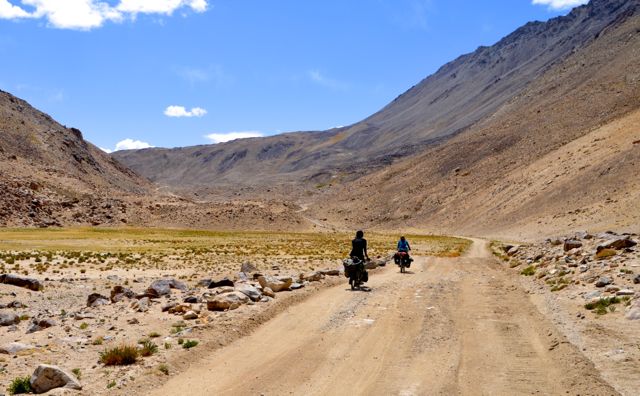
Glacial rivers and snow capped peaks will be our constant companions.

Glacial rivers and snow capped peaks will be our constant companions.

High altitude desert of fun.

High altitude desert of fun.

The change is immediate.

The change is immediate.

Riding the rough roads.

Riding the rough roads.

Collecting water from the freezing cold lakes, lucky we have a filter.

Collecting water from the freezing cold lakes, lucky we have a filter.

"Neutral" territory between China and Tajikistan, despite it being officially Tajikistan.

“Neutral” territory between China and Tajikistan, despite it being officially Tajikistan.

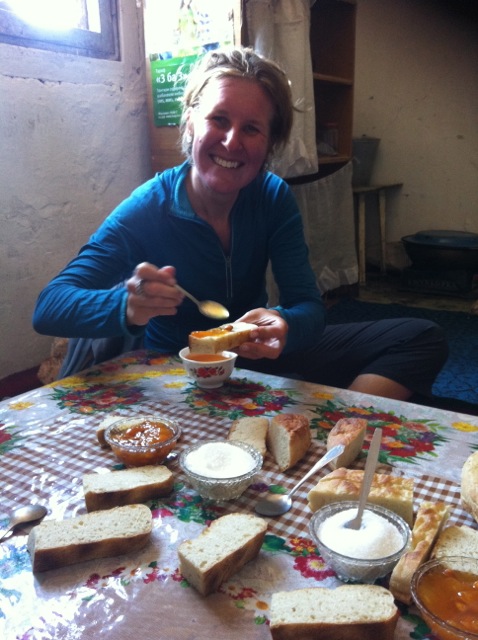
Ten centimetres of snow covered our tents and the landscape when we woke. We estimated that it had been approximately -8 to -10 degrees overnight and the frigid temperatures continued that morning. Our fingers and feet froze no matter what we did and getting ready that morning took us almost 3 hours. The sun provided welcome relief and we were eventually on the road warming ourselves by the energy required for cycling. At the base of some crazy looking switchbacks we came across a house where the family entertained us with tea, bread and homemade apricot jam, and I entertained them with my faltering Russian language skills. I had no idea that people were allowed to reside in no-mans land, but their house was comfortable and warm and it was a pleasure to rest there for a while.

Salt lakes and marshes are can be found throughout the region.

Salt lakes and marshes are can be found throughout the region.

Windswept landscape.

Windswept landscape.

Red marmots.

Red marmots.

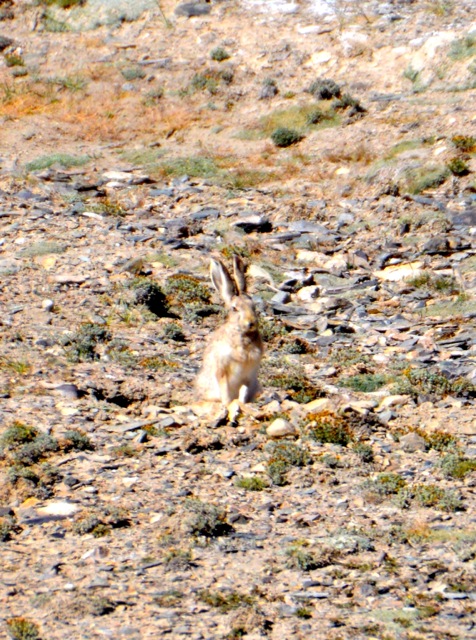
Alpine hares.

Alpine hares.

12 cyclists and 4 cars seen that day, a great ratio.

12 cyclists and 4 cars seen that day, a great ratio.

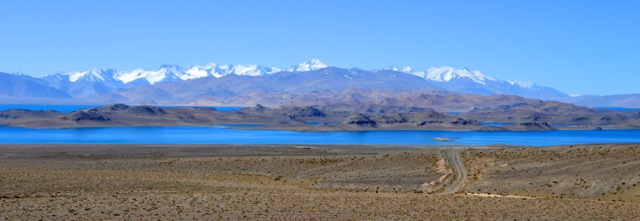
The top of the switchbacks marked the top of the pass and the Kyrgyzstan/Tajikistan border. I was breathless but excited to have made it, being country number ten on our journey and the gateway to the Pamirs. We snapped the mandatory photographs and were super excited to have made it to the top of the first 4000 plus metre pass. Tajikistan’s border post was a kilometer down the other side and could easily have been mistaken for a couple of derelict buildings of insignificance. Friendly guards completed the mandatory paperwork (no computers here) and we were soon on our way to explore the wonders that awaited us. The difference between the Kyrgyzstan and Tajikistan landscapes was immediate. The lush green of the Kyrgyz plains, was replaced by the barren beauty of a high altitude desert. Blue glacial rivers cut through the brownish red rocky valleys, backed by the ever-present snow capped peaks.
Cycling down to the lake.

Cycling down to the lake.

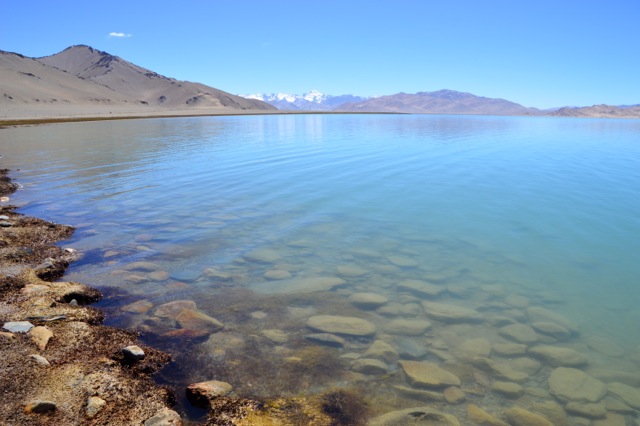
Yes it's really that blue.

Yes it’s really that blue.

Sand and lake.

Sand and lake.

The lake used to be this high at some stage.

The lake used to be this high at some stage.

Collecting the grasses that grow in the marshes.

Collecting the grasses that grow in the marshes.

Our road now undulated through valleys at approximately 4000m and the wind storms created dust towers taller than buildings. Finding shelter that night was a little difficult and the tents were tightly secured with guy-ropes and stones. This was the first night that I would experience the displeasure of altitude induced sleeplessness, my brain behaved like a crazy monkey and for two hours (from midnight until 2am) it ran riot. This phenomenon was to continue nightly until we again slept below 3800m, numerous days later.

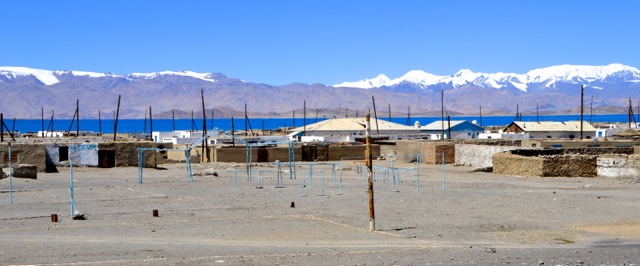
Ghost town.

Ghost town.

Karakol mosque.

Karakol mosque.

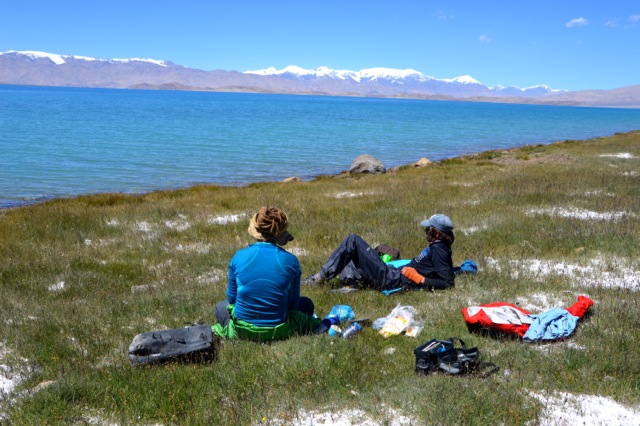
The living is easy.

The living is easy.

If it wasn't for the mozzies I would have gone swimming.

If it wasn’t for the mozzies I would have gone swimming.

Heading away from Lake Karakol.

Heading away from Lake Karakol.

The wind continued in our favour and by mid morning we crested our second pass and were rewarded with views of the iridescent blue Lake Karakol. While waiting for the others I was offered a glimpse into rodent life with red marmots and white hares dashing about. I laughed at the antics of two marmots having a punch-on, as it reminded me of men in pubs. During our descent to the lake we came across many cyclists heading the other way – 12 in all and only 4 cars, a good ratio I believe. Karakol town was located on the far side of the lake and we cycled through sand beds that had once been the lake floor. The fence that had started from the border continued, and Jude let us know that the Chinese had built it (surprise, surprise). The area is now considered neutral territory despite officially being part of Tajikistan and entry is not permitted. I think the locals disagree as holes have been cut in the fence and many of the wooden poles have been removed for use as firewood. In 2011 China claimed 1% of Tajikistan’s land mass in that area as it’s own and I continue to be convinced that water will be the next commodity that wars will be fought over in this region due to climate change and the large amount of glacier fed rivers in the region.
Just cruising with wings of roadside brush.

Just cruising with wings of roadside brush.

The Chinese fence in the Tajikistan desert.

The Chinese fence in the Tajikistan desert.

Heading down into the valley.

Heading down into the valley.

Collecting water is a constant job.

Collecting water is a constant job.

Don't be fooled, it's freezing.

Don’t be fooled, it’s freezing.

A nice afternoon cycle.

A nice afternoon cycle.

Riding into Karakol felt like riding into a ghost town, I could almost hear the banjos playing in the background. We wound our way through the deserted streets and white washed buildings until we reached the lakeside. We spread our goodies on the salt-crusted earth between clumps of grass and as we ate, the mosquitos noticed our arrival and we were soon covered in bites. I had hoped to spend the night camped by the beautiful water but our intruders convinced me otherwise. After a fruitless search for a magazin to replenish our biscuit and chocolate supplies we hit the road again for a few more hours of riding. Exiting a narrow valley we came across a big river and found a derelict building nearby where we set up camp for the night. Neil had collected some dead bushes on the way and Jude collected some old dung so that we could have a campfire. After the initial smoke-out we settled by the fire and enjoyed our view of the stars and the Milky Way.

Collecting scrub and poo for the campfire.

Collecting scrub and poo for the campfire.

Sheltered from the elements.

Sheltered from the elements.

Tea and shoe fixing, all in a nights work.

Tea and shoe fixing, all in a nights work.

Great pastoral land.

Great pastoral land.

The caravanserai of old.

The caravanserai of old.

Yaks!!!

Yaks!!!

The valley we followed was good pastoral land for the area and as such we saw numerous yak herds as we cycled along the riverbank. The path we followed had been an old trade route and caravanserais from centuries past still dot the landscape. Except for the section of dirt road from the switchbacks to the top of the first pass, the road conditions thus far had been reasonable – until now. The corrugations and loose gravel began, bad enough to bring back memories of our time along the Savannah Way. A chance encounter with our friend Dave provided a respite for our shaken bodies and a chance to carb load before the next climb.

The crazy corrugated roads.

The crazy corrugated roads.

More corrugations.

More corrugations.

Looking towards our next challenge.

Looking towards our next challenge.

Having a break with our mate Dave.

Having a break with our mate Dave.

The start of the Ak-Baital Pass.

The start of the Ak-Baital Pass.

Ak Baital Pass was our next challenge, the highest pass on the Pamir Highway at 4655m. It was tough going and I must admit that during the steeper sections I probably spent more time gasping for air than I did cycling. Snow capped peaks looked close enough to touch and they provided welcome distraction from the reality of pedaling a 40kg bike up a gravel road at altitude. Despite the lack of oxygen my inner lesbian had me belting out Melissa Etheridge at the top of my voice and I received a standing ovation from the Austrian motorcyclist who greeted me at the top of the pass. It was more likely for having made it rather than my singing abilities…

Flat is good at altitude.

Flat is good at altitude.

The flatter section of our big climb.

The flatter section of our big climb.

Jude continues to climb.

Jude continues to climb.

The top is further than it looks, especially breathless at altitude.

The top is further than it looks, especially breathless at altitude.

Looking back down from the pass.

Looking back down from the pass.

Neil takes a break at the summit.

Neil takes a break at the summit.

We made it!! Top of Ak-Baital Pass at 4655m.

We made it!! Top of Ak-Baital Pass at 4655m.

Now it was time to enjoy some chocolate, followed by some sweet downhill. As we freewheeled amongst orange, red and brown peaks, I dubbed the area ‘the multi-coloured pyramid valley’. Thinking that we would again be camping that night, Jude and I went for a wash in the river while the sun was still hot. An (un)fortunate German cycle tourist arrived just as we both jumped out and stated that we were the best scenery he had seen all day. Hmm. He also said that he believed the town of Murghab was only 40kilometres away and that he would be cycling there that evening. Inspired by the news, we took a vote and it was decided that we too would push on to Murghab. As the sun began to kiss the horizon, I saw a fox running along a hill and the length of the day unraveled. I was tired. 40km had turned into 55, and we had cycled almost 100kilometres that day including a 4655m pass. Luckily Erali guesthouse was a true home away from home, and after a massive vegetarian feast and many cups of tea, we fell into bed content with the world.

Coming down the mountain.

Coming down the mountain.

Cycling pyramid valley.

Cycling pyramid valley.

Multi-coloured pyramid valley.

Multi-coloured pyramid valley.

The river we were busted swimming naked in.

The river we were busted swimming naked in.

Good roads, great scenery, what more could you want?

Good roads, great scenery, what more could you want?

Reminded me a bit of home.

Reminded me a bit of home.

Looking hot.

Looking hot.

A welcome sight to a tired traveller.

A welcome sight to a tired traveller.

Erali sits at the top of a hill overlooking the town. In the early morning hours I watched the town come to life. People walked or cycled to work, fresh cow’s milk was collected and then boiled in huge pots, a goat was butchered by neighbours, and dogs roamed and scuffled in packs guarding their territory. After a lazy breakfast, supplies for the next leg of our journey were bought at the local bazaar and we eventually commenced cycling at midday. A climb took us out of the valley we were in and after a couple of hours we met up with a group of other cyclists heading in the same direction. Our group of three was now a party of six – our own bike touring gang. That evening we set up camp together in a dry riverbed and as dusk turned to darkness the galaxy opened before us in a spectacular show of stars.

Murghab town.

Murghab town.

The lovely owner of Erali Guesthouse.

The lovely owner of Erali Guesthouse.

Cycling through the back streets of Murghab.

Cycling through the back streets of Murghab.

Out of Murghab.

Out of Murghab.

Back to barren.

Back to barren.

The six meet and cycle.

The six meet and cycle.

New family home group.

New family home group.

What's for dinner?

What’s for dinner?

Under the Milky Way tonight.

Under the Milky Way tonight.

Cycling the next morning took us over a handful of undulations and into a wide valley that cradled the Alichur River. Men and women used scythes to hand cut the grasses that grow in the marshes. It is collected and dried to feed their livestock in the coming winter months when this area is numerous feet under snow. Reports had reached us that a fish lunch could be had somewhere in Alichur, so we searched out the local restaurants but no fish could be found. Instead we had the usual soup, tea and bread (we later found out that the fish is found about 10km earlier at the restaurant next to the sacred blue spring). Just outside of town we spotted a beautiful patch of grass next to the river and an afternoon of fun in the sun commenced. We all splashed about in the freezing water, Didier threw in his fishing line hoping to catch us some dinner, Jude & Jeff went to town and bought some beer to share and we spent a pleasant afternoon and evening relaxing.

The valley opened up as we followed the Alichur River.

The valley opened up as we followed the Alichur River.

Men and women hand cut the grass with scythes.

Men and women hand cut the grass with scythes.

The blue spring where fish can be caught.

The blue spring where fish can be caught.

Collecting water from the local well.

Collecting water from the local well.

Splish splash...

Splish splash…

Camping site luxury, grass and all.

Camping site luxury, grass and all.

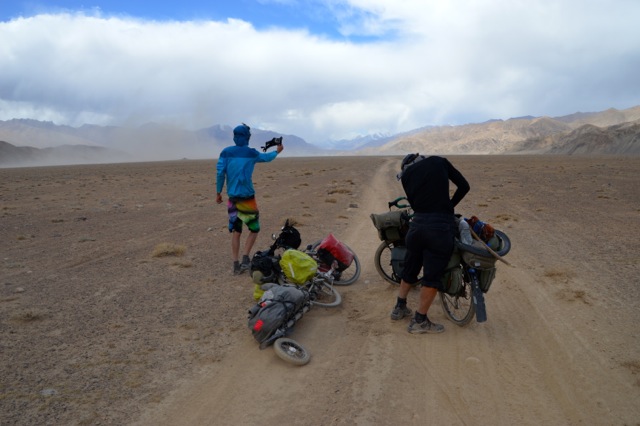
Lake Bulunkul had been suggested as a detour from the Pamir Highway and we were all keen to explore off the beaten track. Yet beaten track it was, a mixture of old 4WD paths that had us wishing for mountain bikes to explore with, as it was awesome! Sparse rocky terrain surrounded the undulating tracks, the occasional salt lake, ramshackle village and river valley added stunning diversity to the scenery. A geyser was marked on the map and it turned out to be a trickle of cold water coming out of a metal pipe in the ground. Cresting to a plateau our maps didn’t match what was in front of us so we headed straight into a gale that blew half of our group over with its strength. 3kms of windstorm and dust tested our endurance to the limit and we sought refuge at some deserted buildings not far in the distance.

Wishing we had mountain bikes to go off trail and explore.

Wishing we had mountain bikes to go off trail and explore.

Into nowhere.

Into nowhere.

Making sure we are going the right way.

Making sure we are going the right way.

Desolate villages, people actually live here.

Desolate villages, people actually live here.

4WD tracks of awesome.

4WD tracks of awesome.

Green and red breaks the rocky monotony.

Green and red breaks the rocky monotony.

Salt lakes of beauty.

Salt lakes of beauty.

Can you spot the cyclists?

Can you spot the cyclists?

Valentina dwarfed by the surrounds.

Valentina dwarfed by the surrounds.

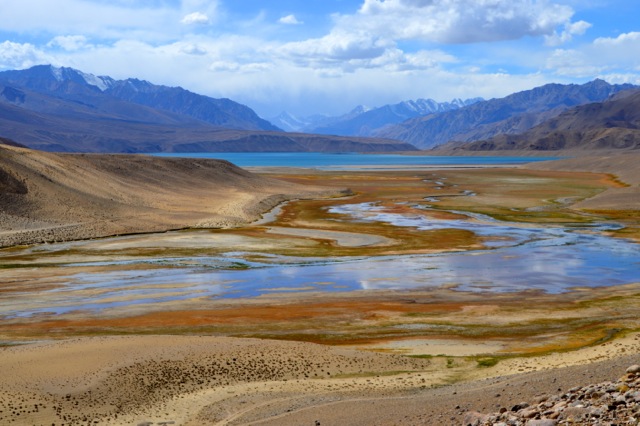
When the dust and wind had settled we walked to the edge of the plateau and were rewarded with views of the glittering Lake Yssykul framed by the rugged mountains of the Tajikistan National Park. Following another track we meandered along the river that joined this larger lake to the smaller Lake Bulunkul. At the lake’s edge we watched as birds skirted and dived into the water hunting for the fish that would be theirs to eat. It was here that we waved goodbye to our new friends Valentina and Didier who were continuing their journey along the Pamir Highway and therefore stopping for the night at Bulunkul town. Thanks for the awesome days together guys and we hope to see you in Switzerland. Jeff decided to join us on our detour to the Wakhan Valley and our threesome became a foursome of fun as we headed south towards the river valley that divides Tajikistan and Afghanistan. A new road and a new chapter in our journey through the Pamirs, and one that Jude will share shortly.

Having a group rest.

Having a group rest.

It's like being on another planet sometimes.

It’s like being on another planet sometimes.

Cycle touring gang on the move.

Cycle touring gang on the move.

Exploring the not so exciting geyser.

Exploring the not so exciting geyser.

Neil filming the dust and windstorm that blew him and Jeff off their bikes in front of me.

Neil filming the dust and windstorm that blew him and Jeff off their bikes in front of me.

The green fairy finds shelter from the wind.

The green fairy finds shelter from the wind.

Prepared for the dust storm.

Prepared for the dust storm.

Until next time,
All my love, Astrid.

The river that joins Yssykul and Bulunkul Lakes.

The river that joins Yssykul and Bulunkul Lakes.

Cycling down off the plateau to Bulunkul.

Cycling down off the plateau to Bulunkul.

Jude and Neil walking to Lake Bulunkul to collect water for the night.

Jude and Neil walking to Lake Bulunkul to collect water for the night.

Neil, Jeff, Jude and I about to leave Lake Bulunkul for our adventure to the Wakhan Valley.

Neil, Jeff, Jude and I about to leave Lake Bulunkul for our adventure to the Wakhan Valley.

China – a refelction

DSC_0883

I wanted to write a piece about China because it is such an interesting country and I have met few people that aren’t fascinated by it in some way. China is well and truly on the western consciousness. Perhaps because many predict it will be the world’s next super power, if it isn’t already. I mean China own a lot of the world’s resources. The tales we get told in the Western media are often negative, human rights abuses, pollution, poisoned baby formula. Certainly the stories I had heard about China alienated me. The distance between the Chinese world and my own seemed immense. And well, there are more than a billion people there, so that’s a lot of people doing things differently. China ended up surprising me in more ways than one and in the end I really loved cycling there. We both did. Here are some of the things that made China great, weird, amusing and at times also frustrating.

The people. It’s such a traveller’s cliché, but the people really made China the experience it was, which was overwhelmingly positive. The Chinese are very hospitable, everyone wants to talk to you, even though most people can’t speak English. We were constantly given food, smiles, waves and were never aloud to pay if someone took us out to dinner. When we were stuck, people went out of their way to help us, often phoning someone who could speak English.

The photos. This gets tiring. Like many places we have visited, everyone wants a photo with the white people on bikes. We began calling this being photoknapped as people would literally pull over on the side of the highway for a photo shoot with us. Other times they would slow right down, an i pad would be hung out the window, a photo snapped and the car would speed off again.

Hot Water. The Chinese have a serious tea obsession. This is wonderful because it means boiling water is available absolutely everywhere. Petrol stations, train stations, trains, and most certainly it is unheard of having a hotel room without a kettle. You get free tea most of the time too.

Toilets. Ah, the toilets. For a country that is developing in leaps and bounds and managed to build the unbuildable railway to Lhasa, they are seriously lacking in sanitation infrastructure. Most of the time you get a wooden floor with a rectangle cut into it. Sometimes this is piled to the top with poo. Sometimes there is poo all over the floor. Sometimes you are literally peeing or pooing into the river below. Pretty gross, although being in Central Asia at the moment has totally desensitised me to even another level.

The food. Chinese food is nothing like the greasy takeaway I knew from home. It’s amazing and diverse and oh so cheap if bought from the street.

The drivers. The driving is terrible. People have very little concept of road rules. Signs and traffic lights appear to be more of a suggestion than anything else. Honking is endemic and it appears to give you the right to drive at people. Also, every single truck will honk at you while cycling. The only time people don’t honk is when they are on silent ninja (electric bikes) that creep up behind you. Ah the logic!

The infrastructure. China is set to have more high speed rail in the coming years than the rest of the world combined. Coming from country that hasn’t seriously updated it’s rail network since early last century, this is awesome. There are so many rail projects. The trains go almost everywhere and are cheap and efficient. It’s impressive how China moves it’s over a billion citizens. Public transport in the cities is also remarkable. Cheap and plentiful. Roads are mostly in great condition. There are often quieter secondary roads as well, especially in provinces like Yunnan.

The paranoia. Far out. It is not the Qing dynasty! Foreigners are not pillaging your land and taking what they want. China, you own the world. Relax. This paranoia refers mainly to the initial visa process (which requires a billion things) and the fact that in many provinces only some hotels allow foreigners to stay. The cheap ones are often only for locals and we sometimes spent hours in the rain looking for a hotel. Plus you are supposed to register within 72 hours of arrival in the country. In some provinces you get moved on when you camp, and have your passport obsessively checked and asked where you will be spending the night. To buy a mobile SIM card you can only go to the larger outlets as only they can register foreigners. Also, needing written police permission to buy fuel for our stove seemed rather over the top. It seems that rules are either ignored or followed obsessively, and as a foreigner it’s difficult to know when either will apply. After months of this it gets a little tiresome. Apparently China wants to become the tourist destination. I feel like a few things would have to change before this happens!

The Environment. Disclaimer: We only went to the least populated provinces of China – Yunnan, Sichuan, Gansu and Xinjiang. China is beautiful and diverse. From the jungles of Yunnan, to high mountains, grasslands, desserts and lakes. China was a lot cleaner and less populated than we expected. The opportunities for cycle touring are almost endless.

The censorship: Facebook, WordPress, u tube and even American tv shows like The Big Bang Theory are considered subversive by the government and censored. Unfortunately a lot of Chinese didn’t know about VPN’s (vertical private networks), which can circumvent some blocks. Fundamentally I think censorship is wrong, however, I think in the west we are censored in a different way. In China it is more overt. Everyone knows the government blocks websites. In Australia (and many other western countries) we are led to believe we are consuming good media, when in actual fact a lot of our media outlets are owned by multinationals with a distinct agenda (Murdoch for instance) which is as bad, if not worse than blatant censorship.

Contrast. China is a land of contrasts. In one minute it is so familiar, so modern, it could be the west. The next it is so alien you feel slightly dizzy. One minute you are surrounded by Chinese tourists with two SLR Cannon’s wearing Northface. The next, you are watching an old man herding goats on a remote mountain pass. China is the future as much as it is the past.

Tourism. After SE Asia where almost all tourism is aimed at foreigners, China is refreshing. SE Asia has ‘white people/foreigner’ prices. China has ‘tourist’ prices. This means all tourists, foreign and Chinese get ripped off equally. Oh and ripped off you get. The entry fee for many attractions is insane. Also, by far the majority of tourists in China are domestic which means even in tourist towns not many people speak English or cater to western tastes (read western cafes and food, usual to most SE Asian tourist towns). This is kind of nice. You also cannot be a student unless you are under 24, despite having a student card. Go figure.

Politics. Due to the language barrier it is hard to get a sense of how people feel in regards to politics and human rights. In Xinjiang you definitely feel the tension after a while. I mean, we were constantly getting our passports scrutinised and the police were everywhere. Most of the time the Chinese and Uyghur don’t seem to mix. It was similar in the Tibetan region, but not as tense. It’s hard to talk to people about these things and you often get very one-dimensional answers.

The parks. Chinese people use their parks and public spaces to the fullest. They really embrace them. Walk through almost any Chinese park or public space and you will see all manner of things; old men in Mao hats drinking tea and playing Majong, groups of colourfully dressed middle aged ladies line dancing to Chinese pop music, ballroom dancing couples, people practicing their instruments or singing, or even a mock catwalk.

The spitting. Perhaps a Chinese cliche but the spitting is intense. For most of the older generation, as well as some of the younger its perfectly acceptable to spit anywhere, usually meaning the street, sometimes meaning the floors of restaurant. While the spitting itself is quite gross, the hacking up of the spit in the back of the throat is probably worse. We once stayed at a hostel where one of the staff would alternate between smoking and hacking/spitting, pretty much the whole day. I have been assured that spitting is seen as not cool by the most of the younger educated generation and that it is fading out slowly as being sociably acceptable.

Coffee. A true tragedy. The Chinese don’t get coffee at all. I sampled some truly heartbreaking attempts in my 3 months in China. And the supermarkets only ever stock Nestle. Sad, sad, sad. I’m sure this is different in the big cities.

The cyclists. China has a growing middle class and on any given weekend you will find groups of Chinese on cycle trips. They all ride Giant or Merida bikes and took great delight in chaperoning us. This inevitably  always ends in a photo shoot. Cycle touring is also growing in popularity. Chinese cycle tourists never have rear panniers and always appear to be wearing all their clothes, even in the desert.

The staring. The Chinese are a nation of starers. Well, at least that was our experience. Opened mouthed, wide eyed, unabashed staring at the foreigners on bikes, or just walking around. One lady stared so intensely she nearly fell of her bike. I don’t think they are meaning to be rude, it’s just part of what they do. It’s not creepy either, in the way we get stared at by some men in other countries. Chinese men haven’t been sleazy really at all, which is saying a lot because almost everywhere else they have. The women stare just as much as the men do.

Strangely, the Chinese reminded me of American’s in some ways. In the way that some American’s can be very inward looking and insular, consumed by their culture and perceived central location in the world with very little knowledge of what lies beyond their borders. The Chinese can be like this too and the similarity is obvious. They too live in a large, populous country, with a fierce cultural dogma and are insulated in a lot of ways from the rest of the world. An example of this was when a girl in the mobile phone shop couldn’t comprehend that my phone wasn’t in Chinese, or when it is assumed that if you can’t speak Chinese, you must be able to at least read Chinese characters!

DSC_0499

The Remote Valleys of Kyrgyzstan

Bishkek to Osh via Issy Kul Lake and the Central Mountains

DSC_0209

Lake Issy Kul  

DSC_0289

Bidding farewell to our new friends at Nomads Home we cycled to the ‘bus station,’ which is a slightly misleading term in Kyrgyzstan. Sure, there is bus station and normal sized buses do leave from there, but by far the majority of transport is private cars and mini buses, which leave when full (or you pay for the whole vehicle). Obviously this presents a problem to the budget traveller with a bicycle. And of course we would rather have cycled the whole distance but due to needing to get visas in Bishkek and the weather in the Pamirs, some compromises needed to be made. Our plan was a leisurely cycle back to Osh. Unfortunately we were soon to come face to face with the true nature of Kyrgyzstan’s ‘roads’ and our trip would be anything but leisurely.

DSC_0216

Cycling down to another awesome camp spot

DSC_0255

Kids hang out on donkeys instead of bikes here!

After some negotiations we managed to secure a car for a reasonable price and were whisked off to Karakol, a town on the eastern edge of Lake Issy Kul. The drive was predictably nerve wracking. The Krygyz are yet another population of crazy drivers. We found ourselves deposited on an immense lake, shining a brilliant blue in the sun and surrounded by snow capped peaks. The area is popular for hiking and horse treks and we enjoyed watching a group of returned hikers shot vodka and dance to Russian pop music while having dinner. I kind of wanted to join in as they looked like they were having a lot of fun.

DSC_0253


DSC_0270

 The next day we packed up our tents and headed closer to the lakeshore. After months of sleek Chinese roads and the deserted roads we first encountered in Kyrgyzstan, we were in for a shock. The road around Issy Kul is narrow and badly paved, the traffic fast and drivers careless (and often intoxicated). Taking advice from cycling friends we met in Lao (Alleykat) Astrid and I secured big sticks to our bikes with a big red cloth on the end. This made the drivers take notice and give us enough space. As we got closer to the lake, we decided we would turn off and try and find a place to camp near the water. Some local kids on bikes helped us negotiate the back roads to the lakeshore. Unfortunately it was full of families, volleyball and music. Not really what we had in mind. However, after some bush bashing we managed to find a quieter spot and settled into a relaxed afternoon of swimming, reading and napping. After China, it felt like we were on holiday.

DSC_0183

Flag protection from the terrible drivers


DSC_0186

Local kids show us the way


DSC_0202

Sunset lake Issy Kul. The holiday vibe is alive!

The holiday spirit continued the following day, we stopped for lunch at a Kafe and then made camp on the lake shore again. It was more remote now and only a few people came down to swim in the afternoon. Taking a leaf out of the locals book, we shared some vodka ($2 a bottle!) and watched the sky turn a brilliant orange. Some boys joined us and enthusiastically built a fire. Life was perfect. We hadn’t cycled far but felt that this was okay, our target was only 55km a day and we could easily cycle more than this if needed. Or so we thought.

DSC_0243

Another night on the lake with some locals.

DSC_0241

More amazing sunsets..

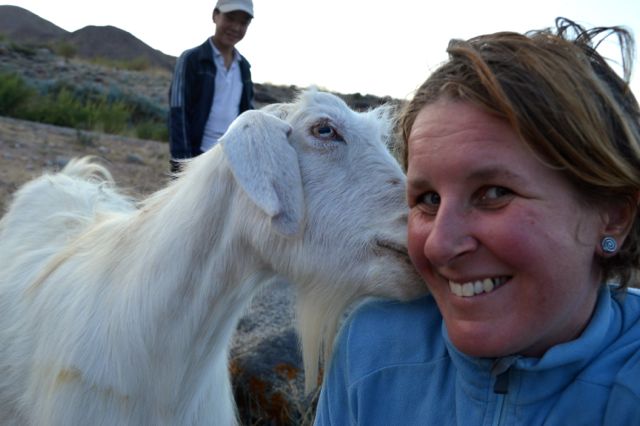
The day started with an early morning swim, followed by cups of tea and eventually we packed up and cycled the short distance to Barskoon. Here we met up with Jan, a friend from Nomads Home. We had some lunch and coffee and eventually hit the road again, our panniers bursting with food for the next leg. After another 20km cycling along the beautiful lakeshore, resisting the urge to make camp and go for a swim, we turned off and headed south. This was the road that would take us from around 1600m to 4000m in 30km. Well, we thought it was the road. Our map said so but google maps was silent on the matter. We decided to chance it. From here the road deteriorated significantly. It was now a rocky stone path, following a river up a valley. Not long and we were climbing, then pushing our bikes. It reminded us a bit of the Savannah Way. After only 3km (in 1.5 hours) we stopped and made camp high above the river. While cooking dinner a young boy herding his goats and sheep came passed. He had one goat that was his obvious favourite and it was very tame. It cuddled up to him and when we shared out biscuits with him, he in turn shared them with his goat. Later we made a fire and the shepherd boy came back down and gave us gifts of ‘Keffier’ (yogurt) and delicious Apricot jam. So much kindness.

DSC_0246

A quick catch up in Barskoon

DSC_0266

Our first night on the road to Naryn 

DSC_0261

Selfie with the friendly goat

The climbing continued up the rocky, narrow road. In the distance we could see the icy gleam of the glaciers and the pass. After a few hours (but not many km’s) we found ourselves in a wider valley where we sat ourselves down on the soft green grass beside a crystal clear river. This was paradise. It was also where the road forked. Luckily we found a few people to ask and it was confirmed that we were indeed on the correct road to Naryn. Upwards we continued to go, sometimes cycling, sometimes pushing, sometimes falling off. Switch back after switchback, we climbed passed nomads with their animals, yurts and slightly intoxicated locals riding their horses (with the wife on the back) to some remote mountain dwelling. I sure wished I could trade my awkward heavy bike for a nimble mountain horse a few times!

DSC_0269

Which way to we go?

DSC_0278

Everywhere is beautiful 

DSC_0279

DSC_0274

Intoxicated local takes his wife home on a horse

With Neil’s encouragement we have become even more tea obsessed and take every opportunity to brew a cup. While we were enjoying a break and a cuppa, a family in a 4wd pulled up. Their son spoke excellent English, making sure we were okay and then gifting us fresh (made that morning) butter, and eggs. We had a delicious lunch. Some Western motorcyclists also stopped, giving us valuable information about the road ahead (it was going to get worse) and details about a good place to camp.

DSC_0354

The nomads are always friendly and curious

DSC_0281

DSC_0275

Some motorcyclists give us advice on the road

 We continued on and the altitude began to affect me, mainly because I was a bit sick. I found myself stopping every few minutes and just wishing I could lie down. Finally after what seemed like eternity, Neil came towards me on a horse! He offered me the horse in exchange for the green fairy, a good deal for me. I rode the remaining short distance to our camp and it made me realise I miss horses and riding a lot. The horse had come courtesy of some nomad children who watched us set up camp and later came down to share some Kemez (fermented horse milk) with us. It’s the national drink of Kyrgyzstan and the Kyrygz seem to love it and drink it in huge quantities. I thought it was okay in a small dose. A very small dose.

DSC_0292

Neil comes to help find me on a horse 

DSC_0294

This is a good deal for me. It feels like home.

DSC_0296

Our camp spot, the glaciers don’t look too far away now..

Morning brought hot tea as the sun slowly came over the mountain, illuminating us and the glaciers not so far above. The extremely slow ascent continued. We were basically hiking with bikes as large boulders obscured the road. It was like trying to cycle up a dry river bed. At times two people were needed to push the bikes up a particularly steep section. Finally, after hours we reached the top, the glaciers were so close now. We could here them crack and groan in the sun, rocks occasionally avalanching down to earth. It was just ice and rock up there, stark and beautiful and somehow very alive. After some time resting and staring at glaciers we were joined by an eccentric German on a girls bike (basket and all). You meet all kinds of people on the top of 4000m passes!

DSC_0297

DSC_0306

Oh yes they are YAKS!!

DSC_0312

The glaciers get closer.. 

DSC_0314

And we push up and up..

DSC_0317

The descent was predictably rocky (I spent a lot of time pretending I was on a mountain bike, probably going way too fast) and the valley that opened up before us was just about the most beautiful thing I had seen. I thought the valley we had just cycled up was amazing, but this just took it to a whole new level. Alpine grasslands stretched out before us, dotted with yurts and horses. A huge river cut through the landscape and immense snow capped mountains towered above us. Every view was breathtaking. After another hour or so and a whopping 18km total for the day, we made camp beside a small stream on some soft grass. As I lay in the tent later on, the light fading, I could hear the thunder of the semi wild horses hooves as they galloped across the grass just behind the tent.

DSC_0320

The top of the pass is beautiful

DSC_0324

Relieved to have made it!

DSC_0330

And on the other side the view is equally awesome!

DSC_0333

Down we go..

 We woke to frozen water bottles and ice on the tent. Hot tea and porridge soon sorted us out and we hit the road in high spirits. Although slightly better, it was still slow going. The road had been washed away in many places and more than a few icy river crossings were encountered. We also came across many cyclists; some on self supported tours, some on mountain bikes and one group that was racing. A few ancient 4×4 Lada’s also rattled by, but all in all we had the road mainly to ourselves. In the afternoon the landscape changed and we entered a dry rocky canyon, and made camp high above the river.

DSC_0334

A few cold river crossings!

DSC_0336

A stunning camp spot yet again 

DSC_0339

DSC_0344

By the next day our supplies were running low and we all began to fantasise about the Magazin (shop) that we knew lay ahead. Unfortunately it was Saturday and no one felt like opening it. We continued on. Being lower now, it began to get warm and we stopped to dip in the freezing water to wash. We were all rather smelly. After a morning of undulating through the canyon we entered yet another breathtaking valley, villages and snow capped mountains on the horizon. It was about this time that the green fairy decided to get a flat. While fixing it, a lady invited us in for ‘chai’ (tea). We happily accepted, curious to see what the inside of the houses looked like and grateful for the offer of tea. Well, it was here that we learnt that chai actually means EVERYTHING. Bread, fresh cream, homemade jam, Kemez and actual tea. It was amazing and delicious. We were then shown around the house and we got a sense of how cold it must get in winter. The walls were thick mudbrick, the insides lined with carpets, the windows double panned. The houses were old, electricity an obvious later add on, but the building quality was impressive. Finally we bade farewell to our host and her family and headed to the small magazin in town. By now the road had improved and we made good time down the valley.

DSC_0351

DSC_0381

The landscape slowly changed as we dropped lower – christmas trees!

DSC_0380

DSC_0384

This was our afternoon swim/wash 

DSC_0394

This lovely lady invited us in for chai and showed us around her home

Just as dusk was beginning to hint at her presence who should we come across but Remi and Rebecca (who we had met in Osh) cycling the opposite way. A reunion ensued and we quickly made plans to camp together that night. Being Kyrgyzstan it took about 5 mins to find a sheltered camp by a stream and it was here we sat, talking and cooking and sharing stories from the road.

DSC_0406

Reunion!


DSC_0393

With warnings about the quality of the road ahead (and the awesomeness of the views), we left Remi and Rebecca and headed the short distance into Naryn, a medium sized town. Another great aspect of travel in Kyrgyzstan is CBT (community based tourism) which offers a network of homestays and other services. In Naryn they have an office offering free wifi and advice from the tireless Gulvira. It was here that we came face to face with fact that we had been unable to do enough kilometres as well as the poor nature of Kyrgyzstan’s infrastructure. And the “Green Mumba” (aka a South African passport). Poor Neil is one of the only nationalities that we know of that needs a visa for Kyrgyzstan. As he only had a one month visa (as apposed to our 60 or even 90 day entry stamp) and the fact that our Tajik visa’s were starting soon, we did not have enough time to cycle on the apparently mostly awful roads back to Osh. We then found out it was going to cost us over US $100 to cut off the worst 200km. Ahhhh! After some discussion we conceded to taking the night bus to Bishkek and then a car to Osh. It was going to be 24 hours of travelling hell. That night however we stayed at Gulvira’s lovely flat because all the other homestays were full. She was wonderful and it was great to get to talk to someone about life in Kyrgyzstan.

DSC_0373

After a day of catching up on emails we boarded the night bus for Bishkek. Predictably we had to argue over the price of the bikes (even though there was hardly any luggage in the bus) and Gulvira once again came to our aid. The bus ride was a bit uncomfortable and we arrived bleary eyed back in Bishkek. It was still really early and the only driver we found appeared to be drunk (or so fatigued he seemed drunk) so we decided to wait it out with coffee (and hope for a Muslim driver who wouldn’t be drunk!). Lucky we did. Soon a man came and found us, a reasonable price was negotiated and our bikes were loaded onto the roof. Soon more passengers where found and then we left for Osh. Our driver was a Muslim and a true legend. Not only was he a careful driver, he also lent us money (as we had been unable to get any out) and treated us like family. In fact, the whole atmosphere in the car was one of instant family. The drive itself is long, hot and cramped (and I really don’t want to do it ever again) but the people do make up for the discomforts. Once in Osh our driver even rang the Guesthouse (as it was really late) to make sure we had a place to stay.

DSC_0391

We bade farewell to our friendly companions and cycled the short distance back to TES Guesthouse and predictably headed straight for the beer fridge. It had been 24 hours on the road without sleep but we had arrived. The Pamir Highway was only days away..

Love Jude

PS: Check out Neil’s video of this part of the trip to get a sense of what it was like. It’s a really cool short film: https://www.youtube.com/watch?v=VZ7veqrIMS8&list=UUC0n_A3NZwaTSsIMx7jipng

DSC_0249


Arriving in Paradise.

Kashgar -> Irkeshtam -> Sary-Tash -> Osh -> Bishkek.

Paradise found, Astrid looking at the stunning view. (Photo by Neil @ H2Htrip.com)

Paradise found, Astrid looking at the stunning view. (Photo by Neil @ H2Htrip.com)

The road signs were all now in Mandarin, Uighur, English and Russian.  It would be two days until we crossed the border into Kyrgyzstan, yet the excitement of a new country filled us with energy.  There are two international border posts near Kashgar, the Torugart Pass – stunning and stunningly expensive due to Chinese permit requirements, and Irkeshtam where the Chinese border checkpoint is in Ulugqat – 142 kilometres from the actual border.  As I have often said, things in China are rarely based on logic.  We chose Irkeshtam and pedalled out of Kashgar early in the morning hoping to make it to somewhere near Ulugqat.  Two days earlier as we cycled the last 20kms downhill into Kashgar, we expressed our dread at the 20km backtrack to the turnoff.  Funny how after some rest, what we thought would be a painful climb was now a quick morning cycle.  Since Google Maps last visited the area, a new road (an extension of the ‘dirty 30’) has been built – right through the centre of many small Uighur villages.  As usual the road has been fenced with barbed wire and trying to get off the road to purchase food and drinks was difficult.  So too was getting back on, therefore we cycled along the secondary road for a while and just as we found an entry ramp the skies opened up and it started hailing.  While golf ball sized pieces of ice fell from the sky, we scrambled down an embankment to sit it out in a irrigation tunnel.  Now we had experienced it all – searing heat to constant rain, dust storms to hail storms.
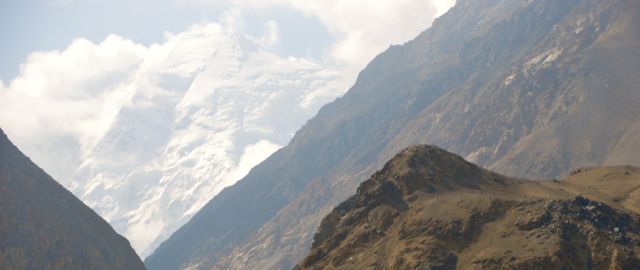
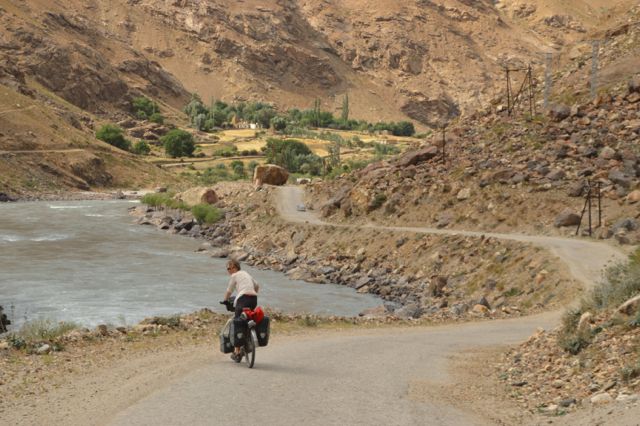
Cycling out of Kashgar.

Cycling out of Kashgar.

Signs in Mandarin and Uighur.

Signs in Mandarin and Uighur.

Watching the rain clouds come over.

Watching the rain clouds come over.

Our last campsite in China.

Our last campsite in China.

Neil keeps the fire stoked to cook dinner.

Neil keeps the fire stoked to cook dinner.

That evening as we sat watching the rain storms roll in over the mountains, the last of our stove fuel ran out (thanks to the petrol paranoia) and dinner was cooked on a fire that had to be constantly tended to.  Our love for China was waning and the next day it was skating on thin ice.  First there was the final flat tyre on the ‘Dirty 30’ 2 kilometres from Ulugqat; at the checkpoint we were to discover that they had banned hitching rides in trucks to the border; now we had to hire two taxis (at twenty times the price of a truck) to the border so that our three bikes would fit; the officials at the checkpoint sat us in a waiting room for over an hour for an unspecified reason; they wanted to x-ray all our gear and bikes before leaving but didn’t look at the screen (we refused to dismantle the bikes to put them through the machine); our driver displayed the usual fantastic driving skills that all Chinese seem to possess (most of our trip was spent on the wrong side of the road); when we made it to the actual border the officials were on their three hour lunch break; and after spending an hour sitting around, approximately 50 metres from the crossing, our driver raced to the border and gave us less than five minutes to unpack our bikes and gear and put them together as he had to hand in our paperwork.  By the time we had cycled the five kilometres through no-mans land we weren’t sure what to expect on the other side, but it had to be better than what we had left.  And it was!

Cycling the road to Ulugqat.

Cycling the road to Ulugqat.

Waiting for an unknown reason - better eat a peanut butter sandwich.

Waiting for an unknown reason – better eat a peanut butter sandwich.

Yep, that's two bikes in the boot of the taxi.

Yep, that’s two bikes in the boot of the taxi.

The last of the dry barren hills for a while.

The last of the dry barren hills for a while.

Waiting for the border guards to open the gate after their 3 hour lunch break.

Waiting for the border guards to open the gate after their 3 hour lunch break.

Cycling through no-mans land, hoping for things to get better.

Cycling through no-mans land, hoping for things to get better.

Kyrgyzstan is paradise.  The change is immediate.  The landscape is no longer a barren desert with brown hills, but green fields and rivers surrounded by snow capped peaks.  You can actually drink the water from the streams.  You can buy petrol without needing a permission slip from the police.  You can camp wherever you want – so we did.  After purchasing some fuel from a small village about 5 kilometres from the border, we pedalled up a hill and decided that our first camp in Kyrgyzstan should be on an open grassy plain with a view of all the mountains surrounding us.  We celebrated with cups of tea and a hearty dinner.  Basking in such beauty we couldn’t keep the smiles off our faces.

Passing the caravans that surround the Kyrgyz border post.

Passing the caravans that surround the Kyrgyz border post.

We loved Kyrgyzstan from the moment we arrived.

We loved Kyrgyzstan from the moment we arrived.

Celebrating Paradise.

Celebrating Paradise.

With views like this from our campsite, how could we not love it here...

With views like this from our campsite, how could we not love it here…

Sunrise on our first full day of cycling in Kyrgyzstan.

Sunrise on our first full day of cycling in Kyrgyzstan.

Sary-tash is the closest big village to the border and our next place to pick up food supplies. Being only 80 kilometres away we assumed we would be there by the next afternoon.  Kyrgyzstan would teach us that our perception of our cycling speed and distance would need some serious adjusting.  Xinjiang had been relatively flat and over the last month we had lost our ‘hill legs’.  This too would need some serious work which we discovered as soon as we set off in the morning.  We undulated over hills, down into valleys, just to climb back up the next hill.  The gradients were steeper than anything we had encountered since Laos, usually about 9% for all you cyclists and engineers.  Altitude was also playing its part, as we had climbed while driving the 142km to the border.  As our legs and lungs burnt, our eyes feasted on the never ending grandeur of the countryside.  The snow capped 6,000m peaks that border with Tajikistan were on our left, rocky smaller peaks to our right, a red river below us and green rolling hills between.  By lunchtime we came to the end of a climb that had been going on for a couple of hours.  From here we sailed down into a grassy valley dotted with yurts and animals.  The summer life of the nomads was in full swing as they rode their horses and donkeys, herded their livestock and milked their horses to make the country specialty – kumuz (fermented mares milk).  Greetings were exchanged with everyone we met and the kids were super excited when we passed by.

Perfect cycling road!

Perfect cycling road!

The red and blue waters of river ways combine to make a good fishing spot.

The red and blue waters of river ways combine to make a good fishing spot.

Rolling green hills surround us.

Rolling green hills surround us.

The yurts of the Kyrgz nomads.

The yurts of the Kyrgz nomads.

View to our right.

View to our right.

And the view to our left.

And the view to our left.

Jude is just about to reach the top of the long morning climb.

Jude is just about to reach the top of the long morning climb.

By mid afternoon it was decided that we were in no hurry and that a grassy patch next to the river looked particularly inviting.  I also had some bike maintenance to attend to – my chain was sounding as if it was about to snap and my rear breaks weren’t working.  The tents were pitched and we settled in to the slow life.  More cups of tea, some tinkering with the bike, some reading and writing, some staring at the scenery and more cups of tea.  Heavenly.

Astrid loving it here.

Astrid loving it here.

The road is shared by bikes, donkeys, herd animals and the occasional car.

The road is shared by bikes, donkeys, herd animals and the occasional car.

Nomad's yurt and livestock.

Nomad’s yurt and livestock.

Friendly locals and Russian tourists.

Friendly locals and Russian tourists.

Many children request to have their photo taken.

Many children request to have their photo taken.

Time to stop for the day and enjoy the scenery.

Time to stop for the day and enjoy the scenery.

Our homes.

Our homes.

Morning life in Sary-tash was just kicking off as we rode in.  Needing supplies we stopped at the first magazin (what they call the local shops here) and squealed with delight at all the produce we could buy.  Cheese, they actually had cheese!!!  Now I knew we were in paradise.  It would be another few days until we reached Osh and we didn’t know about the availability of food along the road, so we stocked up on all the staples and a few extra treats – yes cheese and chocolate are back on the menu.  Then it was time to find second breakfast.  A little restaurant on the village outskirts was the only place open and fortunately the ladies cooking was excellent.  We had been warned prior to coming that the meals in Kyrgyzstan were meat heavy and they weren’t wrong.  Stew of mutton, dumplings with mutton or plov (rice with mutton).  My inner vegetarian wasn’t sure what to do.

Cycling into Sary-Tash.

Cycling into Sary-Tash.

Everyone has their own cycling gear and style.

Everyone has their own cycling gear and style.

Paradise found - CHEESE and SALAMI!!!

Paradise found – CHEESE and SALAMI!!!

Two passes awaited us as we pedalled out of Sary-tash, the first at 3550m and the second at 3615m.  A dog from the restaurant had decided to join us and he enjoyed himself padding along side our bikes and then chasing birds and critters in the fields next to us.  Watching him run with unadulterated joy and abandon, it reminded me of how I feel cycling.  By the time we had reached the first pass we were over 15km from Sary-tash and the dog was still showing no signs of going home.  Luckily, as we sped down the hill we were able to wave goodbye to our four legged friend who couldn’t keep up.  The next climb was easier and 200 metres from the top a truck waved me down and offered us a lift first to Osh and then to Bishkek.  I was hesitant initially but when the others arrived we made a group decision to catch a ride to save ourselves riding the same route twice (we will return this way to cycle through Tajikistan).

Jude's excited to reach the top of the first pass.

Jude’s excited to reach the top of the first pass.

A mare being milked so 'kumuz' can be made.

A mare being milked so ‘kumuz’ can be made.

Our four legged friend taking a rest at the top of the pass.

Our four legged friend taking a rest at the top of the pass.

The truck that pulled over and offered us a lift to Bishkek (almost).

The truck that pulled over and offered us a lift to Bishkek (almost).

Mohamed helped us to load our bikes in the back and we jumped into the most deluxe truck cabin I have ever seen.  I must admit that if it wasn’t so luxurious I would have been more upset about the fantastic downhill we were missing.  When Mohamed stopped for prayer time we had a wash in the river next to the mosque, an hour later he pulled over and made fresh Brazilian coffee for us, we abused the police when they pulled him over just to collect a bribe (police corruption is huge here), and an hour out of Osh he out manouvered us by buying a melon and Snickers for us when we wanted to get him a watermelon to eat that night when his fasting ended (due to Ramadan).  Unfortunately Mohamed was heading to Bishkek, just not for a few days. So we had him drop us off at the turn-off just before Osh and after Jude turned down his second marriage proposal (don’t tell people in Central Asia you’re not married), we pedalled into town to enjoy some R&R city style.

In the luxurious comfort of Mohamed's cabin.

In the luxurious comfort of Mohamed’s cabin.

Cycling into Osh - yes Jude is swerving to avoid being hit by a car despite having right of way..

Cycling into Osh – yes Jude is swerving to avoid being hit by a car despite having right of way..

Relaxing in the local park.

Relaxing in the local park.

Osh bazaar where you can buy anything from a shipping container.

Osh bazaar where you can buy anything from a shipping container.

Relaxing with other travellers at our favourite outdoor restaurant.

Relaxing with other travellers at our favourite outdoor restaurant.

After the soulless mega-cities of China, Osh was a breath of fresh air.  Old buildings stand side by side with Soviet era greyness, people swim in the river that runs through the centre of town, couples walk in the shade of tree filled parks and children play on the footpaths.  The bazaar is made from shipping containers and it’s bustling with people buying and selling everything from spices to t-shirts with the Kyrgyzstan flag, the most delicious pecans in the world to the handmade felt hats that the local men wear.  Men and women sit on day beds in outdoor restaurants drinking cold beers while shashliks are being barbequed over coals nearby.  Women sit on the side of the road with big kegs of iced tea, kvass or kefir, and locals stand around drinking it to provide relief from the heat of the day.  Mashutkas (the local minibuses) are the only things that seems to be in a hurry here and the pervasive feeling is one of relaxed calm.  We spent our days chatting with other travellers in the rose lined garden of the TES guesthouse, wandering the bazaar, swimming in the river, and drinking cold beers and eating shashliks at our favourite restaurant in the local park.  As the song goes ‘Summertime and the living is easy’.

Locals swim in the river.

Locals swim in the river.

So do we.

So do we.

Camping at the TES guesthouse.

Camping at the TES guesthouse.

Neil checking that the bikes are secure on the roof.

Neil checking that the bikes are secure on the roof.

Views from the road.

Views from the road to Bishkek.

While in Osh we made a plan for our remaining three weeks in Kyrgyzstan.  Visas needed to be applied for in Bishkek and as most of the ones for Central Asia are date specific we needed to map out the next few months too.  It was decided that we would catch a shared minivan to Bishkek to get all of the admin stuff sorted and then we could skip over to Karakol, a town on Lake Ysyk-Kol, and from there we would cycle back to Osh and then on to Tajikistan to cycle the Pamir Highway.  The following morning we squeezed into the minivan with four others and a baby, our luggage piled in the back and our bikes strapped to the roof.  Bishkek was a whole days drive away and from the backseat we would learn that the drivers here are crazier than the ones in China.  For 12 hours we sweated in the back, our legs aching from not moving, wishing we were cycling through the stunning countryside that we were passing by at breakneck speed.  But we made it and that night we pitched our tents in the backyard of Nomad’s Home guesthouse, the place we would call home for the next five days.

Camping at Nomad's Home.

Camping at Nomad’s Home.

Jude celebrates COFFEE!!

Jude celebrates COFFEE!!

Excited by the care package send by Heide - dried food for the Pamirs, chocolate and more!!

Excited by the care package send by Heidi – dried food for the Pamirs, chocolate and more!!

Rest day coffee break.

Rest day coffee break.

Bishkek is a fun, vibrant city that we cruised about exploring on our bikes.  Grey soviet buildings are hidden by the myriad of parks that dominate the city.  The errands we had to perform found us cycling through all parts of town, bouncing our bikes along the back streets in desperate need of repair, the houses reminding us of the older suburbs in Melbourne.  After spending the last 11 months in Asia it was nice to again somewhat blend in with the locals, as the population of Kyrgyzstan cities are as culturally diverse as those of home.  Being Eid al-Fitr embassy opening times were changed and luckily we still managed to procure our Tajikistan visa.  To enter the Pamir Highway requires a different permit (a GBAO) which normally corresponds with your visa dates.  Unfortunately the embassy was only issuing one week long GBAO permits at this time (later that week it was only 5 days or not at all).  The route we want to cycle will take us at least three to four weeks so we have employed an agency to help us procure a longer permit – we will only find out the length in 10 days time.  Besides running errands and catching up on all the little things (like this blog) we have spent a good amount of time just relaxing and hanging out with other travellers.  It really feels like a home away from home, another reason Kyrgyzstan continues to be paradise.

Street art.

Street art.

Cheeky beers at Steinbrau.

Cheeky beers at Steinbrau.

Chilling out with other travellers.

Chilling out with other travellers.

Mika cuts the locks off - best haircut ever (Thanks Mika!).

Mika cuts the locks off – best haircut ever (Thanks Mika!).

Tasty homemade treats.

Tasty homemade treats.

More cycling in paradise to come (yes that's Jude!). Photo from Neil @ H2Htrip.com

More cycling in paradise to come (yes that’s Jude!). Photo from Neil @ H2Htrip.com

The shifting winds of Xinjiang

Dunhuang to Kashgar

DSC_0844

Xinjiang sits in the far west of China, a province dominated by desert, skirted by momentous mountains and filled with ancient tales of the silk road traders. Culturally it is barely China at all, populated mainly by the Uyghur minority, a Turkic people from Central Asia. They look different from the Han Chinese, speak a different language, their food is different and most follow Islam. There are tensions between the Uyghur’s and the Chinese government which have often spilled over into bloodshed in recent times. While I won’t go into the politic’s any great detail, I will say it is here that we began to feel the force of Chinese paranoia, insecurity and control. From being moved on by the police, seeing security camera’s in Uyghur towns, barred petrol stations, x ray machines in shopping centres and having our passports scrutinised on numerous occasions.

Screen Shot 2014-08-01 at 7.05.02 PM

The Northern Silk Road

We left the oasis town of Dunhuang with a heavy heart, at least I did. The break had been wonderful, almost too wonderful and it was hard to get going. I was having a rare blue day, where I missed my friends and family a lot. Cycling however, often makes things better. There is something about being on the move that clears the soul and lets the light back in. At first we pedalled passed lush vineyards, crops and the small mud dwellings typical of this part of China. This soon gave way to the starker, dry desert landscape full of bare brown hills. As the afternoon wore on the lovely tailwind suddenly turned and violently spun in our faces, dark clouds flying towards us. A sign of things to come. Quickly we pushed our heavy bikes behind some hills and made camp.

DSC_0474

The next day saw a rainy morning that had us sheltering in a petrol station. It was also the first time we had to give i.d. to buy petrol for our stove. Another sign of things to come. Once the rain had become less torrential we ventured out onto the G30, the main highway, as there were no more secondary roads. Luckily the road is smooth and the shoulder wide, and the trucks not too annoying. That afternoon we cycled over the border, out of Gansu and into Xinjiang, our last province in China. The landscape was desolate, marred by powerlines, and strangely, a never ending barbed wire fence. Why fence the desert? It was particularly annoying for us as we had to keep cycling until there was a break in the wire and awkwardly manoeuvre our bikes through to find a place to camp.

DSC_0469

Fencing the desert..

DSC_0471

Wind farms in the desert. They may offend Joe Hockey, but we love them.

We thought the previous morning had been wet, but now it poured. After Astrid fixed her flat we pushed our bikes up onto the highway, already wet and exhausted. Heavy fog descended and our visibility was at about 150m. Crazy desert cycling! Eventually it lifted and we slowly dried out. For lunch we stopped at a truck stop, these desolate outposts reminded us of a run down version of the Australian road houses we had seen during our outback leg. They serve immense plates of noodles for about $2, perfect for a ravenous cyclist. The food almost makes up for the human excrement found scattered on the road around these abodes, as it seems truck drivers do not like to bury their poo. Looking on the bright side, it did lead to the invention of the game ‘dodge the poo’. Due to the barbed wire it was difficult again to find a place to camp and we had to make do pitching our tent behind a dirt embankment, not far from the noisy road. Still, it was the first clear night we had had in ages and the sky was amazing.

DSC_0466

Is this the desert?!

DSC_0451

The rain approaches

DSC_0457

One of our camps

The following morning we pedalled into Hami after experiencing the most amazing bread, being gifted cucumbers and having two flats. It only took us 4 hotels to find somewhere affordable to stay and this became our home for the next three nights. It was only supposed to be two but Astrid was unwell and needed an extra day off. Aside from visiting the supermarket and one night out, we were mainly hermits. Long term travel is so different to short holidays, sometimes you just don’t feel like ‘seeing the sights’ but would rather recharge and watch Orange is the New Black in your underwear while eating yogurt.

DSC_0442

The G30

DSC_0473

Into the headwind

Once out of Hami we were a little perturbed to learn that Turpan was 100km further than we expected. The problem with not being able to read Chinese characters. From here on in it grew hot. Really hot. The sun beat down relentlessly, the wind was temperamental, often starting as a tailwind, only to spin around mid morning to become a sheering headwind. Plus we were climbing, often in 40 degree heat, wind in our face. Although the climbs were tough, they afforded views of the most dramatic and beautiful landscape. Petrol stations were our saviour, offering cool drinks and respite from the heat. At night we sheltered under road tunnels because the sun didn’t go down until 10pm (everything runs on Beijing time here) and it remained stiflingly hot until it sunk below the horizon. The day before we reached Turpan it was so hot we could literally cycle only a few kilometres without stopping to rest and guzzling water. Luckily we were on the edge of oasis’ towns and irrigation channels from the snow capped mountains in the distance offered much needed relief. It was remarkable how quickly our clothes dried after being saturated.

DSC_0587

Cycling into Turpan

DSC_0581

DSC_0580

DSC_0572

After 4 days of tough cycling and a hot, sleepless night in another road tunnel we rolled into Turpan, the second lowest and second hottest place on earth. The cycle in was absolutely stunning and the hostel we found a true refuge. One of the first things I saw when we arrived was another touring bike. A heavily laden one, suggesting a long adventure. The owner did not appear to be around though. Logging on to my email I found a private message from someone responding to a post I had put up on Caravanistan (the place for all things Central Asian). It was from a cyclist called Neil, he had seen my post and wondered whether our paths would cross. It was his bike that stood in the foyer of the White Camel Hostel as he was on a visa run in Urumqi and would be returning the next day. Beers were planned for the next afternoon. Although we were tired, we decided to tag along to see the Minaret in Turpan with two other travellers we got chatting to at the hostel. It was stunning and the first Mosque I have ever been in to. The rest of the evening was reserved for beers and Street food.

DSC_0595

End of prayer time, Turpan

 DSC_0610

DSC_0606

DSC_0602

After visiting the museum in Turpan and learning more about the Silk Road we relaxed until the arrival of Neil the mystery cyclist, a South African living in Taiwan and cycling back to Cape Town (h2htrip.com). There was an instant connection (something about our Southern Hemisphere commonality Neil reckons) and we laughed and shared stories from the road. It turns out Neil (who speaks Chinese) had heard about us, and had even been shown our photo by a noodle lady who had taken our picture. He knew that we were two days ahead and had tried to catch up, but when we turned off to Dunhuang, he had given up. However, because we stayed there so long, we had ended up behind him and now our paths had finally crossed. Neil however was going to Kashgar, not Urumqi and Kazakhstan like we had planned. The more we talked, the more the idea of continuing on the Northern Silk Road with Neil and culminating our China trip in Kashgar, a town that embodies the Silk Road appealed. And for Australian’s Kyrgyzstan is visa free, meaning no lengthy waits for embassies to process our visa (we were looking at 7 days for Kazakhstan). This along with the fact that Kazakhstan is immense and we would not spend much time there anyway, changed our minds and we decided to join Neil. Having the freedom to do this was awesome.

DSC_0629

Outside the White Camel

DSC_0631

Breakfast

So it was the three of us that set off from the White Camel the next morning, both parties happy for the extra company. Astrid and I love cycling alone together, but having someone else along is a lot of fun too. Being the second lowest place on earth we inevitably had to climb. After a cruisey morning looking at the range coming closer, we began to climb. It was hard going in the heat, but drivers gifted us cold water and a massive watermelon. Nearing the top we pulled off and made camp in amongst some beautiful, stark brown hills. Taking encouragement from Neil, we ditched the tent and slept out under the stars.

DSC_0657

Amazing camping


DSC_0652

DSC_0645

Sand dunes!

DSC_0638

The next few days saw us alternatively climb through beautiful rocky landscape and sailing along the G30. Well, not exactly sailing. More stopping and fixing flats. This part of the highway is notorious amongst cyclist for the staples from the truck tyres that puncture our inner tubes. Our situation wasn’t helped by the fact that our tyres had done over 15,000km and were looking rather worn. Plus, our elderly inner tubes had started to break at the valve, something we couldn’t easily fix. This was complicated further by the fact that our French valves (common on touring bikes) were not common in China and we had been unable to purchase any inner tubes in Turpan. There was some potential for disaster but luckily we were spared. However after having 5 flats in one day I finally conceded and replaced my aged rear tyre with a shiny new one. It was during this time we began referring to the G30 as the ‘dirty 30’ and we tried to avoid it as much as possible.

DSC_0669

Smashing some biscuits

There weren’t always back roads, but when there were we were dually rewarded. They passed through poplar lined oasis villages where we snacked on bread, samosas, cold noodle, and were gifted melons, and dried apricots. At night we camped in tree plantations, or at the edge of fields, the only thing people wanted, was ask us to dinner and to let us know that we could contact them if we needed anything. We slept under brilliant star lit skies, the mountains of the Tian Shan on our right, the immense Taklamakan desert on our left. The people who live on this thin strip of land between these two immense forces of nature, channel the snow melt from the mountains for irrigation, the same way it was done when the caravans passed through these regions a thousand years before. With all its modern infrastructure it is not always easy to get a sense of the past until you get off the main road and spend some time in these villages.

DSC_0715

Camping in amongst some young poplars

DSC_0695

Cooking delicious samosa

DSC_0696

Bread was our staple. So amazing when fresh.

DSC_0698

Curious locals check out Neil’s trailer and bike

DSC_0721

Apricot orchard camping

DSC_0718

Passing a donkey and cart

DSC_0690

DSC_0693

So many second breakfast options..

DSC_0671

Perfect cycling

DSC_0674

Bosten Lake, a short cut that turned into more of a side trip

DSC_0682

And the road bloody ends!

DSC_0684

Unfortunately it was not all villages and open skies. This is still China, which means huge, ugly, soulless cities. Korla was one such city, where we stayed in a backpackers for a night. We kind of regretted it and left as quickly as possible. Kuqa was another such monstrosity, but we had decided to stay just outside of it so we could visit the Bazaar the next day. Unfortunately, the police had other ideas. We had been invited to camp behind a small Uyghur village and were just getting stuck into our second cup of tea when the police turned up. Even with Neil’s mandarin we were unable to talk ourselves out of being escorted back into town to a dingy hotel. Apparently it was Chinese law that we stay in a hotel and the village was dangerous. Yep, that 80 year old Uyghur grandpa certainly looked like a killer. The hotel was an absolute dump. I don’t think the toilet had ever been cleaned and ‘man shower’ had piles of dirt in it, and possibly the floor was going to collapse at any moment. And it wasn’t even that cheap. Massive fail.

DSC_0872

Washing time

DSC_0733

DSC_0731

DSC_0725

Rage. Being made to move

DSC_0726

Police escort into town

DSC_0728

Room of doom and fest

What was even more of a fail, was that the bazaar wasn’t happening till the afternoon. We did not want to wait around, Kuqa felt oppressive and unfriendly, the tension between the police and the Uyghur’s palpable. So we left and cycled into what we named ‘The valley of paranoia’. It was off the G30, a valley that ran behind a mountain range and the massive Tian Shan (pretty much parallel to the G30). We thought it might be nicer than staying on the ‘dirty 30’. Well, it was, except for the police harassment. It’s nothing compared to what the Tibetan’s and Uyghur’s face, but after going through checkpoint after checkpoint, being approached while having lunch, our passports scrutinised and questioned where we would be staying (Neil managed to convince the police we could cycle 200km in a day) all three of us felt uneasy and slightly anxious. We also began to run into problems with our fuel. All through Xinjiang the petrol stations are barred. Drivers must let all of their passengers out and only then can they get fuel. Motorbikes must collect it in a jerry can and walk out to their bikes, which are not aloud in the petrol station. Foreign cyclists are not allowed to park their bicycles inside, nor buy petrol for their stoves, unless they have written permission from the police. Something about petrol bombs. Far out. It would take till Kyrgyzstan for us to be able to buy fuel again. Luckily we had just enough. The ‘valley of paranoia’ was however beautiful. Mostly tree lined oasis villages and right at the end 7000m snow capped peaks of the Tian Shan and spectacular camping.

DSC_0876

No bikes in the petrol station!

DSC_0740

Cycling into the valley of paranoia

DSC_0741

DSC_0764

DSC_0770

The truck offers some protection from the headwind

DSC_0771

Tired and sick of checkpoints

DSC_0796

Beautiful

DSC_0781

The police find us everywhere we go

DSC_0775

Sunset Donkey

DSC_0818

Camping an amongst the beautiful rocks

DSC_0821

DSC_0822

The 7000m peaks of the Tian Shan

DSC_0713

DSC_0829

DSC_0848

Once out of ‘the valley of paranoia’ Kashgar was within our reach, albeit a long reach. All three of us were tired and looking forward to some days off and we pushed hard to make it in a short amount of days. This meant cycling until nearly 10pm most days. Out in this part of China, we really began to feel the desolate and immense nature of the Taklamakan, as before we had been cycling mainly through Oasis’. In the headwind and heat, it seemed to stretch on forever to our left, inhospitable and threatening. One day we battled it out for 10 hours in the headwind, falling exhaustedly under a train tunnel after 113km. The next day we breezed 172km in 8 hours, a raging tailwind at our back. Xinjiang, wait five minutes and the wind will shift.

DSC_0892

Taklamakan desert in the heat and headwind

DSC_0894

At the edge of nothingness

DSC_0895

sheltering from the heat with Hami melon

DSC_0888

Holding the upside down rainbow. The desert is strange..

DSC_0905

Sheltering from a sand storm in a railway tunnel

DSC_0902

Tunnels offer much needed shelter

DSC_0909

The dry cracked earth..

DSC_0910

Locals pack two melons into Neil’s panniers

DSC_0918

Sometimes you cannot find level ground to camp on!

 On our final day into Kashgar we woke up early, anxiously wondering whether we would have a ferocious headwind to deal with. Luck was on our side as an uncommitted tail/cross wind blew unenergetically. We reached the lively old town of Kashgar in the late afternoon and were no longer in China. Culturally anyway. I have not been to the Middle East but it felt how I imagine the middle east to be. Venders pedalling their wares, sheep being slaughtered, spices, a thousand different aromas, old men in traditional Muslim dress watching the world go by from benches, motorbikes honking, carpets, women in beautiful Hadjib’s, the bustling and chaotic nature of the place was intoxicating. I loved it. We all did. In amongst this was Old Town Hostel, the place we would call home for the next 2 days. Travellers share conversation and beers around a courtyard, discussing routes in and out of China, long distance cyclist’s tinker with their bikes, and when the dorms are full people simply sleep outside on mats. It’s relaxed and wonderful and the three of us felt incredible happy to be there. We shared delicious dark beer, celebrating our epic 12 day 1400km journey along the Northern Silk Road.

We were really and truly on the edge of Central Asia now.

DSC_0921

Camels!!

DSC_0930

Made it!

 DSC_0975

DSC_0968

Lifting a cow into a ute at the Livestock market, Kashgar.

DSC_0963

DSC_0960

Fat bottom sheep. They exists.

All my love

Jude

Wild weather in Gansu.

Wuwei -> Zhangye -> Jiangyuan -> Dunhuang

Amazing cycling.

Amazing cycling.

Rules in China. Either they are followed to the letter or just completely ignored. As a foreigner how do you know which one’s which? When we entered China we were under the impression that we could get two extensions on our initial visa, giving us 3 months to cycle through this amazing country. Then a fellow tourist directed us to the government website where it says you can extend only once. Yet we had heard of others obtaining a second extension recently but only in capital cities. But you must officially apply 7 days before your current visa runs out or else they wont grant you the full month. How to make head or tail of the information and continue to cycle towards Kazakhstan, squeezing in a visa extension somewhere and hoping not to have to leave the country in a weeks time?

The map of this leg of the journey.

The map of this leg of the journey.

Relatively simple is usually the best. (I’ve attached a map so you can see where I mean.) We were in Xiahe and Dunhuang, one of the major crossroads on the Silk Road, was our next major destination. We had six days to cycle there, leaving us two days spare to travel back to Lanzhou to do the visa extension if required. This meant 1,350km to cover in a short amount of time. After much deliberation, to save time, we caught a bus to Lanzhou and then a train to Wuwei, which put us at the entry to the Hexi corridor and on to the Silk Road proper. The trip was relatively uneventful, though we were hassled by the bus drivers because of the bikes (despite organising everything the day before), and the scenery changed dramatically from green highlands to red desert.

Jumping with joy at the South Gate Wuwei.

Jumping with joy at the South Gate Wuwei.

Buddhist Temple Wuwei.

Buddhist Temple Wuwei.

Pagoda at Wuwei.

Pagoda at Wuwei.

Arriving in Wuwei that night was exciting, as it was our first city on the ancient Silk Road. Jude and I have been dreaming of cycling along the Silk Road since the idea of this journey was first born. Like most cities along this road, the ancient temples, gates and alleyways are now hidden amongst the shiny generic buildings of ‘New China’. Our hotel room for the night overlooked the South Gate of the city and as we drifted off to sleep, images of following the path that people, goods and ideas journeyed along between China, Europe and India over a millennia ago floated through our minds.

Jude was gifted an umbrella, a sign of the rain to come.

Jude was gifted an umbrella, a sign of the rain to come.

A dedicated bike lane, well sort of.

A dedicated bike lane, well sort of.

The disintegrating S312.

The disintegrating S312.

Despite having a large distance to cover in a relatively short amount of time, we agreed that we didn’t want to miss out on the major sights of the Silk Road. A balance would have to be reached between cycling hard and sightseeing. Waking early the following morning, we explored a few temples before hitting the road heading west. Cycling out of town a slow drizzle began and by lunchtime our dreams of the ancient road had melted with the rain as we passed through industrial areas and flat uninspiring scenery. By nightfall we doubted that we were in the desert during summer, as the rain had not abated all day. Abandoned housing provided the perfect shelter for the night, and we bunked down for an evening of indoor camping.

Camping in an abandoned building.

Camping in an abandoned building.

Re-inspired to be on the Silk Road.

Re-inspired to be on the Silk Road.

We came across an occasional green oasis.

We came across an occasional green oasis.

We squealed with Joy when we saw our first snow capped peaks.

We squealed with joy when we saw our first snow capped peaks.

Fresh and dry we woke the next morning re-inspired by the idea of the Silk Road. With smiles on our faces we set off early and squealed with joy when we saw our first snow capped peaks in the distance. After about 20km a couple on a tractor drove passed, and they waited for us 2kms further on to offer us a ride with them. We accepted their offer, as the idea of riding on the back of a tractor was novel and we thought they were only going 10kms up the road. So we bumped our way along, retying the green fairy to the trailer five times as she kept falling over. The kilometres slowly passed by – 10, then 20, then 30, then 100. We stopped for lunch and our hosts enjoyed the notoriety that bringing two foreigners into the restaurant afforded them. As we couldn’t speak Chinese all questions were directed to them and I’m sure some fantastical stories were shared.

Putting the bikes on the back of the tractor.

Putting the bikes on the back of the tractor.

Retying the green fairy as it kept falling over.

Retying the green fairy as it kept falling over.


The mandatory goodbye photo shoot.

The mandatory goodbye photo shoot.

The lovely couple waved us goodbye in Zhangye, after the mandatory photo shoot was completed. All in all we had bumped along for 120kms, mostly on dirt roads, going a little faster than we would have gone if riding the bikes. While I was not admiring the amazing scenery I was again wondering about the logic of ‘New China’. The G30 motorway runs beside the decaying S312 on which we had travelled, but tractors, motorbikes and bicycles are not allowed on it. When the S312 finally gives up the ghost, I wondered how the locals are meant to travel between towns using the only transport they can afford.

Dafo Si.

Dafo Si.

Peaceful gardens.

Peaceful gardens.

This building is over 1000 years old.

This building is over 1000 years old.

 Dafo Si in Zhangye houses a spectacular wooden reclining Buddha in a temple that dates back to the Western Xia dynasty (1098 A.D.). It was phenomenal to see an original structure and Buddha dating back to ancient times, as almost all of these were destroyed during the Cultural Revolution. Many of the ‘old’ structures you see in China today are either renovated, or completely rebuilt replicas. While wandering around the complex the rain started again and we overheard a tour guide telling their group that it is a sign of good fortune if it rains while you are there. It probably is for the locals, but we were beginning to wonder if the daily rain would be a feature of our mid-summer desert crossing. Not so fortunate as a cycle tourist.

Excited to meet some French cycle tourists.

Excited to meet some French cycle tourists.

On the road out of Zhangye.

On the road out of Zhangye.

Cycling into the headwind.

Cycling into the headwind.

The desert landscape.

The desert landscape.

Following the S312 next to the G30.

Following the S312 next to the G30.

Fortune was also not smiling on us when we attempted to find some accommodation. As we were to experience many times during our stay in Gansu and Xinjiang provinces, being a foreigner is a hindrance when looking for accommodation. In large towns we would spend 2-3 hours looking for a hotel that would accept foreigners, if they did the price was usually way over our budget, and despite being the 2014 edition of the Lonely Planet, most of the recommended hotels were either being renovated or no longer accepted foreigners. After our seventh rejection we were getting frustrated and soaked, and were about to cycle out of town to camp when I happened upon a rather plush hotel that would accept us. We did blow the budget and but we made the most of it.

Hot days into a headwind.

Hot days into a headwind.

Excited to find water after making the rookie mistake of not carrying enough in the desert.

Excited to find water after making the rookie mistake of not carrying enough in the desert.

A whole lot of nothing.

A whole lot of nothing.

Ruins alongside the road.

Ruins alongside the road.

Service stations provide the opportunity for water and snacks in the desert landscape.

Service stations provide the opportunity for water and snacks in the desert landscape.

Gansu district is China’s renewable energy homeland, having loads of sun and constant strong winds. Strong winds can either be a blessing or a pain in the arse, and for the next three days it was the later. While cycling through the open desolate landscape we battled a constant headwind, receiving reprieve only at the small poplar tree lined oasis towns that we occasionally cycled through. The going was tough, but our campsite for the night more than made up for it. Ruins from days of old were scattered along the side of the road and they provided the perfect shelter for our tent. Cup of tea in hand we watched the sunset colour the sky and the snow capped mountains that dominated the skyline to our south.

Our camp sheltered by the ruins.

Our camp sheltered by the ruins.

Sunset tent.

Sunset tent.

Desert sunset.

Desert sunset.

The view out of tent in the morning.

The view out of tent in the morning.

The weather remained volatile the next day with morning heat, afternoon windstorms followed by cold rainy weather. Along the freeway between Jiuquan and Jiangyuan we were battling a ripping crosswind with side wards rain, when a 4WD pulled out of a service station that we were passing and ran straight into me. As usual in China the driver had pulled out on to the road without looking for traffic. As I hurled a barrage of abuse at her, she stood there smiling and nodding like the idiot she was. Being hit by a car ratio – Astrid 2: Jude 1. Battered and bruised we continued on and were accosted by a group of Chinese cyclists. They led us to their bicycle shop where we posed for the mandatory photo shoot and then we played the ‘find a hotel that will accept foreigners’ game. It took 3 hours and we vowed to camp for the rest of the trip unless we knew of a backpackers in the town we were passing through.

Riding out in the morning.

Riding out in the morning.

Another oasis town with a stunning view.

Another oasis town with a stunning view.

Mandatory photo shoot with the Chinese cyclists.

Mandatory photo shoot with the Chinese cyclists.

During the Han dynasty when the Silk Road was at its peak, Jiangyuan was the gateway between China and the badlands to the west. A fort was built and the great wall was extended to keep the barbarians at bay. Sections of these structures remain, but as with all things ancient in China they were getting a thorough facelift. The fort was nice to see, but not worth the extortionate entry fee (in my opinion). With the continuing headwind we only managed 40km that afternoon. Setting up camp that night we discussed how amazing a tailwind the following day would be and we put a request out into the universe. Would it work?

The dirty salmon would have fit right in during the Han dynasty.

The dirty salmon would have fit right in during the Han dynasty.

East gate to the fort.

East gate to the fort.

Walking the fort walls.

Walking the fort walls.

Bok bok loves the fort.

Bok bok loves the fort.

You can see where the reconstruction has occurred.

You can see where the reconstruction has occurred.

Tunnel to the centre.

Tunnel to the centre.

Outside view.

Outside view.

Rising in the morning we put our heads out of the tent and checked the wind. During the night it had changed direction and we were ecstatic. We packed up quickly and hit the road, covering kilometres in half the time. By mid morning it had swung again, but we held on to hope as the road was changing direction soon, providing us with a tail wind again. In the distance we could see hundreds of giant wind turbines, and I was reminded of the current Australian governments idiocy when it comes to renewable energy. That afternoon we flew. Passed wind farms, passed Silk Road ruins, passed bizarre land formations, finally stopping on the side of a giant lake. A beautiful campsite should always be taken.

Small villages dot the road.

Small villages dot the road.

This night we requested a change in the wind direction - would it happen?

This night we requested a change in the wind direction – would it happen?

Houses provide good shelter from the wind.

Houses provide good shelter from the wind.

We sure are in the desert.

Wind farms in the desertt.

Hundreds of wind turbines on the horizon.

Hundreds of wind turbines on the horizon.

Still excited about ruins.

Still excited about ruins.

We had covered 165km that day and we had 160km to go until Dunhuang. The challenge was set.   In the morning we could see a multitude of storms on the horizon. Our day was spent trying to outride them for as long as possible and when they hit we bunkered down in tunnels, drinking cups of tea and reading books.   Despite storm induced delays we arrived in Dunhuang by the early afternoon. We celebrated with food and beer before attempting the frustrating search for accommodation – the place we had planned to stay no longer existed. During our search we located the large group of cyclists that we had heard about a few days earlier from cyclists going in the opposite direction. It was great to chat with them about their adventures and before we knew it the sun was setting and we still had nowhere to stay.

Taking full advantage of the tailwind.

Taking full advantage of the tailwind.

Camping on the lake was beautiful.

Camping on the lake was beautiful.

Storm on the horizon 1.

Storm on the horizon 1.

Storm on the horizon 2.

Storm on the horizon 2.

Storm on the horizon 3.

Storm on the horizon 3.

Storm on the horizon 4.

Storm on the horizon 4.

At 10pm we checked into Sha Zhouyi International Youth hostel, the place that became our home for the next six days. It was time to relax, well sort of. There was still that little visa issue that we needed to take care of. So which rules apply? Seems like you can get a second visa extension in our experience at this time. We arrived seven days before our visa expired as required by the government, to be told that in Dunhuang they only accept extension requests the day before the visa expires. After being provided every excuse under the sun as to why they could not help us we made a last-ditch effort and typed into Google translate “is there any way that you can help us please?”. Well it worked. We were sent off to the photography studio, had the forms issued and were asked to return in 3 days time to lodge the paperwork. Score!!!!

They skies cleared and we were happy.

They skies cleared and we were happy.

Looking hot in blue.

Looking hot in blue.

Covering the last 160kms to Dunhuang.

Covering the last 160kms to Dunhuang.

The main reason for our detour to Dunhuang was to visit the Magao Grottoes. 25kms southeast of Dunhuang, there are 735 caves carved into a 1.6km stretch of cliff face. The frescoes on the walls cover a thousand years of Buddhist paintings, the change in styles and content was fascinating. There were over a thousand Buddha images in each cave, and the colours and details are still vivid. The caves must be visited with a tour guide, and luckily we were the only English speakers there at the time, so we had our guide Michael all to ourselves. He told endless stories and filled our head with the history of this magical place. We did get to see the famed ‘library cave’ where 50,000 Buddhist manuscripts had been discovered and due to the instability of the time “sold off” for a pittance to opportunistic explorers from Europe. The whole experience was incredible.

Jude and our guide Michael.

Jude and our guide Michael.

In front of the Mogao Grottoes.

In front of the Mogao Grottoes.

The view from the outside.

The view from the outside.

A replica of the caves.

A replica of the caves.

A replica of the caves.

A replica of the caves.

What the caves looked like a hundred years ago.

What the caves looked like a hundred years ago.

What the caves looked like a hundred years ago.

What the caves looked like a hundred years ago.

The remainder of our time in Dunhuang was spent drinking cups of tea, organising our visa extension, tinkering with the bikes, preparing for the next leg of the journey, catching up with family and friends via Skype, and exploring the culinary delights of the city with fellow Aussies Jill and Richard. The local burger with as side of tempura mushrooms and a cold beer was an afternoon favourite.

Sunset dinner on the roof of a fancy hotel.

Sunset dinner on the roof of a fancy hotel.

Dinner overlooking the sand dunes.

Dinner overlooking the sand dunes.

Our daily steam bun shop.

Our daily steam bun shop.

Steam bun goodness.

Steam bun goodness.

Sharing a beer (or 5) with Jill and Richard.

Sharing a beer (or 5) with Jill and Richard.

Talking of cold beer, it’s time to go an enjoy one.

So all my love as always,

Astrid.