Enjoy our first attempt at making a video of cycling Victoria, NSW and Queensland.

Enjoy our first attempt at making a video of cycling Victoria, NSW and Queensland.
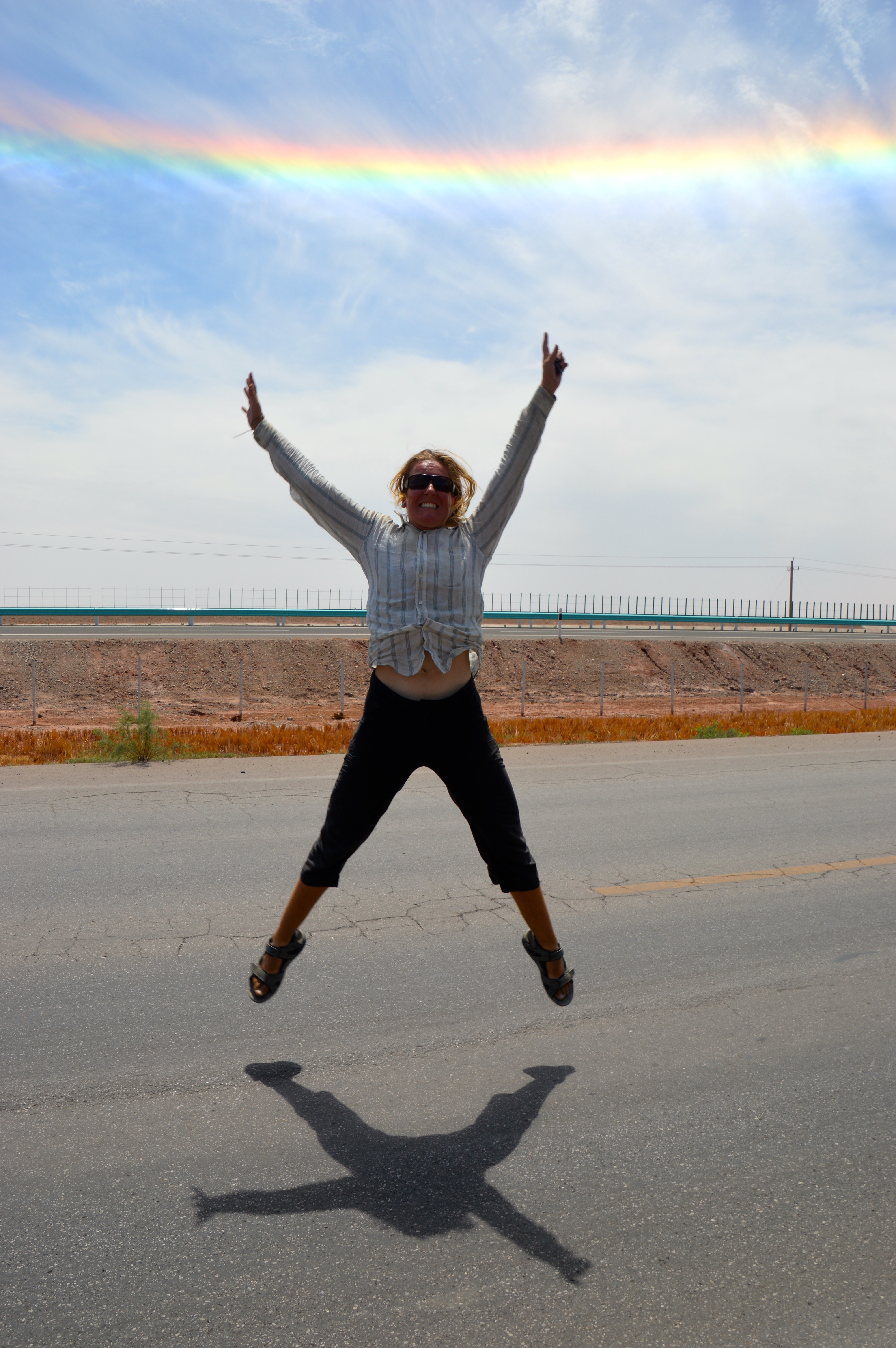
I wanted to write a piece about China because it is such an interesting country and I have met few people that aren’t fascinated by it in some way. China is well and truly on the western consciousness. Perhaps because many predict it will be the world’s next super power, if it isn’t already. I mean China own a lot of the world’s resources. The tales we get told in the Western media are often negative, human rights abuses, pollution, poisoned baby formula. Certainly the stories I had heard about China alienated me. The distance between the Chinese world and my own seemed immense. And well, there are more than a billion people there, so that’s a lot of people doing things differently. China ended up surprising me in more ways than one and in the end I really loved cycling there. We both did. Here are some of the things that made China great, weird, amusing and at times also frustrating.
The people. It’s such a traveller’s cliché, but the people really made China the experience it was, which was overwhelmingly positive. The Chinese are very hospitable, everyone wants to talk to you, even though most people can’t speak English. We were constantly given food, smiles, waves and were never aloud to pay if someone took us out to dinner. When we were stuck, people went out of their way to help us, often phoning someone who could speak English.
The photos. This gets tiring. Like many places we have visited, everyone wants a photo with the white people on bikes. We began calling this being photoknapped as people would literally pull over on the side of the highway for a photo shoot with us. Other times they would slow right down, an i pad would be hung out the window, a photo snapped and the car would speed off again.
Hot Water. The Chinese have a serious tea obsession. This is wonderful because it means boiling water is available absolutely everywhere. Petrol stations, train stations, trains, and most certainly it is unheard of having a hotel room without a kettle. You get free tea most of the time too.
Toilets. Ah, the toilets. For a country that is developing in leaps and bounds and managed to build the unbuildable railway to Lhasa, they are seriously lacking in sanitation infrastructure. Most of the time you get a wooden floor with a rectangle cut into it. Sometimes this is piled to the top with poo. Sometimes there is poo all over the floor. Sometimes you are literally peeing or pooing into the river below. Pretty gross, although being in Central Asia at the moment has totally desensitised me to even another level.
The food. Chinese food is nothing like the greasy takeaway I knew from home. It’s amazing and diverse and oh so cheap if bought from the street.
The drivers. The driving is terrible. People have very little concept of road rules. Signs and traffic lights appear to be more of a suggestion than anything else. Honking is endemic and it appears to give you the right to drive at people. Also, every single truck will honk at you while cycling. The only time people don’t honk is when they are on silent ninja (electric bikes) that creep up behind you. Ah the logic!
The infrastructure. China is set to have more high speed rail in the coming years than the rest of the world combined. Coming from country that hasn’t seriously updated it’s rail network since early last century, this is awesome. There are so many rail projects. The trains go almost everywhere and are cheap and efficient. It’s impressive how China moves it’s over a billion citizens. Public transport in the cities is also remarkable. Cheap and plentiful. Roads are mostly in great condition. There are often quieter secondary roads as well, especially in provinces like Yunnan.
The paranoia. Far out. It is not the Qing dynasty! Foreigners are not pillaging your land and taking what they want. China, you own the world. Relax. This paranoia refers mainly to the initial visa process (which requires a billion things) and the fact that in many provinces only some hotels allow foreigners to stay. The cheap ones are often only for locals and we sometimes spent hours in the rain looking for a hotel. Plus you are supposed to register within 72 hours of arrival in the country. In some provinces you get moved on when you camp, and have your passport obsessively checked and asked where you will be spending the night. To buy a mobile SIM card you can only go to the larger outlets as only they can register foreigners. Also, needing written police permission to buy fuel for our stove seemed rather over the top. It seems that rules are either ignored or followed obsessively, and as a foreigner it’s difficult to know when either will apply. After months of this it gets a little tiresome. Apparently China wants to become the tourist destination. I feel like a few things would have to change before this happens!
The Environment. Disclaimer: We only went to the least populated provinces of China – Yunnan, Sichuan, Gansu and Xinjiang. China is beautiful and diverse. From the jungles of Yunnan, to high mountains, grasslands, desserts and lakes. China was a lot cleaner and less populated than we expected. The opportunities for cycle touring are almost endless.
The censorship: Facebook, WordPress, u tube and even American tv shows like The Big Bang Theory are considered subversive by the government and censored. Unfortunately a lot of Chinese didn’t know about VPN’s (vertical private networks), which can circumvent some blocks. Fundamentally I think censorship is wrong, however, I think in the west we are censored in a different way. In China it is more overt. Everyone knows the government blocks websites. In Australia (and many other western countries) we are led to believe we are consuming good media, when in actual fact a lot of our media outlets are owned by multinationals with a distinct agenda (Murdoch for instance) which is as bad, if not worse than blatant censorship.
Contrast. China is a land of contrasts. In one minute it is so familiar, so modern, it could be the west. The next it is so alien you feel slightly dizzy. One minute you are surrounded by Chinese tourists with two SLR Cannon’s wearing Northface. The next, you are watching an old man herding goats on a remote mountain pass. China is the future as much as it is the past.
Tourism. After SE Asia where almost all tourism is aimed at foreigners, China is refreshing. SE Asia has ‘white people/foreigner’ prices. China has ‘tourist’ prices. This means all tourists, foreign and Chinese get ripped off equally. Oh and ripped off you get. The entry fee for many attractions is insane. Also, by far the majority of tourists in China are domestic which means even in tourist towns not many people speak English or cater to western tastes (read western cafes and food, usual to most SE Asian tourist towns). This is kind of nice. You also cannot be a student unless you are under 24, despite having a student card. Go figure.
Politics. Due to the language barrier it is hard to get a sense of how people feel in regards to politics and human rights. In Xinjiang you definitely feel the tension after a while. I mean, we were constantly getting our passports scrutinised and the police were everywhere. Most of the time the Chinese and Uyghur don’t seem to mix. It was similar in the Tibetan region, but not as tense. It’s hard to talk to people about these things and you often get very one-dimensional answers.
The parks. Chinese people use their parks and public spaces to the fullest. They really embrace them. Walk through almost any Chinese park or public space and you will see all manner of things; old men in Mao hats drinking tea and playing Majong, groups of colourfully dressed middle aged ladies line dancing to Chinese pop music, ballroom dancing couples, people practicing their instruments or singing, or even a mock catwalk.
The spitting. Perhaps a Chinese cliche but the spitting is intense. For most of the older generation, as well as some of the younger its perfectly acceptable to spit anywhere, usually meaning the street, sometimes meaning the floors of restaurant. While the spitting itself is quite gross, the hacking up of the spit in the back of the throat is probably worse. We once stayed at a hostel where one of the staff would alternate between smoking and hacking/spitting, pretty much the whole day. I have been assured that spitting is seen as not cool by the most of the younger educated generation and that it is fading out slowly as being sociably acceptable.
Coffee. A true tragedy. The Chinese don’t get coffee at all. I sampled some truly heartbreaking attempts in my 3 months in China. And the supermarkets only ever stock Nestle. Sad, sad, sad. I’m sure this is different in the big cities.
The cyclists. China has a growing middle class and on any given weekend you will find groups of Chinese on cycle trips. They all ride Giant or Merida bikes and took great delight in chaperoning us. This inevitably always ends in a photo shoot. Cycle touring is also growing in popularity. Chinese cycle tourists never have rear panniers and always appear to be wearing all their clothes, even in the desert.
The staring. The Chinese are a nation of starers. Well, at least that was our experience. Opened mouthed, wide eyed, unabashed staring at the foreigners on bikes, or just walking around. One lady stared so intensely she nearly fell of her bike. I don’t think they are meaning to be rude, it’s just part of what they do. It’s not creepy either, in the way we get stared at by some men in other countries. Chinese men haven’t been sleazy really at all, which is saying a lot because almost everywhere else they have. The women stare just as much as the men do.
Strangely, the Chinese reminded me of American’s in some ways. In the way that some American’s can be very inward looking and insular, consumed by their culture and perceived central location in the world with very little knowledge of what lies beyond their borders. The Chinese can be like this too and the similarity is obvious. They too live in a large, populous country, with a fierce cultural dogma and are insulated in a lot of ways from the rest of the world. An example of this was when a girl in the mobile phone shop couldn’t comprehend that my phone wasn’t in Chinese, or when it is assumed that if you can’t speak Chinese, you must be able to at least read Chinese characters!

Bishkek to Osh via Issy Kul Lake and the Central Mountains
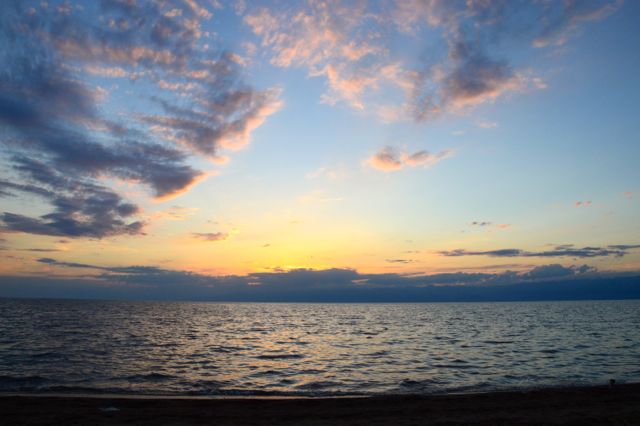
Lake Issy Kul
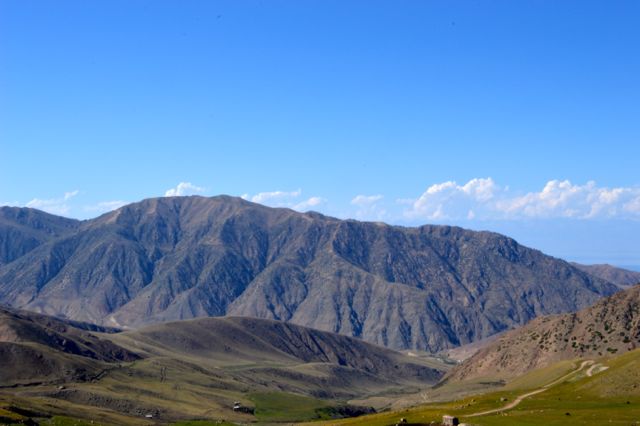
Bidding farewell to our new friends at Nomads Home we cycled to the ‘bus station,’ which is a slightly misleading term in Kyrgyzstan. Sure, there is bus station and normal sized buses do leave from there, but by far the majority of transport is private cars and mini buses, which leave when full (or you pay for the whole vehicle). Obviously this presents a problem to the budget traveller with a bicycle. And of course we would rather have cycled the whole distance but due to needing to get visas in Bishkek and the weather in the Pamirs, some compromises needed to be made. Our plan was a leisurely cycle back to Osh. Unfortunately we were soon to come face to face with the true nature of Kyrgyzstan’s ‘roads’ and our trip would be anything but leisurely.

Cycling down to another awesome camp spot
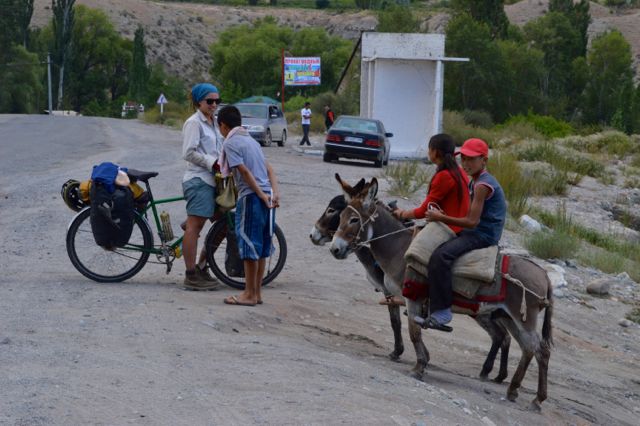
Kids hang out on donkeys instead of bikes here!
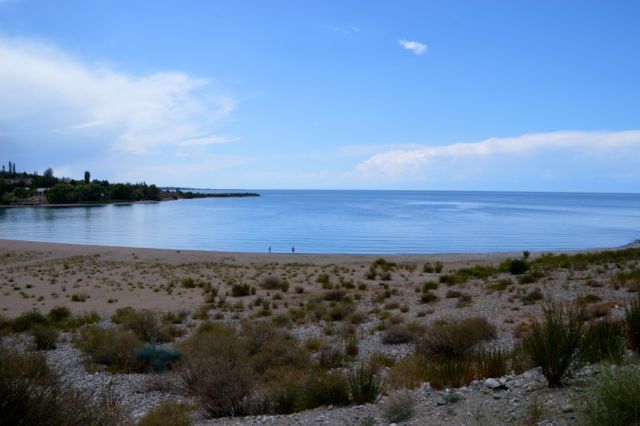
After some negotiations we managed to secure a car for a reasonable price and were whisked off to Karakol, a town on the eastern edge of Lake Issy Kul. The drive was predictably nerve wracking. The Krygyz are yet another population of crazy drivers. We found ourselves deposited on an immense lake, shining a brilliant blue in the sun and surrounded by snow capped peaks. The area is popular for hiking and horse treks and we enjoyed watching a group of returned hikers shot vodka and dance to Russian pop music while having dinner. I kind of wanted to join in as they looked like they were having a lot of fun.
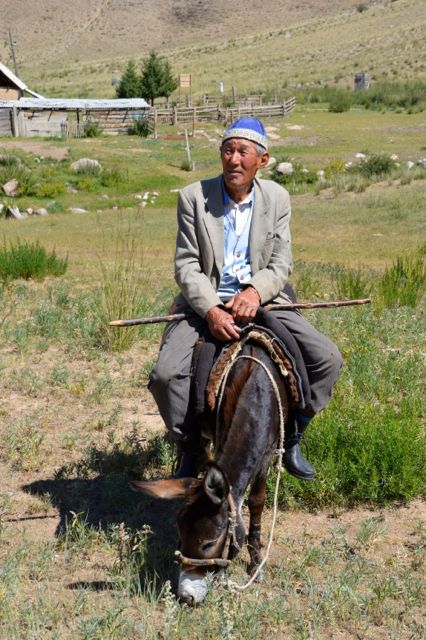
The next day we packed up our tents and headed closer to the lakeshore. After months of sleek Chinese roads and the deserted roads we first encountered in Kyrgyzstan, we were in for a shock. The road around Issy Kul is narrow and badly paved, the traffic fast and drivers careless (and often intoxicated). Taking advice from cycling friends we met in Lao (Alleykat) Astrid and I secured big sticks to our bikes with a big red cloth on the end. This made the drivers take notice and give us enough space. As we got closer to the lake, we decided we would turn off and try and find a place to camp near the water. Some local kids on bikes helped us negotiate the back roads to the lakeshore. Unfortunately it was full of families, volleyball and music. Not really what we had in mind. However, after some bush bashing we managed to find a quieter spot and settled into a relaxed afternoon of swimming, reading and napping. After China, it felt like we were on holiday.
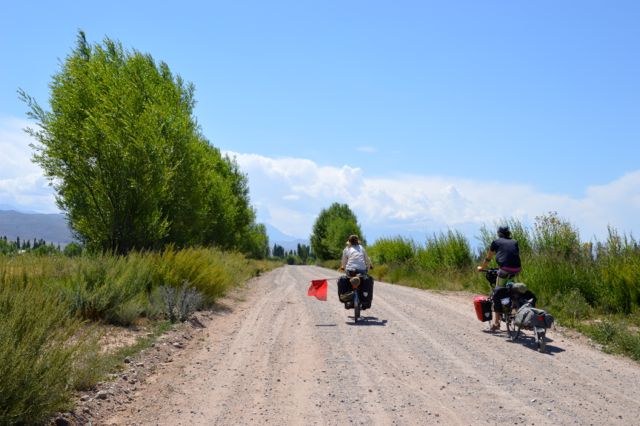
Flag protection from the terrible drivers
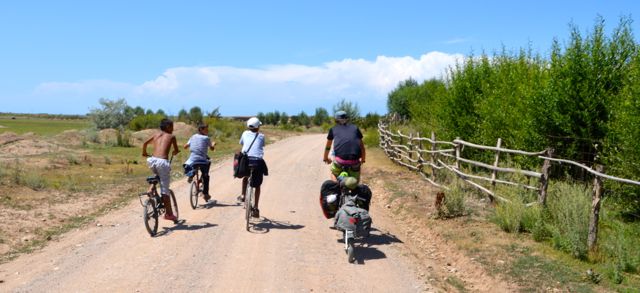
Local kids show us the way

Sunset lake Issy Kul. The holiday vibe is alive!
The holiday spirit continued the following day, we stopped for lunch at a Kafe and then made camp on the lake shore again. It was more remote now and only a few people came down to swim in the afternoon. Taking a leaf out of the locals book, we shared some vodka ($2 a bottle!) and watched the sky turn a brilliant orange. Some boys joined us and enthusiastically built a fire. Life was perfect. We hadn’t cycled far but felt that this was okay, our target was only 55km a day and we could easily cycle more than this if needed. Or so we thought.
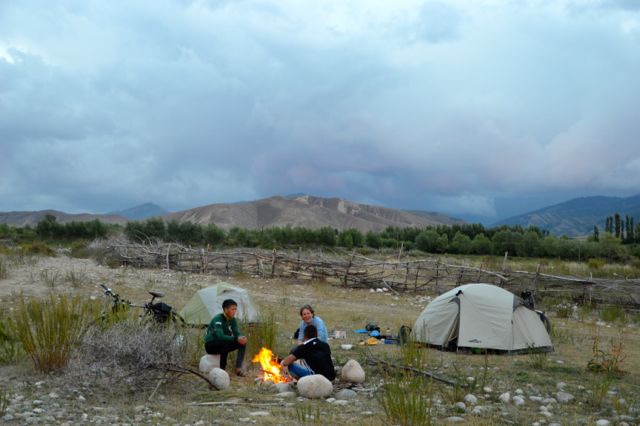
Another night on the lake with some locals.

More amazing sunsets..
The day started with an early morning swim, followed by cups of tea and eventually we packed up and cycled the short distance to Barskoon. Here we met up with Jan, a friend from Nomads Home. We had some lunch and coffee and eventually hit the road again, our panniers bursting with food for the next leg. After another 20km cycling along the beautiful lakeshore, resisting the urge to make camp and go for a swim, we turned off and headed south. This was the road that would take us from around 1600m to 4000m in 30km. Well, we thought it was the road. Our map said so but google maps was silent on the matter. We decided to chance it. From here the road deteriorated significantly. It was now a rocky stone path, following a river up a valley. Not long and we were climbing, then pushing our bikes. It reminded us a bit of the Savannah Way. After only 3km (in 1.5 hours) we stopped and made camp high above the river. While cooking dinner a young boy herding his goats and sheep came passed. He had one goat that was his obvious favourite and it was very tame. It cuddled up to him and when we shared out biscuits with him, he in turn shared them with his goat. Later we made a fire and the shepherd boy came back down and gave us gifts of ‘Keffier’ (yogurt) and delicious Apricot jam. So much kindness.

A quick catch up in Barskoon

Our first night on the road to Naryn
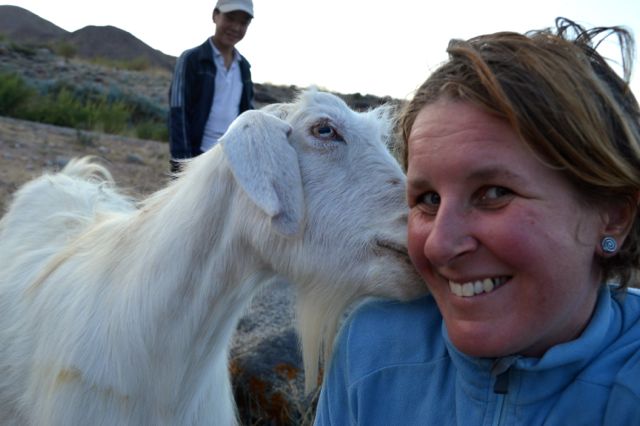
Selfie with the friendly goat
The climbing continued up the rocky, narrow road. In the distance we could see the icy gleam of the glaciers and the pass. After a few hours (but not many km’s) we found ourselves in a wider valley where we sat ourselves down on the soft green grass beside a crystal clear river. This was paradise. It was also where the road forked. Luckily we found a few people to ask and it was confirmed that we were indeed on the correct road to Naryn. Upwards we continued to go, sometimes cycling, sometimes pushing, sometimes falling off. Switch back after switchback, we climbed passed nomads with their animals, yurts and slightly intoxicated locals riding their horses (with the wife on the back) to some remote mountain dwelling. I sure wished I could trade my awkward heavy bike for a nimble mountain horse a few times!

Which way to we go?
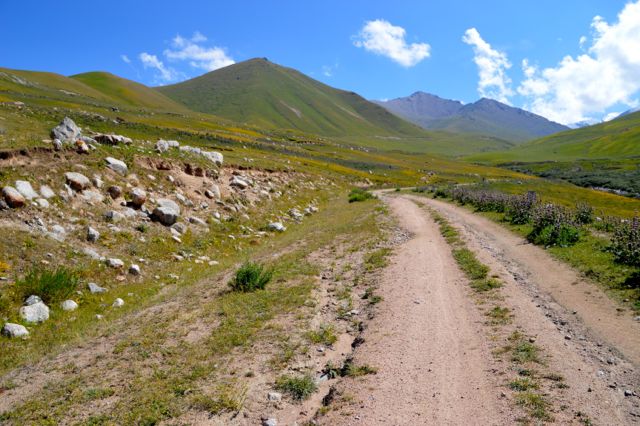
Everywhere is beautiful


Intoxicated local takes his wife home on a horse
With Neil’s encouragement we have become even more tea obsessed and take every opportunity to brew a cup. While we were enjoying a break and a cuppa, a family in a 4wd pulled up. Their son spoke excellent English, making sure we were okay and then gifting us fresh (made that morning) butter, and eggs. We had a delicious lunch. Some Western motorcyclists also stopped, giving us valuable information about the road ahead (it was going to get worse) and details about a good place to camp.
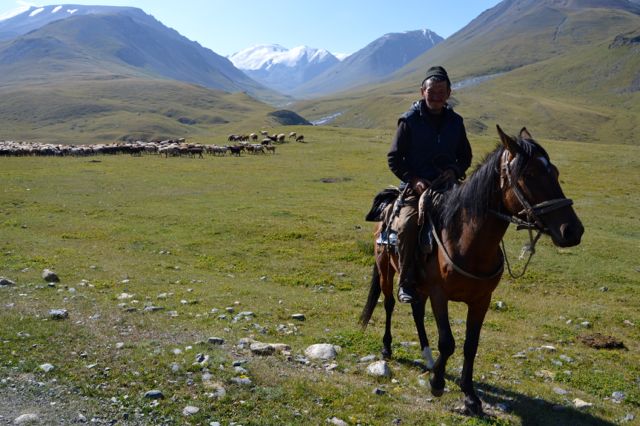
The nomads are always friendly and curious
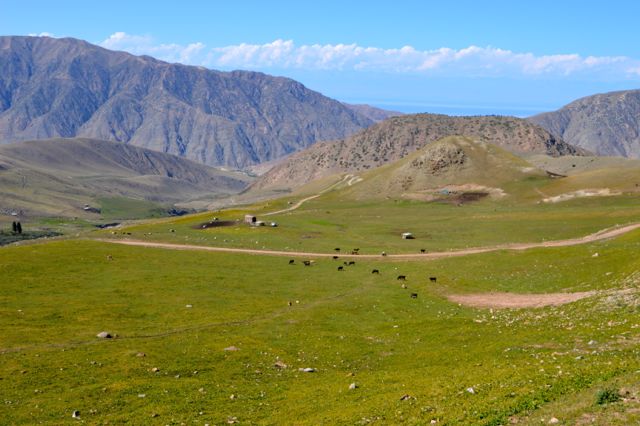

Some motorcyclists give us advice on the road
We continued on and the altitude began to affect me, mainly because I was a bit sick. I found myself stopping every few minutes and just wishing I could lie down. Finally after what seemed like eternity, Neil came towards me on a horse! He offered me the horse in exchange for the green fairy, a good deal for me. I rode the remaining short distance to our camp and it made me realise I miss horses and riding a lot. The horse had come courtesy of some nomad children who watched us set up camp and later came down to share some Kemez (fermented horse milk) with us. It’s the national drink of Kyrgyzstan and the Kyrygz seem to love it and drink it in huge quantities. I thought it was okay in a small dose. A very small dose.

Neil comes to help find me on a horse

This is a good deal for me. It feels like home.

Our camp spot, the glaciers don’t look too far away now..
Morning brought hot tea as the sun slowly came over the mountain, illuminating us and the glaciers not so far above. The extremely slow ascent continued. We were basically hiking with bikes as large boulders obscured the road. It was like trying to cycle up a dry river bed. At times two people were needed to push the bikes up a particularly steep section. Finally, after hours we reached the top, the glaciers were so close now. We could here them crack and groan in the sun, rocks occasionally avalanching down to earth. It was just ice and rock up there, stark and beautiful and somehow very alive. After some time resting and staring at glaciers we were joined by an eccentric German on a girls bike (basket and all). You meet all kinds of people on the top of 4000m passes!
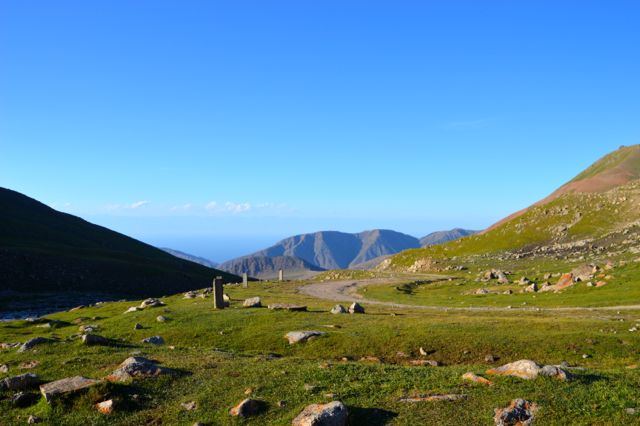
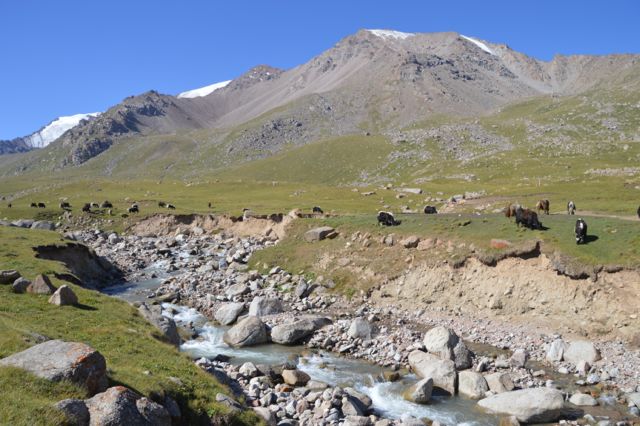
Oh yes they are YAKS!!
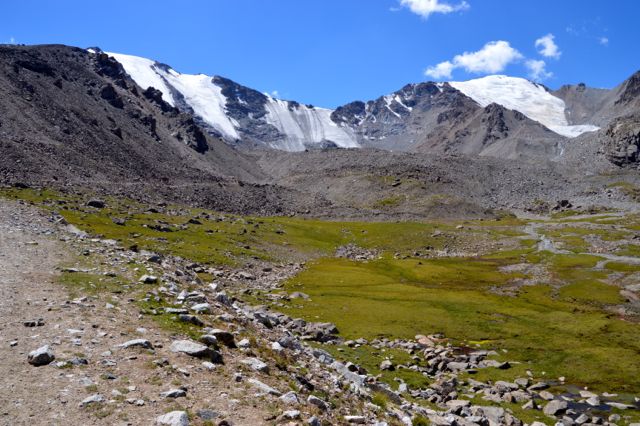
The glaciers get closer..
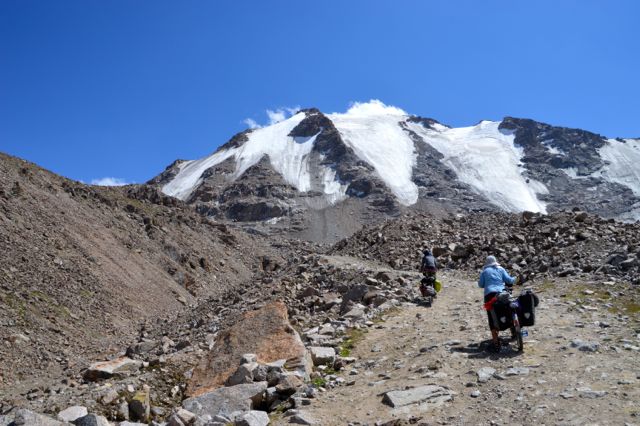
And we push up and up..
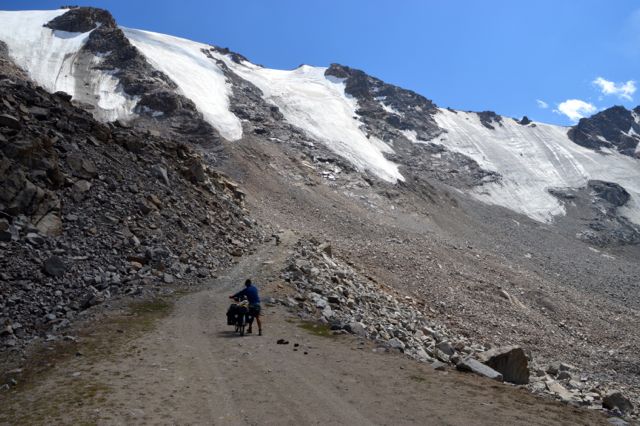
The descent was predictably rocky (I spent a lot of time pretending I was on a mountain bike, probably going way too fast) and the valley that opened up before us was just about the most beautiful thing I had seen. I thought the valley we had just cycled up was amazing, but this just took it to a whole new level. Alpine grasslands stretched out before us, dotted with yurts and horses. A huge river cut through the landscape and immense snow capped mountains towered above us. Every view was breathtaking. After another hour or so and a whopping 18km total for the day, we made camp beside a small stream on some soft grass. As I lay in the tent later on, the light fading, I could hear the thunder of the semi wild horses hooves as they galloped across the grass just behind the tent.
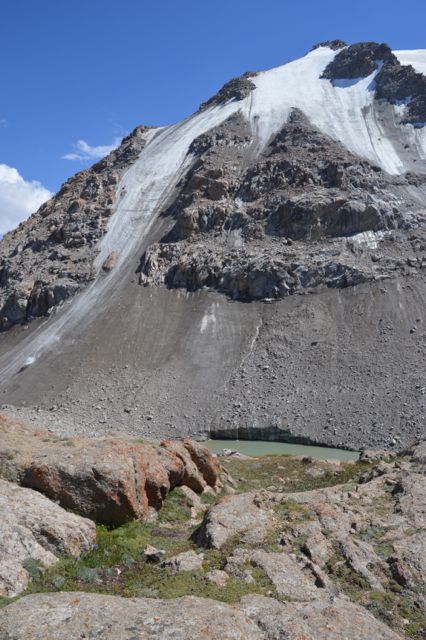
The top of the pass is beautiful

Relieved to have made it!

And on the other side the view is equally awesome!

Down we go..
We woke to frozen water bottles and ice on the tent. Hot tea and porridge soon sorted us out and we hit the road in high spirits. Although slightly better, it was still slow going. The road had been washed away in many places and more than a few icy river crossings were encountered. We also came across many cyclists; some on self supported tours, some on mountain bikes and one group that was racing. A few ancient 4×4 Lada’s also rattled by, but all in all we had the road mainly to ourselves. In the afternoon the landscape changed and we entered a dry rocky canyon, and made camp high above the river.

A few cold river crossings!

A stunning camp spot yet again


By the next day our supplies were running low and we all began to fantasise about the Magazin (shop) that we knew lay ahead. Unfortunately it was Saturday and no one felt like opening it. We continued on. Being lower now, it began to get warm and we stopped to dip in the freezing water to wash. We were all rather smelly. After a morning of undulating through the canyon we entered yet another breathtaking valley, villages and snow capped mountains on the horizon. It was about this time that the green fairy decided to get a flat. While fixing it, a lady invited us in for ‘chai’ (tea). We happily accepted, curious to see what the inside of the houses looked like and grateful for the offer of tea. Well, it was here that we learnt that chai actually means EVERYTHING. Bread, fresh cream, homemade jam, Kemez and actual tea. It was amazing and delicious. We were then shown around the house and we got a sense of how cold it must get in winter. The walls were thick mudbrick, the insides lined with carpets, the windows double panned. The houses were old, electricity an obvious later add on, but the building quality was impressive. Finally we bade farewell to our host and her family and headed to the small magazin in town. By now the road had improved and we made good time down the valley.


The landscape slowly changed as we dropped lower – christmas trees!
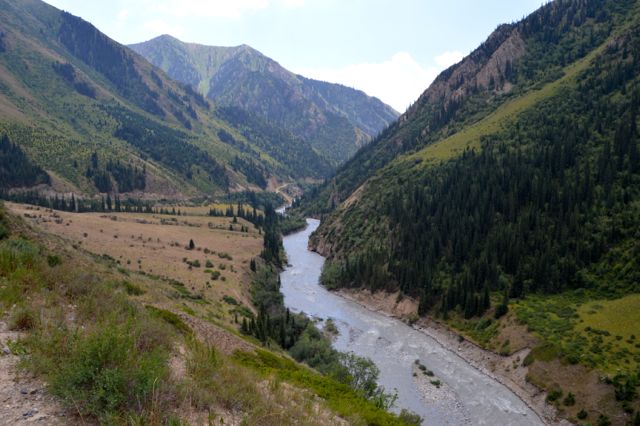

This was our afternoon swim/wash

This lovely lady invited us in for chai and showed us around her home
Just as dusk was beginning to hint at her presence who should we come across but Remi and Rebecca (who we had met in Osh) cycling the opposite way. A reunion ensued and we quickly made plans to camp together that night. Being Kyrgyzstan it took about 5 mins to find a sheltered camp by a stream and it was here we sat, talking and cooking and sharing stories from the road.

Reunion!

With warnings about the quality of the road ahead (and the awesomeness of the views), we left Remi and Rebecca and headed the short distance into Naryn, a medium sized town. Another great aspect of travel in Kyrgyzstan is CBT (community based tourism) which offers a network of homestays and other services. In Naryn they have an office offering free wifi and advice from the tireless Gulvira. It was here that we came face to face with fact that we had been unable to do enough kilometres as well as the poor nature of Kyrgyzstan’s infrastructure. And the “Green Mumba” (aka a South African passport). Poor Neil is one of the only nationalities that we know of that needs a visa for Kyrgyzstan. As he only had a one month visa (as apposed to our 60 or even 90 day entry stamp) and the fact that our Tajik visa’s were starting soon, we did not have enough time to cycle on the apparently mostly awful roads back to Osh. We then found out it was going to cost us over US $100 to cut off the worst 200km. Ahhhh! After some discussion we conceded to taking the night bus to Bishkek and then a car to Osh. It was going to be 24 hours of travelling hell. That night however we stayed at Gulvira’s lovely flat because all the other homestays were full. She was wonderful and it was great to get to talk to someone about life in Kyrgyzstan.

After a day of catching up on emails we boarded the night bus for Bishkek. Predictably we had to argue over the price of the bikes (even though there was hardly any luggage in the bus) and Gulvira once again came to our aid. The bus ride was a bit uncomfortable and we arrived bleary eyed back in Bishkek. It was still really early and the only driver we found appeared to be drunk (or so fatigued he seemed drunk) so we decided to wait it out with coffee (and hope for a Muslim driver who wouldn’t be drunk!). Lucky we did. Soon a man came and found us, a reasonable price was negotiated and our bikes were loaded onto the roof. Soon more passengers where found and then we left for Osh. Our driver was a Muslim and a true legend. Not only was he a careful driver, he also lent us money (as we had been unable to get any out) and treated us like family. In fact, the whole atmosphere in the car was one of instant family. The drive itself is long, hot and cramped (and I really don’t want to do it ever again) but the people do make up for the discomforts. Once in Osh our driver even rang the Guesthouse (as it was really late) to make sure we had a place to stay.
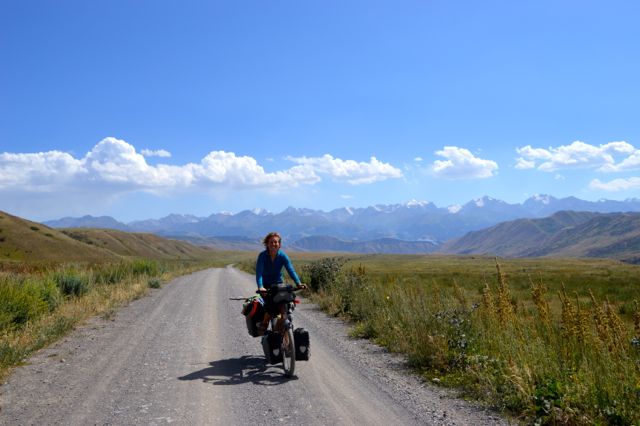
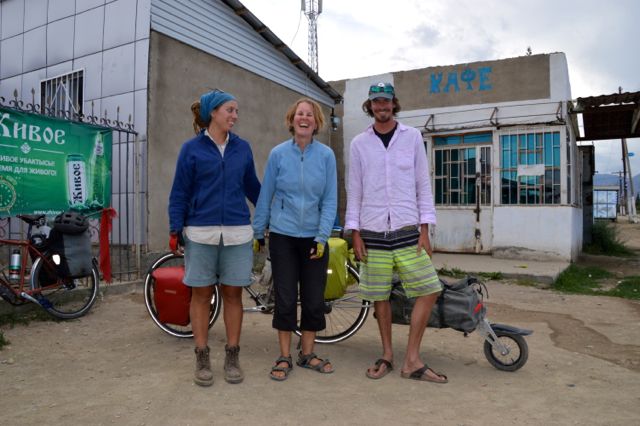
We bade farewell to our friendly companions and cycled the short distance back to TES Guesthouse and predictably headed straight for the beer fridge. It had been 24 hours on the road without sleep but we had arrived. The Pamir Highway was only days away..
Love Jude
PS: Check out Neil’s video of this part of the trip to get a sense of what it was like. It’s a really cool short film: https://www.youtube.com/watch?v=VZ7veqrIMS8&list=UUC0n_A3NZwaTSsIMx7jipng
Kashgar -> Irkeshtam -> Sary-Tash -> Osh -> Bishkek.

Paradise found, Astrid looking at the stunning view. (Photo by Neil @ H2Htrip.com)
The road signs were all now in Mandarin, Uighur, English and Russian. It would be two days until we crossed the border into Kyrgyzstan, yet the excitement of a new country filled us with energy. There are two international border posts near Kashgar, the Torugart Pass – stunning and stunningly expensive due to Chinese permit requirements, and Irkeshtam where the Chinese border checkpoint is in Ulugqat – 142 kilometres from the actual border. As I have often said, things in China are rarely based on logic. We chose Irkeshtam and pedalled out of Kashgar early in the morning hoping to make it to somewhere near Ulugqat. Two days earlier as we cycled the last 20kms downhill into Kashgar, we expressed our dread at the 20km backtrack to the turnoff. Funny how after some rest, what we thought would be a painful climb was now a quick morning cycle. Since Google Maps last visited the area, a new road (an extension of the ‘dirty 30’) has been built – right through the centre of many small Uighur villages. As usual the road has been fenced with barbed wire and trying to get off the road to purchase food and drinks was difficult. So too was getting back on, therefore we cycled along the secondary road for a while and just as we found an entry ramp the skies opened up and it started hailing. While golf ball sized pieces of ice fell from the sky, we scrambled down an embankment to sit it out in a irrigation tunnel. Now we had experienced it all – searing heat to constant rain, dust storms to hail storms.
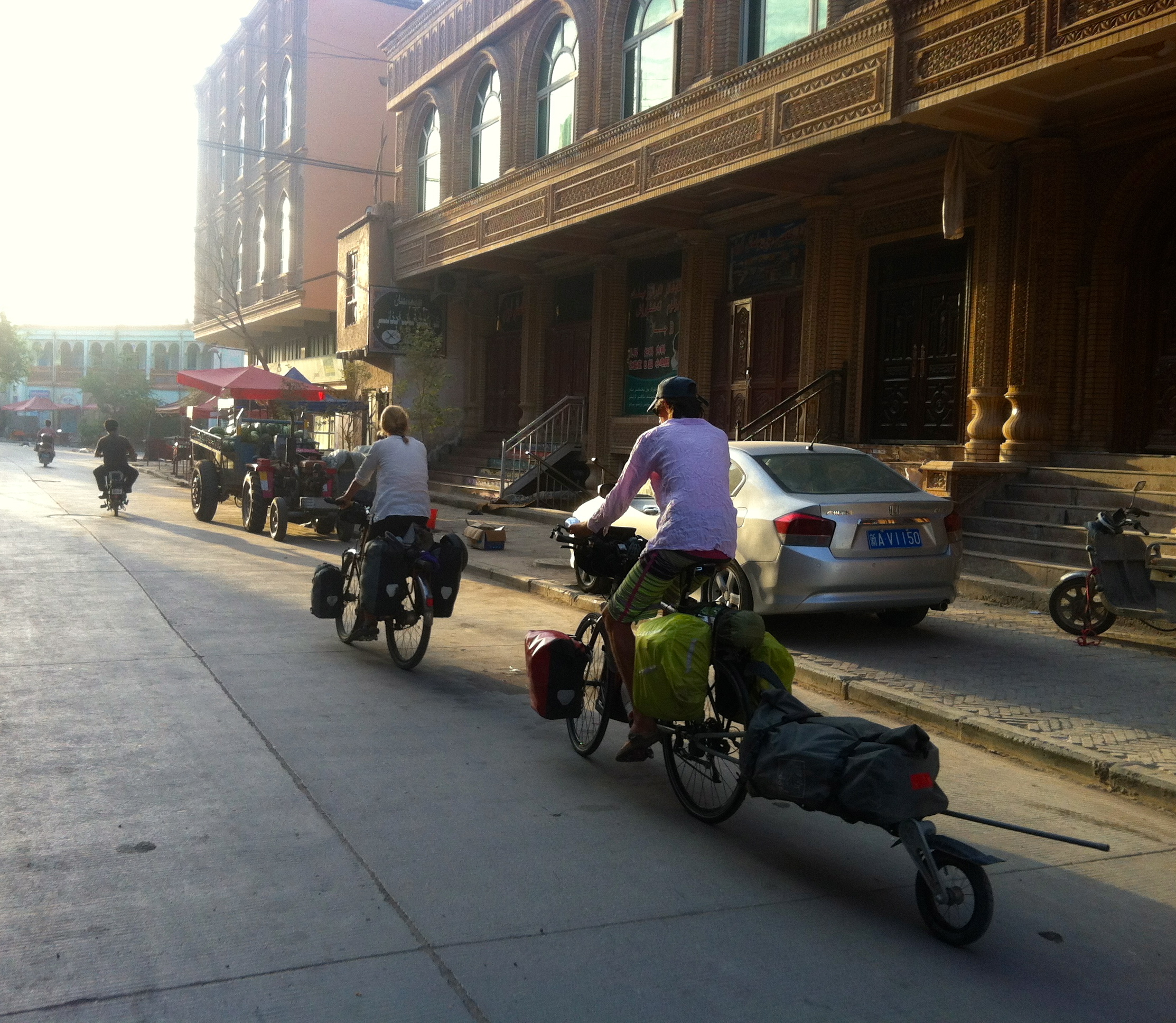
Cycling out of Kashgar.

Signs in Mandarin and Uighur.
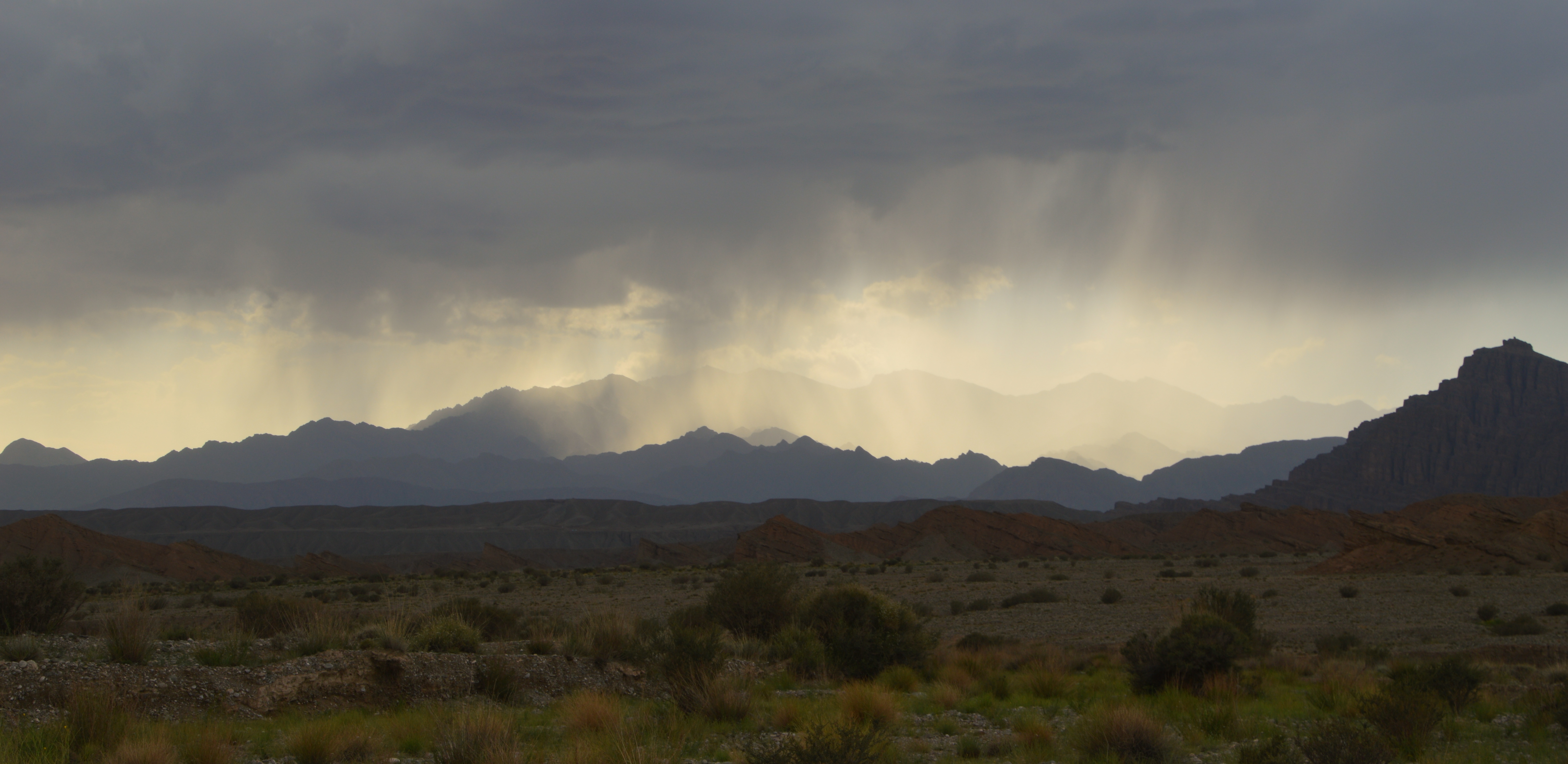
Watching the rain clouds come over.

Our last campsite in China.

Neil keeps the fire stoked to cook dinner.
That evening as we sat watching the rain storms roll in over the mountains, the last of our stove fuel ran out (thanks to the petrol paranoia) and dinner was cooked on a fire that had to be constantly tended to. Our love for China was waning and the next day it was skating on thin ice. First there was the final flat tyre on the ‘Dirty 30’ 2 kilometres from Ulugqat; at the checkpoint we were to discover that they had banned hitching rides in trucks to the border; now we had to hire two taxis (at twenty times the price of a truck) to the border so that our three bikes would fit; the officials at the checkpoint sat us in a waiting room for over an hour for an unspecified reason; they wanted to x-ray all our gear and bikes before leaving but didn’t look at the screen (we refused to dismantle the bikes to put them through the machine); our driver displayed the usual fantastic driving skills that all Chinese seem to possess (most of our trip was spent on the wrong side of the road); when we made it to the actual border the officials were on their three hour lunch break; and after spending an hour sitting around, approximately 50 metres from the crossing, our driver raced to the border and gave us less than five minutes to unpack our bikes and gear and put them together as he had to hand in our paperwork. By the time we had cycled the five kilometres through no-mans land we weren’t sure what to expect on the other side, but it had to be better than what we had left. And it was!

Cycling the road to Ulugqat.

Waiting for an unknown reason – better eat a peanut butter sandwich.

Yep, that’s two bikes in the boot of the taxi.

The last of the dry barren hills for a while.

Waiting for the border guards to open the gate after their 3 hour lunch break.

Cycling through no-mans land, hoping for things to get better.
Kyrgyzstan is paradise. The change is immediate. The landscape is no longer a barren desert with brown hills, but green fields and rivers surrounded by snow capped peaks. You can actually drink the water from the streams. You can buy petrol without needing a permission slip from the police. You can camp wherever you want – so we did. After purchasing some fuel from a small village about 5 kilometres from the border, we pedalled up a hill and decided that our first camp in Kyrgyzstan should be on an open grassy plain with a view of all the mountains surrounding us. We celebrated with cups of tea and a hearty dinner. Basking in such beauty we couldn’t keep the smiles off our faces.

Passing the caravans that surround the Kyrgyz border post.

We loved Kyrgyzstan from the moment we arrived.

Celebrating Paradise.
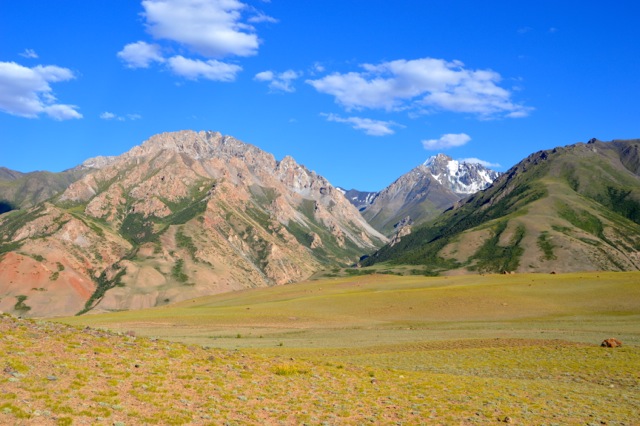
With views like this from our campsite, how could we not love it here…
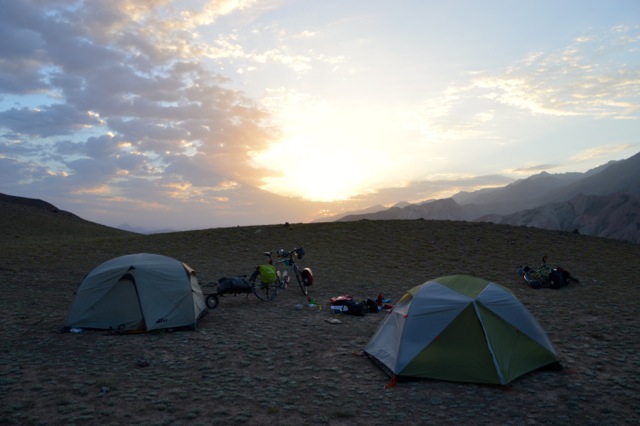
Sunrise on our first full day of cycling in Kyrgyzstan.
Sary-tash is the closest big village to the border and our next place to pick up food supplies. Being only 80 kilometres away we assumed we would be there by the next afternoon. Kyrgyzstan would teach us that our perception of our cycling speed and distance would need some serious adjusting. Xinjiang had been relatively flat and over the last month we had lost our ‘hill legs’. This too would need some serious work which we discovered as soon as we set off in the morning. We undulated over hills, down into valleys, just to climb back up the next hill. The gradients were steeper than anything we had encountered since Laos, usually about 9% for all you cyclists and engineers. Altitude was also playing its part, as we had climbed while driving the 142km to the border. As our legs and lungs burnt, our eyes feasted on the never ending grandeur of the countryside. The snow capped 6,000m peaks that border with Tajikistan were on our left, rocky smaller peaks to our right, a red river below us and green rolling hills between. By lunchtime we came to the end of a climb that had been going on for a couple of hours. From here we sailed down into a grassy valley dotted with yurts and animals. The summer life of the nomads was in full swing as they rode their horses and donkeys, herded their livestock and milked their horses to make the country specialty – kumuz (fermented mares milk). Greetings were exchanged with everyone we met and the kids were super excited when we passed by.
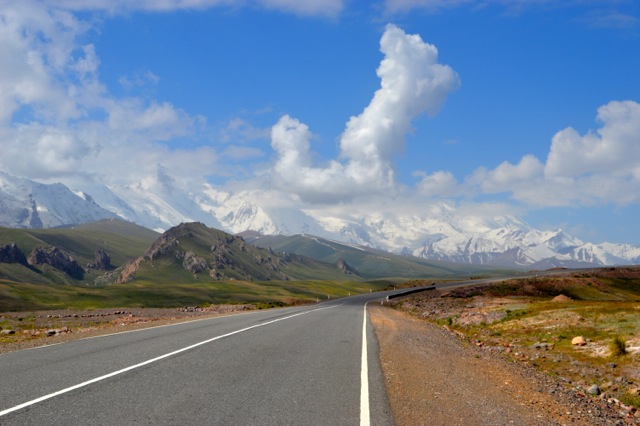
Perfect cycling road!

The red and blue waters of river ways combine to make a good fishing spot.

Rolling green hills surround us.

The yurts of the Kyrgz nomads.

View to our right.

And the view to our left.

Jude is just about to reach the top of the long morning climb.
By mid afternoon it was decided that we were in no hurry and that a grassy patch next to the river looked particularly inviting. I also had some bike maintenance to attend to – my chain was sounding as if it was about to snap and my rear breaks weren’t working. The tents were pitched and we settled in to the slow life. More cups of tea, some tinkering with the bike, some reading and writing, some staring at the scenery and more cups of tea. Heavenly.
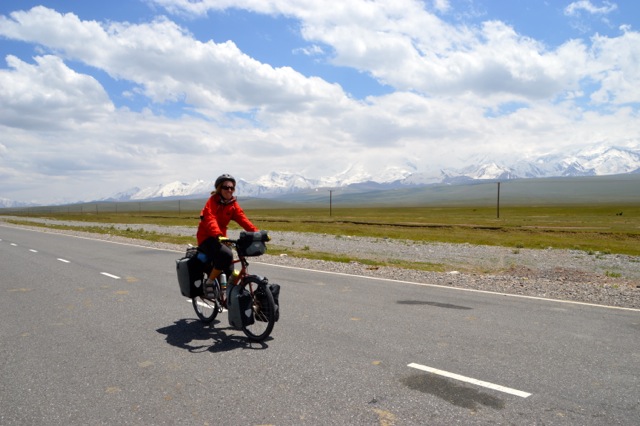
Astrid loving it here.

The road is shared by bikes, donkeys, herd animals and the occasional car.
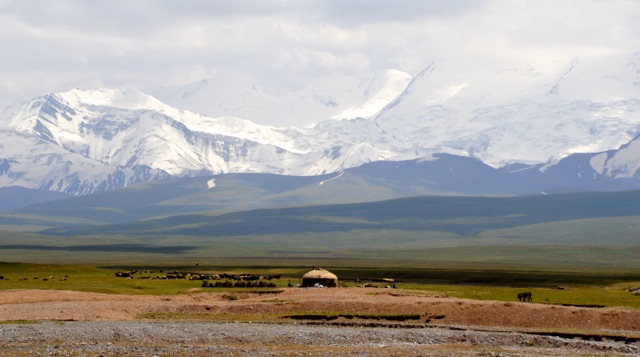
Nomad’s yurt and livestock.
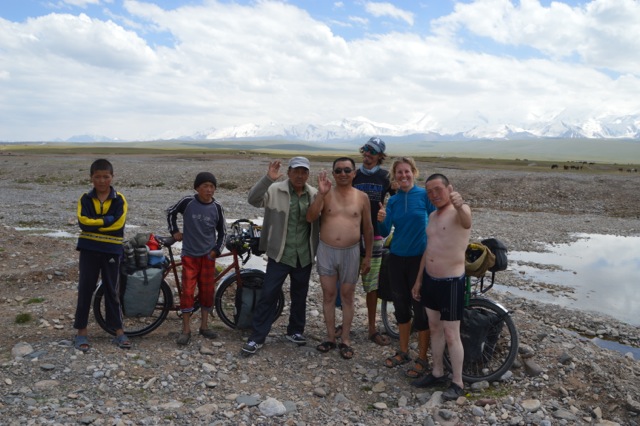
Friendly locals and Russian tourists.

Many children request to have their photo taken.
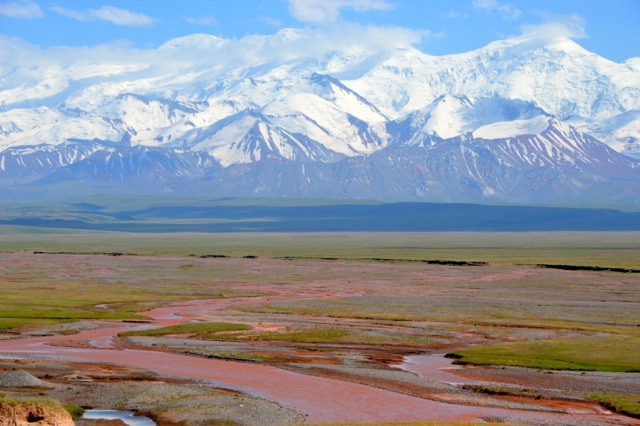
Time to stop for the day and enjoy the scenery.
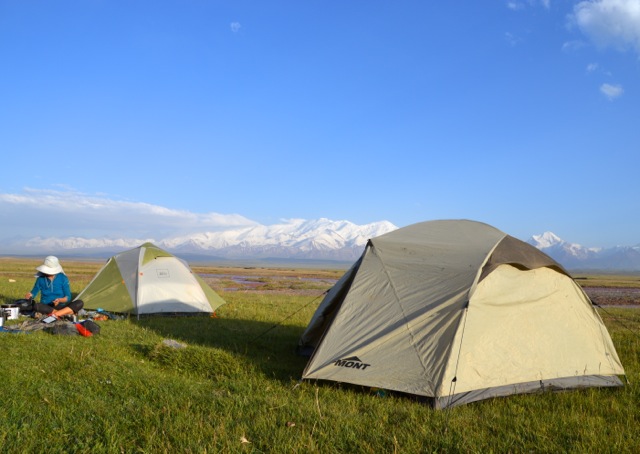
Our homes.
Morning life in Sary-tash was just kicking off as we rode in. Needing supplies we stopped at the first magazin (what they call the local shops here) and squealed with delight at all the produce we could buy. Cheese, they actually had cheese!!! Now I knew we were in paradise. It would be another few days until we reached Osh and we didn’t know about the availability of food along the road, so we stocked up on all the staples and a few extra treats – yes cheese and chocolate are back on the menu. Then it was time to find second breakfast. A little restaurant on the village outskirts was the only place open and fortunately the ladies cooking was excellent. We had been warned prior to coming that the meals in Kyrgyzstan were meat heavy and they weren’t wrong. Stew of mutton, dumplings with mutton or plov (rice with mutton). My inner vegetarian wasn’t sure what to do.

Cycling into Sary-Tash.
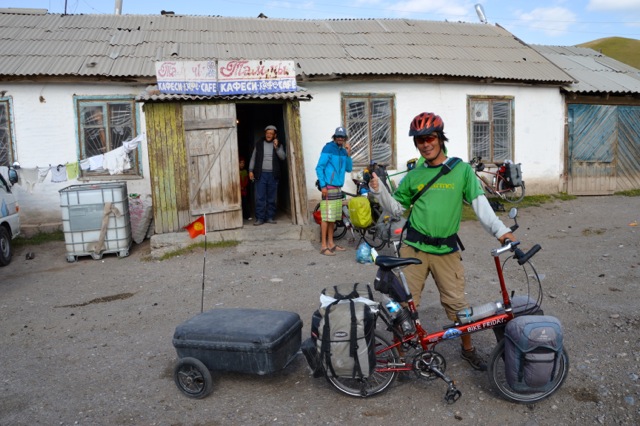
Everyone has their own cycling gear and style.

Paradise found – CHEESE and SALAMI!!!
Two passes awaited us as we pedalled out of Sary-tash, the first at 3550m and the second at 3615m. A dog from the restaurant had decided to join us and he enjoyed himself padding along side our bikes and then chasing birds and critters in the fields next to us. Watching him run with unadulterated joy and abandon, it reminded me of how I feel cycling. By the time we had reached the first pass we were over 15km from Sary-tash and the dog was still showing no signs of going home. Luckily, as we sped down the hill we were able to wave goodbye to our four legged friend who couldn’t keep up. The next climb was easier and 200 metres from the top a truck waved me down and offered us a lift first to Osh and then to Bishkek. I was hesitant initially but when the others arrived we made a group decision to catch a ride to save ourselves riding the same route twice (we will return this way to cycle through Tajikistan).
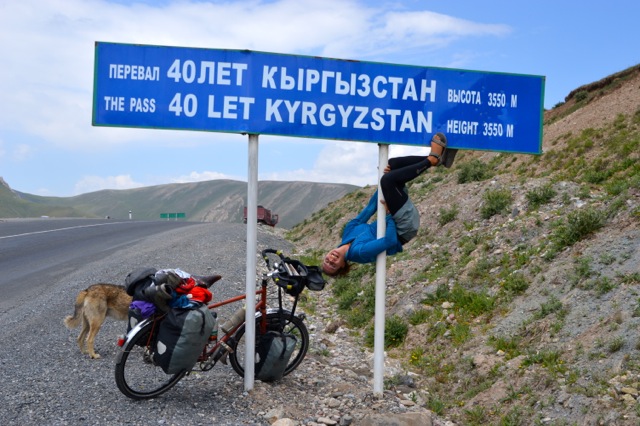
Jude’s excited to reach the top of the first pass.

A mare being milked so ‘kumuz’ can be made.
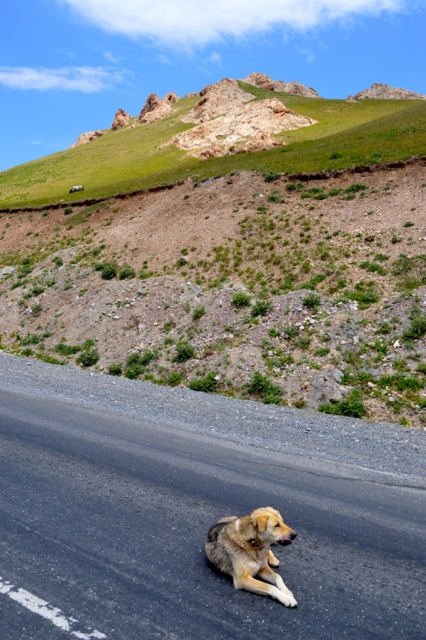
Our four legged friend taking a rest at the top of the pass.

The truck that pulled over and offered us a lift to Bishkek (almost).
Mohamed helped us to load our bikes in the back and we jumped into the most deluxe truck cabin I have ever seen. I must admit that if it wasn’t so luxurious I would have been more upset about the fantastic downhill we were missing. When Mohamed stopped for prayer time we had a wash in the river next to the mosque, an hour later he pulled over and made fresh Brazilian coffee for us, we abused the police when they pulled him over just to collect a bribe (police corruption is huge here), and an hour out of Osh he out manouvered us by buying a melon and Snickers for us when we wanted to get him a watermelon to eat that night when his fasting ended (due to Ramadan). Unfortunately Mohamed was heading to Bishkek, just not for a few days. So we had him drop us off at the turn-off just before Osh and after Jude turned down his second marriage proposal (don’t tell people in Central Asia you’re not married), we pedalled into town to enjoy some R&R city style.
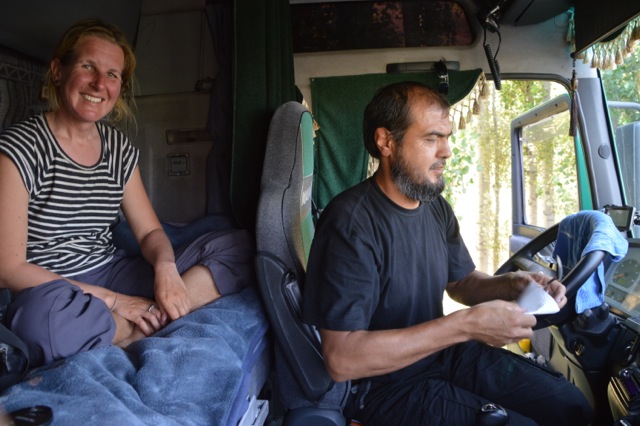
In the luxurious comfort of Mohamed’s cabin.
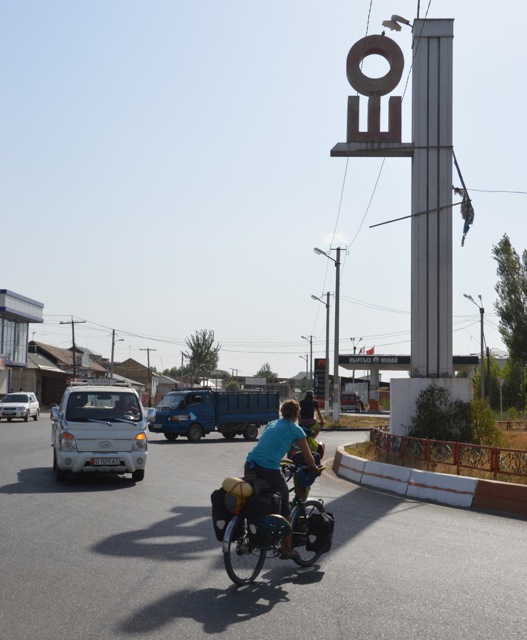
Cycling into Osh – yes Jude is swerving to avoid being hit by a car despite having right of way..

Relaxing in the local park.

Osh bazaar where you can buy anything from a shipping container.

Relaxing with other travellers at our favourite outdoor restaurant.
After the soulless mega-cities of China, Osh was a breath of fresh air. Old buildings stand side by side with Soviet era greyness, people swim in the river that runs through the centre of town, couples walk in the shade of tree filled parks and children play on the footpaths. The bazaar is made from shipping containers and it’s bustling with people buying and selling everything from spices to t-shirts with the Kyrgyzstan flag, the most delicious pecans in the world to the handmade felt hats that the local men wear. Men and women sit on day beds in outdoor restaurants drinking cold beers while shashliks are being barbequed over coals nearby. Women sit on the side of the road with big kegs of iced tea, kvass or kefir, and locals stand around drinking it to provide relief from the heat of the day. Mashutkas (the local minibuses) are the only things that seems to be in a hurry here and the pervasive feeling is one of relaxed calm. We spent our days chatting with other travellers in the rose lined garden of the TES guesthouse, wandering the bazaar, swimming in the river, and drinking cold beers and eating shashliks at our favourite restaurant in the local park. As the song goes ‘Summertime and the living is easy’.
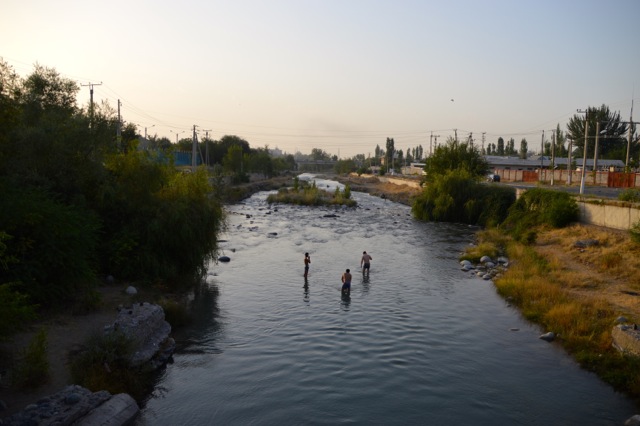
Locals swim in the river.

So do we.

Camping at the TES guesthouse.

Neil checking that the bikes are secure on the roof.

Views from the road to Bishkek.
While in Osh we made a plan for our remaining three weeks in Kyrgyzstan. Visas needed to be applied for in Bishkek and as most of the ones for Central Asia are date specific we needed to map out the next few months too. It was decided that we would catch a shared minivan to Bishkek to get all of the admin stuff sorted and then we could skip over to Karakol, a town on Lake Ysyk-Kol, and from there we would cycle back to Osh and then on to Tajikistan to cycle the Pamir Highway. The following morning we squeezed into the minivan with four others and a baby, our luggage piled in the back and our bikes strapped to the roof. Bishkek was a whole days drive away and from the backseat we would learn that the drivers here are crazier than the ones in China. For 12 hours we sweated in the back, our legs aching from not moving, wishing we were cycling through the stunning countryside that we were passing by at breakneck speed. But we made it and that night we pitched our tents in the backyard of Nomad’s Home guesthouse, the place we would call home for the next five days.
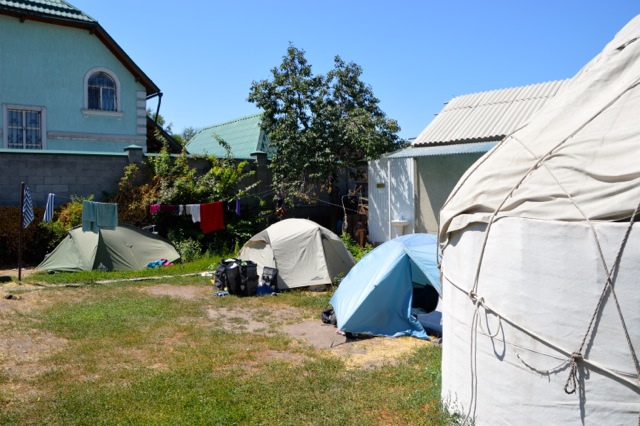
Camping at Nomad’s Home.

Jude celebrates COFFEE!!

Excited by the care package send by Heidi – dried food for the Pamirs, chocolate and more!!

Rest day coffee break.
Bishkek is a fun, vibrant city that we cruised about exploring on our bikes. Grey soviet buildings are hidden by the myriad of parks that dominate the city. The errands we had to perform found us cycling through all parts of town, bouncing our bikes along the back streets in desperate need of repair, the houses reminding us of the older suburbs in Melbourne. After spending the last 11 months in Asia it was nice to again somewhat blend in with the locals, as the population of Kyrgyzstan cities are as culturally diverse as those of home. Being Eid al-Fitr embassy opening times were changed and luckily we still managed to procure our Tajikistan visa. To enter the Pamir Highway requires a different permit (a GBAO) which normally corresponds with your visa dates. Unfortunately the embassy was only issuing one week long GBAO permits at this time (later that week it was only 5 days or not at all). The route we want to cycle will take us at least three to four weeks so we have employed an agency to help us procure a longer permit – we will only find out the length in 10 days time. Besides running errands and catching up on all the little things (like this blog) we have spent a good amount of time just relaxing and hanging out with other travellers. It really feels like a home away from home, another reason Kyrgyzstan continues to be paradise.

Street art.

Cheeky beers at Steinbrau.

Chilling out with other travellers.

Mika cuts the locks off – best haircut ever (Thanks Mika!).
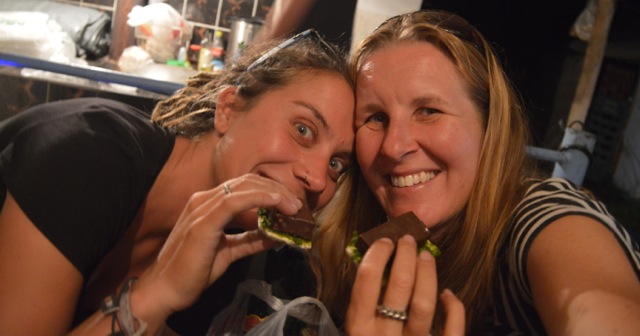
Tasty homemade treats.
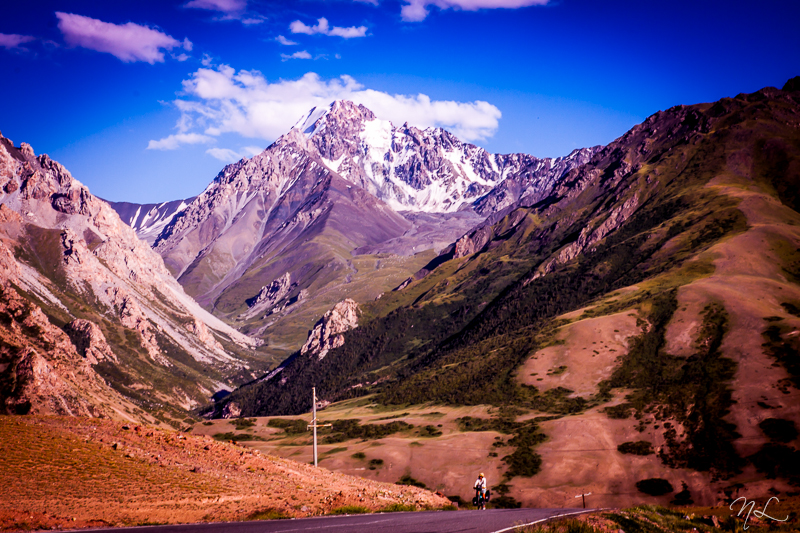
More cycling in paradise to come (yes that’s Jude!). Photo from Neil @ H2Htrip.com
 foonsonbikes